Research Article | | Peer-Reviewed

Utilization of Agricultural Waste Ashes from Cassava and Potato as Eco-Friendly Cement Substitutes in Concrete Mixtures

Received: 20 April 2026     Accepted: 13 July 2026     Published: 22 August 2026
Views:       Downloads:
Abstract

This study evaluates Cassava Peel Ash (CPA) and Potato Peel Ash (PPA) as eco-friendly supplementary cementitious materials (SCMs) in concrete. CPA was produced via controlled calcination at 246°C for 180 minutes, and PPA at 450°C for 275 minutes. Chemical analysis confirmed the presence of reactive oxides (SiO2, K2O, CaO), though predominantly crystalline silica due to relatively low calcination temperatures limits full pozzolanic reactivity. Granite aggregate met standard requirements for specific gravity (2.44), Aggregate Impact Value (24.41%), and Aggregate Crushing Value (8.54%). Sand exhibited excessive water absorption (12.83%) and silt content (4%), requiring corrective measures. XRD analysis confirmed dominant crystalline phases—notably quartz—in both ashes, with CPA showing greater pozzolanic promise due to lower graphite content. Slump tests showed that 5% combined CPPA replacement improved workability; higher dosages reduced slump significantly. At 28 days, 5% CPPA achieved 78.4% of control mix compressive strength, satisfying ASTM C618 thresholds. Strength declined at 10% (68%) and fell below structural limits at 15% and 20% replacement levels. Economic analysis showed CPA (₦1,500/kg) is costlier than PPA (₦800/kg), suggesting PPA as the more economical option for non-structural applications. Taguchi optimization identified an optimal mix of 92.5% cement, 12.5% CPA, and 12.5% PPA. These findings support limited use of agro-waste ashes as cement substitutes, particularly at 5% replacement, to promote sustainable and cost-effective construction.

Published in American Journal of Civil Engineering (Volume 14, Issue 4)
DOI 10.11648/j.ajce.20261404.17
Page(s) 294-303
Creative Commons

This is an Open Access article, distributed under the terms of the Creative Commons Attribution 4.0 International License (http://creativecommons.org/licenses/by/4.0/), which permits unrestricted use, distribution and reproduction in any medium or format, provided the original work is properly cited.

Copyright

Copyright © The Author(s), 2026. Published by Science Publishing Group

Keywords

Cassava Peel Ash (CPA), Potato Peel Ash (PPA), Supplementary Cementitious Materials, Concrete, Pozzolanic Reactivity, Sustainable Construction, ASTM C618, Compressive Strength

1. Introduction
Building materials account for 40–60% of total construction cost, and the rising price of conventional materials such as cement and aggregates has intensified the search for sustainable alternatives . In parallel, rapid population growth and urbanization in developing nations generate enormous volumes of agricultural and domestic waste, presenting both a waste management challenge and an opportunity for resource recovery. Reusing agricultural by-products in construction promotes savings, conserves natural resources, and contributes to a sustainable built environment.
Concrete is the dominant construction material globally, comprising cement, aggregates, and water . Modifying its constituent properties through the use of admixtures has long been an established practice to enhance strength, workability, and durability while potentially reducing material costs. Admixtures, as defined by BS 8500-1:2002 and BS-EN 934-2:2001, are materials added before or during mixing to modify performance characteristics. Agricultural waste ashes—derived from rice husk, corncob, periwinkle shell, and cassava and potato peels—have attracted growing interest as supplementary cementitious materials (SCMs) owing to their pozzolanic properties .
Cassava (Manihot esculenta) is a major commercial crop in Nigeria and across tropical regions. Its processing generates cassava peel as a by-product, constituting 20–35% of the tuber weight. Estimates suggest approximately 6.8 million tonnes of cassava peel are generated annually in Nigeria alone, with this figure projected to rise significantly . Similarly, potato peel is an underutilized by-product with documented potential as a construction material admixture. Indiscriminate disposal of these peels creates environmental hazards; investigating their ash forms as cement substitutes offers a practical and eco-friendly solution.
Previous studies have demonstrated the viability of agro-waste ashes as partial cement replacements found that Cassava Peel Ash Blended Cement (CPABC) showed satisfactory setting time and soundness at 3% replacement. reported improved California Bearing Ratio (CBR) values in soil stabilized with potato peel ash at 20% addition. confirmed enhanced compressive strength and workability using rice husk, sugarcane straw, and groundnut husk ashes. The geotechnical properties of lateritic soil stabilized with sugarcane straw ash was reported to improve in selected engineering properties of the stabilized soil investigated the modelling of concrete containing partial replacement of cement with aluminium waste and sawdust ash, demonstrating the potential of waste-derived materials in concrete production and property prediction. This study builds on these findings by evaluating the combined use of CPA and PPA as admixtures in concrete, assessing mechanical performance, material characterization, workability, economic viability, and statistical optimization.
The specific objectives are to: (i) characterize the physical and chemical properties of CPA and PPA; (ii) evaluate the workability and compressive strength of concrete incorporating CPPA at 0–20% replacement; (iii) determine the optimal CPPA blend using the Taguchi Design of Experiments method; and (iv) conduct an economic analysis comparing CPA and PPA against conventional cement.
2. Materials and Methodology
2.1. Materials
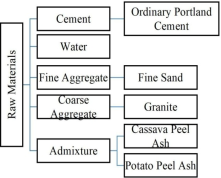
Ordinary Portland Cement (OPC) conforming to BS EN 196-5:1996 was used as the binding material. River sand sourced from a Lagos river served as fine aggregate, while crushed granite from the Lagos–Ibadan quarry was used as coarse aggregate. Cassava and potato peels were washed, air-dried, then oven-dried at 105°C before controlled calcination in a muffle furnace. The resulting ashes were sieved through a 600μm sieve; particles passing the sieve were retained for the study. Potable pipe-borne water free from contaminants was used for mixing and curing.
Figure 1. Mater ials Used in this research.
2.2. Physical Properties Testing
Physical tests on aggregates and ashes were conducted in accordance with standard procedures. Moisture content and bulk density were assessed per , respectively. Water absorption and specific gravity of fine and coarse aggregates were determined per . Sieve analysis of fine aggregate followed BS 812-103:1985, using nested sieves ranging from 4.75 mm to 0.075 mm (pan). From sieve analysis results, the Coefficient of Uniformity (Cu = D60/D10) and Coefficient of Curvature (Cc = D302/ (D60 × D10)) were computed to assess gradation quality. For coarse aggregate, the Aggregate Impact Value (AIV) and Aggregate Crushing Value (ACV) were measured per BS 812.
2.3. Chemical Characterization (XRF and XRD)
X-ray Fluorescence (XRF) analysis was used to determine the oxide composition of the ashes. Ash samples were pressed into pellets and analyzed using an energy-dispersive or wavelength-dispersive XRF spectrometer, producing quantitative oxide percentages (SiO2, Al2O3, Fe2O3, CaO, MgO, K2O, Na2O). Results were compared against ASTM C618 requirements for pozzolanic materials (SiO2 + Al2O3 + Fe2O3 ≥ 70%; LOI ≤ 6%).
X-ray Diffraction (XRD) analysis was performed using a diffractometer with Cu-Kα radiation (λ = 1.5406 Å), scanning from 5° to 70° 2θ at a step size of 0.02° and scan rate of 2° per minute. Diffractograms were interpreted for crystalline phase identification; crystallite size was estimated using the Scherrer equation based on Full Width at Half Maximum (FWHM) values.
2.4. Mix Design and Specimen Preparation
Concrete mixes were prepared using a water-to-cement ratio of 0.50 and a mix proportion of 1:1.5:3 (cement:sand:granite). Combined cassava and potato peel ash (CPPA) replaced cement by weight at 0%, 5%, 10%, 15%, and 20%. A total of 60 concrete cubes (150 × 150 × 150 mm) were cast and cured in water for 7, 14, 21, and 28 days in accordance with BS 1881. A mix ratio optimization was additionally conducted using the Taguchi Design of Experiments (DOE) method in Minitab, considering three factors (cement, CPA, PPA) at five levels each (0%, 5%, 10%, 15%, 20%).
2.5. Workability and Compressive Strength Tests
Slump tests were performed per BS EN 12350-2:2019 using a standard slump cone (height 300 mm; base diameter 200 mm; top diameter 100 mm). Each layer was rodded 25 times. The concrete was compacted in three layers before the cone was lifted and the slump measured. Compressive strength was determined per BS 1881: Part 116:1983 using a compression testing machine. Cubes were surface-dried before testing and loaded continuously to failure. Compressive strength (N/mm2) was computed as: σc = P / A, where P is the maximum load and A = 10,000 mm2. Water absorption capacity was determined as:
Absorption (%) = [(W2− W₁) / W₁]× 100.
2.6. Statistical and Economic Analysis
Regression analysis was performed in Minitab to assess the influence of CPA and PPA replacement levels on concrete performance, using Signal-to-Noise (S/N) ratios from the Taguchi DOE. Cost analysis followed the quantity-rate method, comparing material costs of cement-only mixes against CPPA-blended mixes, expressed in Nigerian Naira (₦).
3. Results and Discussion
3.1. Temperature–Time Curves of CPA and PPA
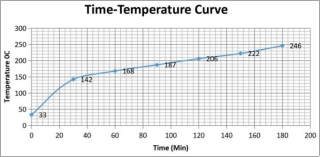
The calcination of cassava peel proceeded over 180 minutes, with temperature rising from 33°C to 246°C. Between 0–60 minutes (up to 168°C), the peel underwent moisture loss and early thermal decomposition. At 90 minutes (187°C), partial combustion of cellulose, hemicellulose, and lignin intensified with visible charring. Full burnout of organic matter was achieved at 246°C after 180 minutes, yielding a grayish-white ash composed predominantly of SiO2, K2O, and CaO. However, 246°C is substantially below the 500–700°C range recommended in the literature for producing amorphous—and thus highly reactive—pozzolanic silica. Crystalline silica formed at lower temperatures is less reactive and may only meet standards for low-strength or non-structural applications.
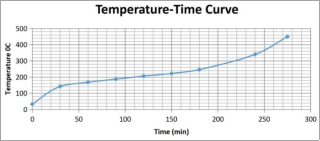
Potato peel calcination extended to 275 minutes, reaching 450°C. Drying and dehydration occurred in the first 60 minutes (up to 168°C). Partial combustion began around 90 minutes (187°C) and continued through 240 minutes (340°C). Full combustion was achieved at 450°C at the 275-minute mark, producing a light gray, mineral-rich ash. Although more complete than CPA calcination in terms of temperature, 450°C still falls short of the optimal 600–700°C range identified in studies by and Both ashes, therefore, carry the limitation of increased crystalline silica content relative to amorphous silica. Future studies should explore calcination at 600°C or higher to enhance pozzolanic reactivity and compliance with .
Figure 2. Graph of (Cassava Peel Ash).
Figure 3. Graph of (Potato Peel Ash).
3.2. Physical Properties of Aggregates
The water absorption of sand was 12.83%, far exceeding the BS EN 12620:2013 recommended maximum of 3% for fine aggregates. This high absorption, indicative of significant porosity or clay/silt contamination, can reduce effective water available for cement hydration, compromise workability, and cause shrinkage-related cracking. By contrast, granite recorded 2.5% water absorption, within the acceptable 2–3% range per ASTM C127. Corrective measures—including washing, blending, or substitution—are strongly recommended for the sand before use in structural concrete.
Both sand and granite exhibited a specific gravity of 2.44, which is within the standard range of 2.4–2.9 (ASTM C127; BS EN 1097-6), though slightly below the ideal 2.6–2.8 for dense concrete. The sand’s silt content of 4% exceeds the BS 882:1992 limit of 3%, posing risks to bond strength and concrete durability. The granite aggregate recorded an AIV of 24.41% (acceptable; limit: < 30%) and an ACV of 8.54% (well within the < 30% limit per BS 812 Part 112), confirming good toughness and suitability for structural concrete.
Sieve analysis placed the sand within BS 882 Zone 2/3, with a Fineness Modulus estimated between 2.2 and 2.6—generally acceptable. However, the Coefficient of Uniformity (Cu = 2.42) indicates poor grading by USCS standards (well-graded sand requires Cu ≥ 6), implying a narrow particle size range that increases void ratio and paste demand. The Coefficient of Curvature (Cc = 1.45) falls within the acceptable 1–3 range, mitigating some adverse effects of poor uniformity. Blending with coarser or finer material is recommended to meet BS 882 zone requirements more fully.
3.3. Chemical Characterization
3.3.1. XRF Results
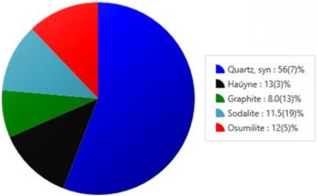
Figure 4. Oxide Composition of Cassava Ash.
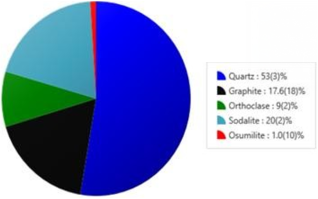
CPA exhibited a mineral composition dominated by quartz (56%), with appreciable quantities of aluminosilicates including hauyne, sodalite, and osumilite. Graphite content was approximately 8%, which is within tolerable limits. The high quartz content, while primarily crystalline, offers moderate filler and secondary pozzolanic potential when ground finely. PPA showed a similar quartz dominance but a notably higher graphite content (17.6%), which is known to interfere with cement hydration and reduce the effectiveness of air-entraining admixtures . PPA also exhibited 20% sodalite content, a source of reactive aluminosilicates that could support medium-term pozzolanic activity. Overall, CPA is more favorable in raw form due to its lower carbon content and more balanced oxide distribution, while PPA requires calcination refinement before use in structural applications.
Figure 5. Oxide composition of Potato Ash.
3.3.2. XRD Results
XRD analysis of CPA revealed dominant crystalline peaks consistent with quartz (SiO2). The most intense peak occurred at 36.52° 2θ (relative intensity: 100%), with a secondary prominent peak at 26.77° (relative intensity: 99.26%). Additional peaks at 20.99°, 23.96°, 29.49°, and 50.24° confirmed the presence of silica-based and potassium-bearing crystalline phases. FWHM values of 0.118–0.236 correspond to crystallite sizes of approximately 30–70 nm (Scherrer equation), consistent with nano-crystalline material suitable for cementitious applications.
Table 1. XRD Results for Cassava Peel Ash.

Pos. [°2Th.]

Height [cts]

FWHM [°2Th.]

d-spacing [Å]

Rel. Int. [%]

20.99

57.20

0.1574

4.2328

63.13

23.96

31.98

0.2362

3.7146

35.29

26.51

85.28

0.1378

3.3625

94.13

26.77

89.92

0.1181

3.3298

99.26

29.49

34.43

0.2362

3.0289

38.00

36.52

90.60

0.1181

2.4603

100.00

50.24

23.35

0.2362

1.8162

25.77

XRD analysis of PPA showed a dominant peak at 26.73° 2θ (relative intensity: 100%; FWHM: 0.1574), corresponding to the (101) plane of crystalline quartz (SiO2). A secondary, broader peak at 29.99° (relative intensity: 22.92%; FWHM: 0.9446) suggested the presence of minor silicate or calcium/potassium oxide phases with smaller crystallite sizes or partial amorphous character. The combination of sharp and broad peaks confirms a mixed crystalline–amorphous character typical of biomass ashes, consistent with findings from and .
Table 2. XRD Results for Potato Peel Ash.

Pos. [°2Th.]

Height [cts]

FWHM [°2Th.]

d-spacing [Å]

Rel. Int. [%]

26.73

64.29

0.1574

3.3357

100.00

29.99

14.73

0.9446

2.9796

22.92

3.4. Taguchi Optimization of Mix Proportions
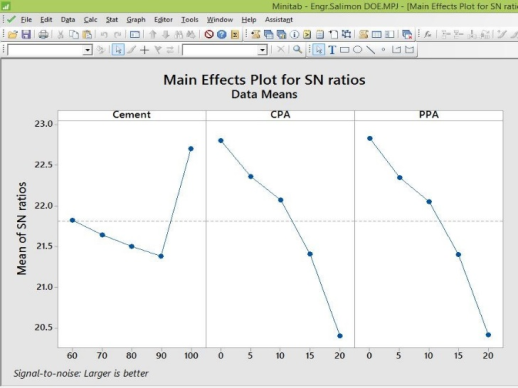
The Taguchi Design of Experiments (DOE) was applied in Minitab to optimize the combination of cement, CPA, and PPA in concrete, with each factor tested at five levels (0%, 5%, 10%, 15%, 20%). The method efficiently identifies optimal factor combinations while minimizing the number of required experiments, using Signal-to-Noise (S/N) ratios to assess robustness across variable conditions.
Figure 6. Particle Size Distribution.
The Taguchi analysis identified an optimal mix of Cement: 92.5%, CPA: 12.5%, PPA: 12.5%, representing a 25% total SCM replacement. This combination, where CPA and PPA each contributed equally, demonstrated the best balance of compressive strength, workability, and durability across curing conditions. The S/N ratios for this mix were consistently superior, indicating high stability and performance. The synergistic effect of both ashes—CPA contributing reactive quartz and aluminosilicates, and PPA providing sodalite and secondary silicate phases—appears to enhance micro-filling and pozzolanic interactions within the concrete matrix. This result reinforces the value of multi-component ash blending as a strategy for sustainable cement replacement.
3.5. Workability (Slump Test)
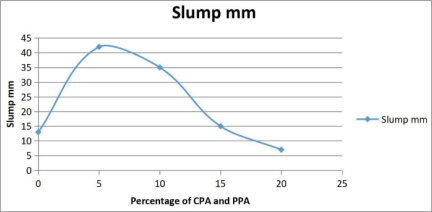
Slump results for concrete mixes at varying CPPA replacement levels are summarized in Table 3. The control mix (0% ash) recorded a very low slump of 13 mm, classifiable as stiff/dry and suitable only for vibration-compacted applications such as precast concrete (ASTM C143: 10–40 mm = low workability). Addition of 5% CPPA increased slump to 42 mm, indicating that at low dosages, the ashes act as micro-fillers, improving particle packing and providing mild plasticizing effects. This aligns with observations by and .
Figure 7. Slump Test Result.
Beyond 5%, slump decreased progressively: 35 mm at 10% (still moderate), 15 mm at 15% (low workability, requiring mechanical vibration), and only 7 mm at 20% (very dry; effectively zero slump). These reductions reflect increased water demand from the finer, more absorptive ash particles. notes that elevated fine content—especially with high absorptive capacity—drastically reduces slump unless offset by admixtures or increased water similarly reported significant workability loss beyond 10–15% agro-waste ash content.
Table 3. Slump Test Results at Various CPPA Replacement Levels.

Replacement Level (%)

Slump Value (mm)

Workability Class

0 (Control)

13

Low (Stiff)

5

42

Moderate

10

35

Moderate

15

15

Low

20

7

Very Low (Dry)

3.6. Compressive Strength
Figure 8. Compressive Strength of Concrete for 7, 14 and 28 Days.
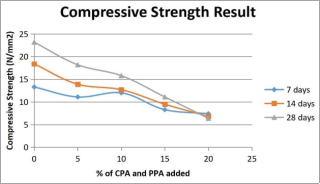
Table 4 summarizes the average compressive strength of concrete cubes at 7, 14, and 28 days for each replacement level. At 7 days, the control mix recorded the highest strength (13.3 N/mm2). Mixes with 5% and 10% CPPA showed modest early strength of 11.1 and 12.0 N/mm2 respectively, while 15% and 20% mixes dropped substantially to 8.3 and 7.4 N/mm2—consistent with dilution of cement content and delayed pozzolanic activity. At 14 days, the control rose to 18.4 N/mm2; the 5% and 10% mixes recorded 13.9 and 12.7 N/mm2 respectively, while 15% and 20% mixes deteriorated further (9.5 and 6.8 N/mm2).
The critical 28-day results (the standard evaluation age) reveal that the control achieved 23.2 N/mm2. The 5% CPPA mix yielded 18.2 N/mm2 (78.4% of control), satisfying the minimum threshold of 75%. The 10% mix attained 15.8 N/mm2 (68%), marginally below the standard. The 15% and 20% mixes recorded 11.1 N/mm2 (47.8%) and 6.4 N/mm2 (27.6%) respectively—far below acceptable structural limits. These trends are consistent with who found 5% CPA to offer the best balance of strength and sustainability, and who reported substantial strength reduction beyond 10% PPA replacement. The slow pozzolanic kinetics of low-calcination ashes, as noted by and further explain the delayed and limited strength development observed.
Table 4. Compressive Strength Results (✓ meets ASTM C618; ~ marginal; ✗ fails).

Replacement (%)

7-Day (N/mm2)

14-Day (N/mm2)

28-Day (N/mm2)

% of Control (28d)

0 (Control)

13.3

18.4

23.2

100%

5

11.1

13.9

18.2

78.4% ✓

10

12.0

12.7

15.8

68.1% ~

15

8.3

9.5

11.1

47.8% ✗

20

7.4

6.8

6.4

27.6% ✗

3.7. Economic Analysis
A cost analysis was conducted for a baseline mix using 60 kg of cement (unit price: ₦220/kg; total: ₦13,200). When 10% of cement (6 kg) is replaced, reduced cement cost is ₦11,880 (54 kg × ₦220). Using CPA at ₦1,500/kg for 5.6 kg of ash yields an ash cost of ₦8,400, bringing the total blended cost to ₦20,280—an increase of ₦7,080 over the pure cement mix. Using PPA at ₦800/kg for 5.6 kg yields ₦4,480 in ash cost, resulting in a total of ₦16,360—an increase of ₦3,160 over the control.
Table 5. Cost Analysis of Cement, CPA, and PPA per Mix.

Material

Weight (kg)

Unit Rate (₦/kg)

Total Cost (₦)

Cement (100% control)

60

220

13,200

Cement (90%, blended)

54

220

11,880

Cassava Peel Ash (CPA)

5.6

1,500

8,400

Potato Peel Ash (PPA)

5.6

800

4,480

Total (cement + CPA)

20,280

Total (cement + PPA)

16,360

Despite offering superior strength and lower graphite content, CPA is economically disadvantaged at its current market price of ₦1,500/kg compared to cement (₦220/kg). Its use is only justifiable in sustainability-critical or performance-prioritized projects. PPA, at ₦800/kg, provides a more cost-accessible alternative and is better suited for non-structural or budget-sensitive applications. To maximize the economic case for both ashes, investment in localized, optimized calcination and supply chain infrastructure is recommended to reduce unit production costs.
3.8. Statistical (Regression) Analysis
Regression analysis conducted in Minitab yielded a model with a coefficient of determination R2 = 99.22%, confirming that over 99% of the variability in concrete performance is explained by cement, CPA, and PPA content. The adjusted R2 was 98.44% and the predicted R2 was 96.61%, indicating strong predictive power and model generalizability. The model residual standard deviation was S = 0.1937.
Analysis of Variance (ANOVA) results showed statistically significant effects for all three factors (p = 0.000 for cement, CPA, and PPA), confirming their meaningful individual contributions to concrete performance. However, at the 10% replacement level, neither CPA nor PPA individually achieved statistical significance (p-values: CPA2 = 0.697; PPA2 = 0.41), suggesting that this specific dosage does not produce a reliably distinguishable effect. Positive regression coefficients at 15% and 20% replacement for both ashes hint at a threshold behavior where meaningful pozzolanic or filler contributions only emerge at higher dosages—a pattern consistent with the behavior of low-reactivity, unprocessed agricultural pozzolans.
The high overall R2 validates the experimental design and confirms that the chosen variables are the primary drivers of concrete performance variation in this study. These findings recommend further investigation into chemical activation or elevated calcination to unlock the reactivity potential of CPA and PPA, particularly at intermediate replacement levels.
4. Conclusions
This study investigated cassava peel ash (CPA) and potato peel ash (PPA) as eco-friendly supplementary cementitious materials in concrete. The following key conclusions are drawn:
CPA calcined at 246°C and PPA at 450°C achieved full combustion but produced predominantly crystalline silica. Calcination temperatures of 600–700°C are recommended to enhance amorphous silica content and pozzolanic reactivity.
Granite aggregate met all standard requirements for concrete (water absorption 2.5%; AIV 24.41%; ACV 8.54%; specific gravity 2.44). Sand exceeded recommended limits for water absorption (12.83%) and silt content (4%), necessitating treatment or substitution for structural applications.
Sand grading falls within BS 882 Zone 2/3, but the Coefficient of Uniformity (Cu = 2.42) indicates poor grading. Blending with better-graded material is recommended to reduce paste demand and enhance concrete performance.
CPA exhibits higher quartz content and lower graphite levels than PPA, making it more suitable for direct pozzolanic use. XRD confirmed dominant crystalline phases in both ashes. PPA’s higher graphite content (17.6%) requires pre-treatment (calcination or blending) before structural application.
Workability was optimized at 5% CPPA replacement (slump: 42 mm). Workability declined sharply beyond 10% due to increased water demand. Super-plasticizers or additional water correction are necessary at higher replacement levels.
At 28 days, 5% CPPA achieved 78.4% of control compressive strength, satisfying ASTM C618. The 10% mix achieved 68% (marginally below threshold). Replacement levels of 15% and 20% yielded unacceptable strength values (47.8% and 27.6% respectively) and are unsuitable for structural concrete.
CPA is cost-ineffective at ₦1,500/kg relative to cement (₦220/kg). PPA at ₦800/kg offers a more economical option for non-structural applications. For structural use, CPA is preferred on a performance basis, while PPA is preferred on cost grounds.
Taguchi optimization identified an optimal mix of 92.5% cement + 12.5% CPA + 12.5% PPA, representing a 25% total SCM replacement with synergistic pozzolanic effects.
5. Recommendations
Based on the findings of this study, the following recommendations are made:
Sand should be washed to remove silt and clay, or blended with better-graded fine aggregate to comply with BS 882 requirements and improve concrete performance.
CPA and PPA should be calcined at 600–750°C to increase amorphous silica content, reduce unburnt carbon (especially in PPA), and meet ASTM C618 chemical criteria (SiO2 + Al2O3 + Fe2O3 ≥ 70%). Fine grinding of ash particles should also be explored to increase specific surface area and reactivity.
CPA replacement should be limited to 5% for structural concrete applications to ensure adequate strength and workability without supplementary measures. 10% replacement may be considered only for non-structural or extended-curing applications.
Economic production of both ashes at scale should be pursued through optimized local sourcing and processing infrastructure to reduce unit costs and improve the cost-benefit ratio of CPA blended concrete.
Future studies should investigate the long-term durability of CPA concrete under aggressive environmental conditions (sulfate attack, chloride penetration, freeze-thaw), and explore chemical activation techniques (e.g., NaOH blending) to enhance pozzolanic activity at intermediate replacement levels.
Abbreviations

CPA

Cassava Peel Ash

PPA

Potato Peel Ash

Acknowledgments
The authors would like to thank the Department of Civil Engineering, Edo State University, Iyamho, Nigeria, for providing the facilities used in conducting this research. Appreciation is also extended to the laboratory staff for their technical support.
Author Contributions
Ibrahim Abdulrazaq Olayinka: Supervision
Salimon Idris Akinrole: Data curation, Methodology
John Wasiu: Validation
Conflicts of Interest
The authors declare no conflict of interest.
References
[1] Abdalla, T. A., Koteng, D. O., Shitote, S. M., and Matallah, M. (2022). Mechanical and durability properties of concrete incorporating silica fume and a high volume of sugarcane bagasse ash. Results in Engineering.
[2] Adeleke, B. K., Garba, M., Alfa, N. M., & Dahiru, D. D. (2020). Effect of Sorghum Flour on the Properties of Concrete. Journal of Environmental Technology, 2(1), 125–129.
[3] Adesina, A. & Olubajo, O. O. (2020). Characterisation of agricultural ashes and their use as supplementary cementitious materials. Construction and Building Materials.
[4] Adewumi, J. B. & Akinwumi, I. I. (2017). Effects of cassava peel ash on properties of concrete. Construction and Building Materials, 142, 612–620.
[5] Agbi, G. G. & Uguru, H. (2021). Assessing the impact of cassava starch on the structural properties of sandcrete blocks produced from recycled paper. Saudi Journal of Engineering Technology, 6(5), 99–103.
[6] Ahmed, A. (2019). Chemical Reactions in Pozzolanic Concrete. Modern Approaches on Material Science, 1(4), 128–133.
[7] Ajamu, S. O., Fajobi, M. A., & Oke, B. O. (2012). Effect of Cassava Peel Ash as a Partial Replacement for Cement in Concrete. International Journal of Engineering and Technology, 2(8), 1313–1320.
[8] Akindahunsi, A. A. (2019). Investigation into the use of extracted starch from cassava and maize as admixture on the creep of concrete. Construction and Building Materials, 214, 659–667.
[9] Akpokodje, O. I., Agbi, G. G., & Uguru, H. (2020). Evaluation of Cassava Effluent as Organic Admixture in Concrete Production for Farm Structures. Turkish Journal of Agricultural Engineering Research, 271–282.
[10] Alaneme, G. U. & Mbadike, E. M. (2019). Modelling of the mechanical properties of concrete with cement ratio partially replaced by aluminium waste and sawdust ash using artificial neural network. SN Applied Sciences, 1(1), 5–14.
[11] Amu, O. O., Ogunniyi, S. A., & Oladeji, O. O. (2011). Geotechnical properties of lateritic soil stabilized with sugarcane straw ash. American Journal of Scientific and Industrial Research, 2(2), 323–331.
[12] ASTM C143/C143M-15a (2015). Standard Test Method for Slump of Hydraulic-Cement Concrete. ASTM International.
[13] ASTM C618-19 (2019). Standard Specification for Coal Fly Ash and Raw or Calcined Natural Pozzolan for Use in Concrete. ASTM International.
[14] Chu, S. H. (2019). Effect of paste volume on fresh and hardened properties of concrete. Construction and Building Materials, 218, 284–294.
[15] Daramola, M. O., Adewuyi, A. P., & Adebayo, G. B. (2018). Characterization of Cassava Peel Ash as a Supplementary Cementitious Material. Silicon, 10, 2547–2553.
[16] Ettu, L. O., Njoku, F. O., & Opara, H. N. (2013). Strength of ternary blended cement concrete containing fly ash and groundnut shell ash. International Journal of Engineering Science Invention, 2(10), 38–42.
[17] Faqe, H., Dabaghh, H., & Mohammed, A. (2020). Natural Admixture as an Alternative for Chemical Admixture in Concrete Technology: A Review. Journal of the University of Duhok, 32(2), 301–308.
[18] Fidel, H. C., Choquechambi, Y. O., Rina, L., & Yampara, T. (2023). Effect of Added Potato Peel Ash on Clay Soils. Research Square Platform LLC.
[19] Grace, M. A., Mansur, P., & Mustapha, B. J. (2021). Effect of Cassava Peel Ash Blended Cement on Setting Time and Density of Concrete. International Journal of Advances in Engineering and Management, 3(10), 224–227.
[20] Gupta, C. K., Sachan, A. K., & Kumar, R. (2022). Utilization of sugarcane bagasse ash in mortar and concrete: A review. Materials Today: Proceedings, 65, 798–807.
[21] Ibiyeye, A. (2018). Effects and suitability of Cassava starch as an admixture in cement paste and concrete. Undergraduate Dissertation.
[22] Iqbal, M., et al. (2019). XRD characterisation of agro-waste ashes for construction material applications.
[23] Kannur, P. P. & Chore, H. S. (2021). Cassava peel as a building material admixture. Construction Materials Journal.
[24] Lazorenko, G., et al. (2022). Advances in admixture application for concrete: A review. Construction and Building Materials.
[25] Mehta, P. K. & Monteiro, P. J. M. (2014). Concrete: Microstructure, Properties and Materials (4th ed.). McGraw-Hill Education.
[26] Mohammed, A., et al. (2022). Admixtures in concrete: Classification and performance. Engineering Reviews.
[27] Neville, A. M. (2011). Properties of Concrete (5th ed.). Pearson Education.
[28] Ogunbode, E. B., et al. (2017). Performance of potato peel ash in blended cement concrete. Construction and Building Materials.
[29] Okafor, F. O. (2004). Effects of aggregate grading on concrete quality. Nigerian Journal of Engineering.
[30] Oluwabusayo, T., et al. (2020). Cassava peel waste management and valorization for construction materials. Waste Management.
[31] Olutoge, F. A., et al. (2012). Cassava peel ash: Properties and use as pozzolan in concrete. Construction and Building Materials.
[32] Onyelowe, K. C., et al. (2020). Innovative use of agro-waste in concrete and soil stabilization applications. Geomechanics and Engineering.
[33] Onikeku, O., et al. (2019). Evaluation of characteristics of blended cassava peel ash concrete. AIMS Materials Science.
[34] Oyedepo, O. J., et al. (2014). XRD analysis of agricultural biomass ashes. Journal of Applied Sciences.
[35] Oyekan, G. L. & Kamiyo, O. M. (2011). Effects of granite aggregate on concrete strength. Journal of Civil Engineering and Construction Technology.
[36] Rukayat, A., et al. (2021). XRD characterization of sweet potato peel ash and application in concrete. Materials Science Forum.
[37] Schmidt, W., et al. (2019). Admixture performance in concrete: Standards and practice. Cement and Concrete Composites.
[38] Shetty, M. S. (2005). Concrete Technology: Theory and Practice. S. Chand & Company.
Cite This Article
  • APA Style

    Olayinka, I. A., Akinrole, S. I., Wasiu, J. (2026). Utilization of Agricultural Waste Ashes from Cassava and Potato as Eco-Friendly Cement Substitutes in Concrete Mixtures. American Journal of Civil Engineering, 14(4), 294-303. https://doi.org/10.11648/j.ajce.20261404.17

    Copy | Download

    ACS Style

    Olayinka, I. A.; Akinrole, S. I.; Wasiu, J. Utilization of Agricultural Waste Ashes from Cassava and Potato as Eco-Friendly Cement Substitutes in Concrete Mixtures. Am. J. Civ. Eng. 2026, 14(4), 294-303. doi: 10.11648/j.ajce.20261404.17

    Copy | Download

    AMA Style

    Olayinka IA, Akinrole SI, Wasiu J. Utilization of Agricultural Waste Ashes from Cassava and Potato as Eco-Friendly Cement Substitutes in Concrete Mixtures. Am J Civ Eng. 2026;14(4):294-303. doi: 10.11648/j.ajce.20261404.17

    Copy | Download

  • @article{10.11648/j.ajce.20261404.17,
      author = {Ibrahim Abdulrazaq Olayinka and Salimon Idris Akinrole and John Wasiu},
      title = {Utilization of Agricultural Waste Ashes from Cassava and Potato as Eco-Friendly Cement Substitutes in Concrete Mixtures},
      journal = {American Journal of Civil Engineering},
      volume = {14},
      number = {4},
      pages = {294-303},
      doi = {10.11648/j.ajce.20261404.17},
      url = {https://doi.org/10.11648/j.ajce.20261404.17},
      eprint = {https://article.sciencepublishinggroup.com/pdf/10.11648.j.ajce.20261404.17},
      abstract = {This study evaluates Cassava Peel Ash (CPA) and Potato Peel Ash (PPA) as eco-friendly supplementary cementitious materials (SCMs) in concrete. CPA was produced via controlled calcination at 246°C for 180 minutes, and PPA at 450°C for 275 minutes. Chemical analysis confirmed the presence of reactive oxides (SiO2, K2O, CaO), though predominantly crystalline silica due to relatively low calcination temperatures limits full pozzolanic reactivity. Granite aggregate met standard requirements for specific gravity (2.44), Aggregate Impact Value (24.41%), and Aggregate Crushing Value (8.54%). Sand exhibited excessive water absorption (12.83%) and silt content (4%), requiring corrective measures. XRD analysis confirmed dominant crystalline phases—notably quartz—in both ashes, with CPA showing greater pozzolanic promise due to lower graphite content. Slump tests showed that 5% combined CPPA replacement improved workability; higher dosages reduced slump significantly. At 28 days, 5% CPPA achieved 78.4% of control mix compressive strength, satisfying ASTM C618 thresholds. Strength declined at 10% (68%) and fell below structural limits at 15% and 20% replacement levels. Economic analysis showed CPA (₦1,500/kg) is costlier than PPA (₦800/kg), suggesting PPA as the more economical option for non-structural applications. Taguchi optimization identified an optimal mix of 92.5% cement, 12.5% CPA, and 12.5% PPA. These findings support limited use of agro-waste ashes as cement substitutes, particularly at 5% replacement, to promote sustainable and cost-effective construction.},
     year = {2026}
    }
    

    Copy | Download

  • TY  - JOUR
    T1  - Utilization of Agricultural Waste Ashes from Cassava and Potato as Eco-Friendly Cement Substitutes in Concrete Mixtures
    AU  - Ibrahim Abdulrazaq Olayinka
    AU  - Salimon Idris Akinrole
    AU  - John Wasiu
    Y1  - 2026/08/22
    PY  - 2026
    N1  - https://doi.org/10.11648/j.ajce.20261404.17
    DO  - 10.11648/j.ajce.20261404.17
    T2  - American Journal of Civil Engineering
    JF  - American Journal of Civil Engineering
    JO  - American Journal of Civil Engineering
    SP  - 294
    EP  - 303
    PB  - Science Publishing Group
    SN  - 2330-8737
    UR  - https://doi.org/10.11648/j.ajce.20261404.17
    AB  - This study evaluates Cassava Peel Ash (CPA) and Potato Peel Ash (PPA) as eco-friendly supplementary cementitious materials (SCMs) in concrete. CPA was produced via controlled calcination at 246°C for 180 minutes, and PPA at 450°C for 275 minutes. Chemical analysis confirmed the presence of reactive oxides (SiO2, K2O, CaO), though predominantly crystalline silica due to relatively low calcination temperatures limits full pozzolanic reactivity. Granite aggregate met standard requirements for specific gravity (2.44), Aggregate Impact Value (24.41%), and Aggregate Crushing Value (8.54%). Sand exhibited excessive water absorption (12.83%) and silt content (4%), requiring corrective measures. XRD analysis confirmed dominant crystalline phases—notably quartz—in both ashes, with CPA showing greater pozzolanic promise due to lower graphite content. Slump tests showed that 5% combined CPPA replacement improved workability; higher dosages reduced slump significantly. At 28 days, 5% CPPA achieved 78.4% of control mix compressive strength, satisfying ASTM C618 thresholds. Strength declined at 10% (68%) and fell below structural limits at 15% and 20% replacement levels. Economic analysis showed CPA (₦1,500/kg) is costlier than PPA (₦800/kg), suggesting PPA as the more economical option for non-structural applications. Taguchi optimization identified an optimal mix of 92.5% cement, 12.5% CPA, and 12.5% PPA. These findings support limited use of agro-waste ashes as cement substitutes, particularly at 5% replacement, to promote sustainable and cost-effective construction.
    VL  - 14
    IS  - 4
    ER  - 

    Copy | Download

Author Information
  • Department of Civil Engineering, Edo State University, Iyamho, Nigeria
  • Department of Civil Engineering, Edo State University, Iyamho, Nigeria

  • Department of Civil Engineering, Edo State University, Iyamho, Nigeria

  • Abstract
  • Keywords
  • Document Sections

    1. 1. Introduction
    2. 2. Materials and Methodology
    3. 3. Results and Discussion
    4. 4. Conclusions
    5. 5. Recommendations
    Show Full Outline
  • Abbreviations
  • Acknowledgments
  • Author Contributions
  • Conflicts of Interest
  • References
  • Cite This Article
  • Author Information