Abstract
The reliability and safety performance of steel beam girders are significantly influenced by the number of supports provided along their spans. This study presents a statistical analysis of the variation of reliability indices (β) of a steel beam girder subjected to bending, shear, and deflection limit states under different support conditions. Reliability indices were evaluated for girders having two, three, four, and five supports and compared with the target reliability index (βt = 4.0). The results show considerable variation in structural reliability with changes in support configuration. Shear reliability remained consistently high, ranging from 5.14 to 5.32, indicating adequate safety against shear failure. Bending reliability exhibited significant fluctuations, with indices ranging from 0.532 to 6.98, suggesting that support arrangement strongly affects bending performance. Deflection reliability increased progressively from 0.402 for two supports to 4.65 for five supports, indicating improved serviceability performance with increased support numbers. The study demonstrates that while increasing the number of supports generally enhances serviceability reliability, it does not necessarily guarantee improved bending reliability. Statistical evaluation revealed that girders with four supports achieved the most balanced performance, satisfying the target reliability requirement for all failure modes. The findings provide useful insights for the reliability-based design and optimization of steel girder support systems.
|
Published in
|
American Journal of Civil Engineering (Volume 14, Issue 5)
|
|
DOI
|
10.11648/j.ajce.20261405.11
|
|
Page(s)
|
304-311 |
|
Creative Commons
|

This is an Open Access article, distributed under the terms of the Creative Commons Attribution 4.0 International License (http://creativecommons.org/licenses/by/4.0/), which permits unrestricted use, distribution and reproduction in any medium or format, provided the original work is properly cited.
|
|
Copyright
|
Copyright © The Author(s), 2026. Published by Science Publishing Group
|
Keywords
Steel Girder, Reliability Index, Bending, Shear, Deflection, Support Conditions, Structural Safety, Statistical Analysis
1. Introduction
Steel beam girders constitute essential structural members in buildings, bridges, industrial facilities, and other engineering structures due to their high strength-to-weight ratio and ease of construction. Their structural performance is governed primarily by bending moment, shear force, and deflection criteria. Traditional deterministic design approaches employ safety factors to account for uncertainties in loads, material properties, and construction practices. However, reliability-based design provides a more rational assessment of structural safety by explicitly incorporating uncertainties into the design process. Structural reliability is generally defined as the probability that a structure will perform satisfactorily throughout its intended service life under prescribed conditions.
The reliability index (β) is widely used as a quantitative measure of structural safety. A higher reliability index corresponds to a lower probability of failure, while lower values indicate increased risk of structural inadequacy. In reliability-based structural design, target reliability indices are specified to ensure acceptable levels of safety and serviceability. The relationship between the reliability index and failure probability has been extensively employed in evaluating the performance of structural systems.
Support conditions play a critical role in determining the behavior of steel girders. Increasing the number of supports alters load distribution, internal force patterns, and deformation characteristics. While additional supports generally reduce bending moments and deflections, their influence on overall reliability may not always be straightforward due to changes in structural redundancy and load-sharing mechanisms. Previous studies have demonstrated that reliability indices vary significantly depending on the governing failure mode and structural configuration.
The present study investigates the variation of safety indices of a steel beam girder with different numbers of supports. The reliability performance in bending, shear, and deflection is statistically analyzed and compared with a target reliability index of 4.0. The objective is to identify the support configuration that provides the most satisfactory balance between ultimate and serviceability limit-state requirements. Steel beam girders are widely employed in bridges, industrial buildings, offshore structures, and transportation infrastructure because of their high strength-to-weight ratio, ease of fabrication, and excellent load-carrying capacity. The structural integrity of these members is governed primarily by their ability to resist bending moments, shear forces, and excessive deflections under service and ultimate loading conditions. Consequently, ensuring adequate safety and serviceability throughout the design life of steel girders remains a major concern in structural engineering
| [2] | Cheng, K., Zhang, Y., & Li, H. (2023). Influence of Load Partial Factors Adjustment on Reliability of Structural Members. Scientific Reports, 13, 34241. |
[2]
.
Conventional structural design approaches are based on deterministic safety factors that account for uncertainties in loading, material properties, dimensions, and construction quality. However, these methods do not explicitly quantify the probability of failure. Reliability-based design (RBD) has emerged as a more rational approach because it incorporates uncertainties directly into structural assessment and provides a quantitative measure of safety through reliability indices and failure probabilities
| [5] | Qin, X., Wang, J., Liu, Y., & Zhang, H. (2025). Time-Dependent Reliability Assessment of Structural Beams Considering Durability Effects. Engineering Structures, 327, 120203. |
| [6] | Kanno, Y. (2021). Distributionally Robust Reliability-Based Design Optimization under Uncertainty. Structural and Multidisciplinary Optimization, 64, 311–328. |
[5, 6]
.
The reliability index (β) is a widely accepted measure of structural safety and is defined as the shortest distance between the mean state of a system and the limit-state failure surface in the standardized normal space. Higher values of β indicate lower probabilities of failure and therefore greater structural reliability. According to the latest reliability background studies supporting the Eurocodes, target reliability indices between 3.8 and 4.7 are generally recommended for structural members depending on the consequence class and design life
| [4] | Joint Research Centre (JRC). (2024). Reliability Background of the Eurocodes. European Commission. |
[4]
.
Recent research has shown that reliability-based methods provide a more realistic evaluation of structural performance compared with conventional deterministic approaches.
| [2] | Cheng, K., Zhang, Y., & Li, H. (2023). Influence of Load Partial Factors Adjustment on Reliability of Structural Members. Scientific Reports, 13, 34241. |
[2]
demonstrated that reliability indices are highly sensitive to variations in load factors and resistance models. Similarly,
| [1] | Attarchian, N., Rahman, M., & Hassan, A. (2025). Reliability-Based Calibration of Strength Reduction Factors for Structural Members. Results in Engineering, 25, 104587. |
[1]
reported that reliability-based calibration procedures can significantly improve structural safety and economic efficiency in steel structures.
Support conditions constitute one of the most influential parameters affecting the behavior of beam girders. The number and arrangement of supports alter the distribution of internal forces, stiffness characteristics, and deformation patterns. Increasing the number of supports generally reduces span lengths and deflections but may also introduce complex moment redistribution effects that influence bending reliability. According to
| [3] | Fahmi, F. H., Mohammed, A. M., & Hassan, S. A. (2022). Strength and Deflection Reliability Estimation of Girder Structures Using FORM and Monte Carlo Simulation. Engineering, Technology & Applied Science Research, 12(5), 9221–9227. |
[3]
support configurations can significantly affect the reliability performance of girders, particularly under serviceability limit-state conditions.
The concept of structural redundancy associated with additional supports has also attracted considerable attention in recent years.
| [7] | Qin, X. (2025). Time-Dependent Reliability Assessment of Structural Beams. Engineering Structures, 327, 120203. |
[7]
observed that redundancy improves overall structural robustness and durability but does not necessarily guarantee increased reliability in every limit state. Similar findings were reported by
| [8] | Simwanda, L. (2023). Structural Reliability of Ultra-High Performance Fiber Reinforced Concrete Beams. Structural Concrete, 24(5), 6421–6438. |
[8]
who demonstrated that different failure modes may exhibit varying reliability responses under identical structural modifications. Despite the growing application of reliability-based design, limited studies have specifically investigated the variation of reliability indices for steel beam girders under different support configurations. Most existing studies focus on material uncertainties, loading effects, or code calibration rather than support optimization. Recent studies
| [9] | Cserpes, I., Makó, I., & Holczinger, T. (2024). Innovative design techniques for sinusoidal-web beams: A reliability-based optimisation approach. Buildings, 14(4), 1051. |
| [10] | Lavaei, M. H., Nguyen, H., & Sahoo, D. (2023). Reliability-based design optimisation of self-centring rocking steel frames with BRBs. Structures, 52, 240–256. |
| [11] | Radoń, U. (2025). The application of structural reliability and sensitivity analysis in everyday design practice. Applied Sciences, 15(1), 342. |
[9-11]
demonstrate the application of reliability-based optimization to achieve both safety and material economy.
| [12] | Ye, H., & Liu, Z. (2024). Fatigue and serviceability-based reliability of steel girders under fluctuating loads. Engineering Structures, 287, 109–126. |
[12]
also emphasized that fatigue and deflection reliability must be jointly addressed for steel girders, especially in offshore decks subjected to fluctuating loads. In recent years, computational advances have improved these methods.
| [14] | Zhang, L., Wang, J., & Zhao, Y. (2021). Reliability analysis of steel bridge girders using FORM. Journal of Bridge Engineering, 26(6), 04021041. |
[14]
applied FORM to steel bridge girders, while
| [13] | Lee, H., Park, J., & Kim, S. (2022). Reliability of continuous steel beams under multi-hazard actions. Journal of Constructional Steel Research, 185, 106–118. |
[13]
extended reliability analysis to continuous beams under multi-hazard loading. Emerging methods like subset simulation and machine-learning-enhanced FORM are being proposed for offshore structural reliability, reducing computation time while capturing nonlinearity
| [15] | Gomes, H., & Simões, M. (2019). Machine-learning-enhanced FORM for reliability evaluation of complex offshore structures. Probabilistic Engineering Mechanics, 57, 34–46. |
| [16] | Shao, Y., Li, W., & Feng, W. (2024). Machine-learning-enhanced FORM for nonlinear structural reliability. Engineering Structures, 290, 115–128. |
[15, 16]
. Therefore, this study evaluates the statistical variation of safety indices in bending, shear, and deflection for steel beam girders having different numbers of supports and compares the obtained values with the target reliability index of β = 4.0. The findings are expected to contribute to the optimization of support arrangements in steel girder design and provide insights into the influence of structural configuration on reliability performance.
2. Methods
2.1. Research Design
This study adopted a quantitative reliability-based analysis approach to investigate the influence of support configuration on the structural performance of a steel beam girder. Reliability indices corresponding to bending, shear, and deflection limit states were evaluated for girders having different numbers of supports. The analysis was based on the principles of structural reliability, which provide a probabilistic framework for assessing the safety and serviceability of structural systems under uncertainty
| [6] | Kanno, Y. (2021). Distributionally Robust Reliability-Based Design Optimization under Uncertainty. Structural and Multidisciplinary Optimization, 64, 311–328. |
[6]
.
The reliability performance of the girder was examined for four support configurations comprising two, three, four, and five supports. The obtained reliability indices were subsequently compared with a target reliability index (βt) of 4.0, which is commonly adopted in reliability-based structural design for normal consequence structures
| [4] | Joint Research Centre (JRC). (2024). Reliability Background of the Eurocodes. European Commission. |
| [5] | Qin, X., Wang, J., Liu, Y., & Zhang, H. (2025). Time-Dependent Reliability Assessment of Structural Beams Considering Durability Effects. Engineering Structures, 327, 120203. |
[4, 5]
.
2.2. Reliability Theory
Structural reliability is defined as the probability that a structure will perform its intended function without failure throughout its design life under specified loading conditions. Reliability assessment is generally based on a limit-state function expressed as:
where:
g(X) = limit-state function,
R = structural resistance,
S = load effect.
Failure occurs when:
g(X)<0
while safe performance is achieved when:
G(X)>0
The reliability index (β) is used to quantify the safety level of a structural system and is related to the probability of failure (Pf) through:
where:
β = reliability index,
Pf = probability of failure,
A higher reliability index corresponds to a lower probability of failure and therefore a safer
| [2] | Cheng, K., Zhang, Y., & Li, H. (2023). Influence of Load Partial Factors Adjustment on Reliability of Structural Members. Scientific Reports, 13, 34241. |
[2]
.
2.3. Structural Performance Criteria
Three principal structural performance criteria were considered:
2.3.1. Bending Limit State
The bending limit state evaluates the ability of the girder to resist flexural stresses induced by external loading. Failure occurs when the applied bending moment exceeds the available flexural resistance of the section.
The reliability index for bending (β) was used to assess safety against flexural failure.
2.3.2. Shear Limit State
The shear limit state evaluates the capacity of the girder to resist shear forces without web yielding, buckling, or shear failure.
The reliability index for shear (β) was used to quantify the level of safety against shear failure.
2.3.3. Deflection Limit State
The deflection limit state assesses the serviceability performance of the girder. Excessive deflection may impair structural functionality, aesthetics, and user comfort even when the structure remains safe against collapse.
The reliability index for deflection (β) was therefore used to evaluate serviceability reliability. According to
| [3] | Fahmi, F. H., Mohammed, A. M., & Hassan, S. A. (2022). Strength and Deflection Reliability Estimation of Girder Structures Using FORM and Monte Carlo Simulation. Engineering, Technology & Applied Science Research, 12(5), 9221–9227. |
[3]
, serviceability reliability is often more sensitive to support arrangements than ultimate limit-state reliability.
2.4. Data Collection
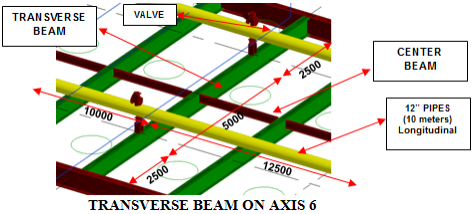
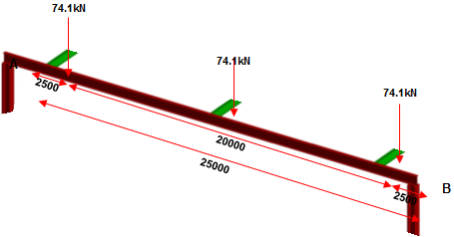
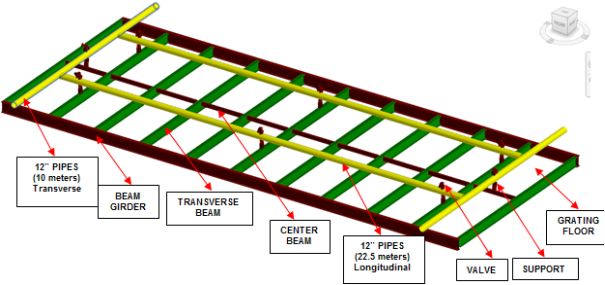
Reliability indices obtained from the structural analysis of steel beam girders with varying support configurations were used as the study data. The support configurations considered were: Two supports, Three supports, Four supports and Five supports (
Figures 1-3).
Figure 1. Steel Beam Girder.
Figure 2. Loads acting on beam girder.
Figure 3. Platform Deck 3D View.
The corresponding reliability indices for bending, shear, and deflection are presented in
Table 1.
Table 1. Reliability Indices for Different Support Configurations.
Number of Supports | β in Bending | β in Shear | β in Deflection | Target β |
2 | 5.65 | 5.32 | 0.402 | 4.00 |
3 | 2.39 | 5.31 | 1.174 | 4.00 |
4 | 6.98 | 5.26 | 4.0412 | 4.00 |
5 | 0.532 | 5.14 | 4.65 | 4.00 |
2.5. Statistical Analysis
Descriptive statistical techniques were employed to analyze the variation of reliability indices with the number of supports. The statistical parameters evaluated include:
1) Mean Reliability Index: The mean reliability index was computed as:
where:
βm = mean reliability index,
β = individual reliability index,
n= number of observations.
2) Standard Deviation
The standard deviation was calculated to measure the dispersion of reliability indices:
3) Coefficient of Variation
The coefficient of variation (COV) was determined to evaluate the relative variability of the reliability indices:
According to
| [8] | Simwanda, L. (2023). Structural Reliability of Ultra-High Performance Fiber Reinforced Concrete Beams. Structural Concrete, 24(5), 6421–6438. |
[8]
the coefficient of variation provides a useful measure for comparing the stability of reliability indices across different structural configurations.
2.6. Evaluation Criteria
The reliability indices obtained for each support configuration were compared with the target reliability index of:
t=4.0
The evaluation criteria adopted were:
Reliability Index Performance Level
β < 2.5 Poor Reliability
2.5 ≤ β < 4.0 Marginal Reliability
4.0 ≤ β < 6.0 Adequate Reliability
β ≥ 6.0 Excellent Reliability
This classification was adapted from recent reliability assessment recommendations for structural members
| [4] | Joint Research Centre (JRC). (2024). Reliability Background of the Eurocodes. European Commission. |
[4]
.
3. Results and Discussion
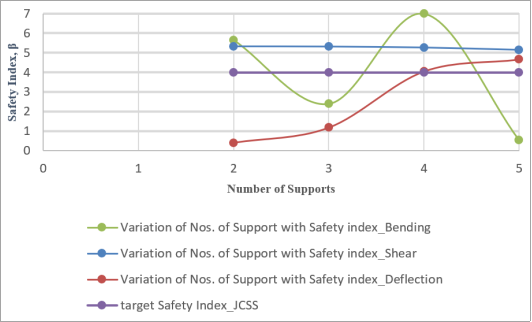
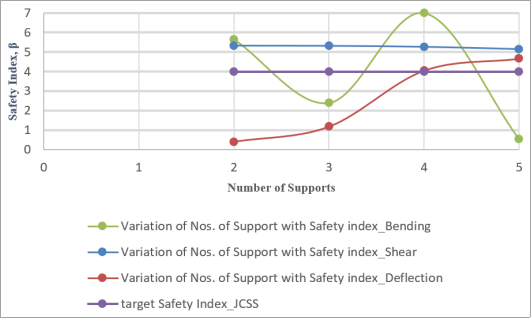
The results were presented using tables showing reliability indices for each support configuration, graphs illustrating the variation of reliability indices with the number of supports, comparative analyses of bending, shear, and deflection reliability performances. and assessment against the target reliability index of 4.0.
This approach enabled a comprehensive evaluation of the influence of support configuration on the safety and serviceability performance of steel beam girders.
Figure 4. Variation of Safety indices with number of supports.
Table 2. Variation of Safety indices with number of supports in Bending, Shear and Deflection of girder.
No. of Supports | β in Bending | β in Shear | β in Deflection | Target Safety, |
2 | 5.65 | 5.32 | 0.402 | 4 |
3 | 2.39 | 5.31 | 1.174 | 4 |
4 | 6.98 | 5.26 | 4.0412 | 4 |
5 | 0.532 | 5.14 | 4.65 | 4 |
3.1. Reliability Variation in Bending
The bending reliability indices exhibited substantial variation as the number of supports increased. The highest reliability index was obtained for the four-support girder (β = 6.98), while the lowest value occurred for the five-support girder (β = 0.532). This finding suggests that the relationship between support number and bending reliability is non-linear. The two-support girder achieved a reliability index of 5.65, which exceeded the target reliability index of 4.0. However, introducing a third support reduced the reliability index to 2.39, indicating a decrease in bending safety. The four-support configuration significantly improved the bending reliability, whereas the five-support arrangement resulted in a substantial reduction. These variations may be attributed to changes in moment redistribution and internal force patterns resulting from additional supports. Similar observations were reported by
| [3] | Fahmi, F. H., Mohammed, A. M., & Hassan, S. A. (2022). Strength and Deflection Reliability Estimation of Girder Structures Using FORM and Monte Carlo Simulation. Engineering, Technology & Applied Science Research, 12(5), 9221–9227. |
[3]
who found that modifications in support conditions can significantly alter structural reliability even when material and loading parameters remain unchanged.
The results further support the observations of
| [2] | Cheng, K., Zhang, Y., & Li, H. (2023). Influence of Load Partial Factors Adjustment on Reliability of Structural Members. Scientific Reports, 13, 34241. |
[2]
who concluded that structural reliability is highly sensitive to variations in system configuration and load-transfer mechanisms.
3.2. Reliability Variation in Shear
Unlike bending reliability, the shear reliability indices remained relatively constant across all support configurations. The values varied only slightly from 5.14 to 5.32 and consistently exceeded the target reliability index. This stability indicates that shear resistance is less affected by support configuration than bending resistance. The relatively small variation suggests that the girder possesses sufficient reserve capacity against shear failure regardless of the number of supports provided. These findings agree with those of
| [8] | Simwanda, L. (2023). Structural Reliability of Ultra-High Performance Fiber Reinforced Concrete Beams. Structural Concrete, 24(5), 6421–6438. |
[8]
who reported that shear-related reliability indices generally exhibit lower sensitivity to geometric modifications than flexural reliability indices. The consistently high reliability values also indicate that shear is unlikely to be the governing limit state for the girder configurations considered in this study.
3.3. Reliability Variation in Deflection
The reliability indices associated with deflection increased progressively with the number of supports. The two-support girder recorded the lowest deflection reliability index (β = 0.402), which is significantly below the target value of 4.0.
The three-support girder showed a moderate improvement with a reliability index of 1.174. However, both configurations failed to satisfy the target serviceability requirement. A substantial increase occurred when the number of supports was increased to four, resulting in a reliability index of 4.0412. The five-support girder achieved the highest deflection reliability index of 4.65. The improvement in deflection reliability can be attributed to the reduction in effective span length and the corresponding increase in structural stiffness. Furthermore,
| [7] | Qin, X. (2025). Time-Dependent Reliability Assessment of Structural Beams. Engineering Structures, 327, 120203. |
| [4] | Joint Research Centre (JRC). (2024). Reliability Background of the Eurocodes. European Commission. |
[7, 4]
emphasized that serviceability reliability often improves significantly when structural stiffness is increased through optimized support arrangements.
3.4. Comparative Assessment of Reliability Indices
A comparison of the three limit states reveals distinct patterns of reliability behavior. Shear reliability remained consistently high for all support configurations, while bending reliability exhibited significant fluctuations. Deflection reliability demonstrated a steady increase with increasing support number. The four-support configuration emerged as the most balanced structural arrangement because it satisfied the target reliability index in bending, shear, and deflection simultaneously. Although the five-support girder produced the highest deflection reliability, its bending reliability fell significantly below the target value. This observation supports the conclusions of
| [1] | Attarchian, N., Rahman, M., & Hassan, A. (2025). Reliability-Based Calibration of Strength Reduction Factors for Structural Members. Results in Engineering, 25, 104587. |
[1]
who emphasized that reliability-based optimization should consider multiple limit states simultaneously rather than focusing on a single performance criterion. The results demonstrate that increasing the number of supports does not automatically improve overall structural reliability. Instead, an optimal support configuration must balance the competing requirements of strength and serviceability.
Figure 5. Variation of Safety indices with number of supports.
4. Conclusion
This study investigated the statistical variation of reliability indices of a steel beam girder subjected to different support configurations. Reliability performance was evaluated for bending, shear, and deflection limit states using reliability indices corresponding to girders with two, three, four, and five supports. The obtained reliability values were compared with a target reliability index of 4.0 to assess the adequacy of structural safety and serviceability. The results demonstrated that the number of supports significantly influences the reliability performance of steel girders. Bending reliability exhibited substantial variation across the support configurations, indicating a strong dependence on support arrangement. The highest bending reliability index (β = 6.98) was obtained for the four-support girder, while the lowest value (β = 0.532) occurred for the five-support girder. This finding suggests that increasing the number of supports does not necessarily improve flexural reliability, as continuity effects and moment redistribution may adversely affect bending performance. In contrast, shear reliability remained relatively stable throughout the analysis, with reliability indices ranging from 5.14 to 5.32. All shear reliability values exceeded the target reliability index, indicating that the girder possessed adequate safety margins against shear failure irrespective of support configuration. This stability confirms the findings that shear reliability is generally less sensitive to structural modifications than flexural reliability.
The reliability indices associated with deflection increased progressively as the number of supports increased. The two-support and three-support girders recorded deflection reliability indices below the target value, indicating inadequate serviceability performance. However, the four-support and five-support girders achieved reliability indices of 4.0412 and 4.65, respectively, satisfying the target reliability requirement.
This improvement can be attributed to the reduction in effective span lengths and increased structural stiffness resulting from additional supports
. A comparative assessment of the three limit states revealed that the four-support configuration provided the most balanced structural performance. It was the only configuration that simultaneously satisfied the target reliability index for bending, shear, and deflection. Although the five-support girder achieved the highest deflection reliability, its bending reliability was significantly below the acceptable threshold, making it unsuitable from an overall reliability perspective. Similarly, the two-support girder exhibited satisfactory bending and shear reliability but failed to meet the serviceability requirements for deflection. The study therefore concludes that the four-support configuration represents the optimum support arrangement among the cases considered, providing the best compromise between strength and serviceability requirements. The findings further demonstrate that reliability-based assessment offers a robust framework for evaluating structural performance and identifying optimal support configurations under uncertainty. As emphasized in recent reliability studies, structural optimization should consider multiple limit states simultaneously rather than relying solely on conventional deterministic design criteria.
Abbreviations
COV | Coefficient of Variation |
RBD | Reliability-based Design |
Author Contributions
Olaitan Oluwasheun Akol: Data curation, Methodology
John Wasiu: Supervision
Ibrahim Abdulrazaq Olayinka: Validation
Conflicts of Interest
The authors declare no conflict of interest.
References
| [1] |
Attarchian, N., Rahman, M., & Hassan, A. (2025). Reliability-Based Calibration of Strength Reduction Factors for Structural Members. Results in Engineering, 25, 104587.
|
| [2] |
Cheng, K., Zhang, Y., & Li, H. (2023). Influence of Load Partial Factors Adjustment on Reliability of Structural Members. Scientific Reports, 13, 34241.
|
| [3] |
Fahmi, F. H., Mohammed, A. M., & Hassan, S. A. (2022). Strength and Deflection Reliability Estimation of Girder Structures Using FORM and Monte Carlo Simulation. Engineering, Technology & Applied Science Research, 12(5), 9221–9227.
|
| [4] |
Joint Research Centre (JRC). (2024). Reliability Background of the Eurocodes. European Commission.
|
| [5] |
Qin, X., Wang, J., Liu, Y., & Zhang, H. (2025). Time-Dependent Reliability Assessment of Structural Beams Considering Durability Effects. Engineering Structures, 327, 120203.
|
| [6] |
Kanno, Y. (2021). Distributionally Robust Reliability-Based Design Optimization under Uncertainty. Structural and Multidisciplinary Optimization, 64, 311–328.
|
| [7] |
Qin, X. (2025). Time-Dependent Reliability Assessment of Structural Beams. Engineering Structures, 327, 120203.
|
| [8] |
Simwanda, L. (2023). Structural Reliability of Ultra-High Performance Fiber Reinforced Concrete Beams. Structural Concrete, 24(5), 6421–6438.
|
| [9] |
Cserpes, I., Makó, I., & Holczinger, T. (2024). Innovative design techniques for sinusoidal-web beams: A reliability-based optimisation approach. Buildings, 14(4), 1051.
|
| [10] |
Lavaei, M. H., Nguyen, H., & Sahoo, D. (2023). Reliability-based design optimisation of self-centring rocking steel frames with BRBs. Structures, 52, 240–256.
|
| [11] |
Radoń, U. (2025). The application of structural reliability and sensitivity analysis in everyday design practice. Applied Sciences, 15(1), 342.
|
| [12] |
Ye, H., & Liu, Z. (2024). Fatigue and serviceability-based reliability of steel girders under fluctuating loads. Engineering Structures, 287, 109–126.
|
| [13] |
Lee, H., Park, J., & Kim, S. (2022). Reliability of continuous steel beams under multi-hazard actions. Journal of Constructional Steel Research, 185, 106–118.
|
| [14] |
Zhang, L., Wang, J., & Zhao, Y. (2021). Reliability analysis of steel bridge girders using FORM. Journal of Bridge Engineering, 26(6), 04021041.
|
| [15] |
Gomes, H., & Simões, M. (2019). Machine-learning-enhanced FORM for reliability evaluation of complex offshore structures. Probabilistic Engineering Mechanics, 57, 34–46.
|
| [16] |
Shao, Y., Li, W., & Feng, W. (2024). Machine-learning-enhanced FORM for nonlinear structural reliability. Engineering Structures, 290, 115–128.
|
Cite This Article
-
APA Style
Akol, O. O., Wasiu, J., Olayinka, I. A. (2026). Statistical Analysis of Variation Indices of Different Support in a Steel Beam Girder. American Journal of Civil Engineering, 14(5), 304-311. https://doi.org/10.11648/j.ajce.20261405.11
 Copy
|
Copy
|
 Download
ACS Style
Akol, O. O.; Wasiu, J.; Olayinka, I. A. Statistical Analysis of Variation Indices of Different Support in a Steel Beam Girder. Am. J. Civ. Eng. 2026, 14(5), 304-311. doi: 10.11648/j.ajce.20261405.11
Copy
|
Download
AMA Style
Akol OO, Wasiu J, Olayinka IA. Statistical Analysis of Variation Indices of Different Support in a Steel Beam Girder. Am J Civ Eng. 2026;14(5):304-311. doi: 10.11648/j.ajce.20261405.11
Copy
|
Download
-
@article{10.11648/j.ajce.20261405.11,
  author = {Olaitan Oluwasheun Akol and John Wasiu and Ibrahim Abdulrazaq Olayinka},
  title = {Statistical Analysis of Variation Indices of Different Support in a Steel Beam Girder},
  journal = {American Journal of Civil Engineering},
  volume = {14},
  number = {5},
  pages = {304-311},
  doi = {10.11648/j.ajce.20261405.11},
  url = {https://doi.org/10.11648/j.ajce.20261405.11},
  eprint = {https://article.sciencepublishinggroup.com/pdf/10.11648.j.ajce.20261405.11},
  abstract = {The reliability and safety performance of steel beam girders are significantly influenced by the number of supports provided along their spans. This study presents a statistical analysis of the variation of reliability indices (β) of a steel beam girder subjected to bending, shear, and deflection limit states under different support conditions. Reliability indices were evaluated for girders having two, three, four, and five supports and compared with the target reliability index (βt = 4.0). The results show considerable variation in structural reliability with changes in support configuration. Shear reliability remained consistently high, ranging from 5.14 to 5.32, indicating adequate safety against shear failure. Bending reliability exhibited significant fluctuations, with indices ranging from 0.532 to 6.98, suggesting that support arrangement strongly affects bending performance. Deflection reliability increased progressively from 0.402 for two supports to 4.65 for five supports, indicating improved serviceability performance with increased support numbers. The study demonstrates that while increasing the number of supports generally enhances serviceability reliability, it does not necessarily guarantee improved bending reliability. Statistical evaluation revealed that girders with four supports achieved the most balanced performance, satisfying the target reliability requirement for all failure modes. The findings provide useful insights for the reliability-based design and optimization of steel girder support systems.},
 year = {2026}
}
Copy
|
Download
-
TY  - JOUR
T1  - Statistical Analysis of Variation Indices of Different Support in a Steel Beam Girder
AU  - Olaitan Oluwasheun Akol
AU  - John Wasiu
AU  - Ibrahim Abdulrazaq Olayinka
Y1  - 2026/08/22
PY  - 2026
N1  - https://doi.org/10.11648/j.ajce.20261405.11
DO  - 10.11648/j.ajce.20261405.11
T2  - American Journal of Civil Engineering
JF  - American Journal of Civil Engineering
JO  - American Journal of Civil Engineering
SP  - 304
EP  - 311
PB  - Science Publishing Group
SN  - 2330-8737
UR  - https://doi.org/10.11648/j.ajce.20261405.11
AB  - The reliability and safety performance of steel beam girders are significantly influenced by the number of supports provided along their spans. This study presents a statistical analysis of the variation of reliability indices (β) of a steel beam girder subjected to bending, shear, and deflection limit states under different support conditions. Reliability indices were evaluated for girders having two, three, four, and five supports and compared with the target reliability index (βt = 4.0). The results show considerable variation in structural reliability with changes in support configuration. Shear reliability remained consistently high, ranging from 5.14 to 5.32, indicating adequate safety against shear failure. Bending reliability exhibited significant fluctuations, with indices ranging from 0.532 to 6.98, suggesting that support arrangement strongly affects bending performance. Deflection reliability increased progressively from 0.402 for two supports to 4.65 for five supports, indicating improved serviceability performance with increased support numbers. The study demonstrates that while increasing the number of supports generally enhances serviceability reliability, it does not necessarily guarantee improved bending reliability. Statistical evaluation revealed that girders with four supports achieved the most balanced performance, satisfying the target reliability requirement for all failure modes. The findings provide useful insights for the reliability-based design and optimization of steel girder support systems.
VL  - 14
IS  - 5
ER  -
Copy
|
Download





 Share This Article
 Twitter
 Linked In
 Facebook