
High-rise buildings increasingly rest on soft and compressible clayey-sandy soils, where soil–structure interaction (SSI) significantly affects dynamic behavior, seismic safety, serviceability, and collapse resistance. Traditional fixed-base approaches neglect the flexibility of soil and foundation systems, leading to inaccurate predictions of natural periods, damping ratios, internal forces, overturning moments, torsional response, and second-order effects. This review aims to synthesize and evaluate more than seventy-three major scientific contributions spanning geotechnical earthquake engineering, structural dynamics, and foundation engineering, with particular focus on the implications of SSI for safe capacity-based design of tall buildings subjected to multidirectional extreme loading. The review covers analytical formulations, finite-element approaches, centrifuge testing, nonlinear time-history analyses, and performance-based design methods. Special attention is devoted to shallow foundations, raft foundations, pile foundations, and hybrid pile-raft systems, with systematic comparison of their effects on vertical stiffness, horizontal stiffness, torsional stiffness, and rocking stiffness. Comparative results from major international researchers are tabulated and discussed. The results consistently demonstrate that soil compressibility amplifies displacement demand, extends structural periods, and intensifies rocking and torsional effects, particularly for slender towers. Among all foundation systems examined, pile–raft foundations provide the most balanced performance in terms of stiffness, settlement control, and energy dissipation. Engineering recommendations are proposed for safe capacity-based design of tall buildings subjected to seismic, wind-induced, blast, and machine-generated multidirectional vibrations.
| Published in | American Journal of Civil Engineering (Volume 14, Issue 4) |
| DOI | 10.11648/j.ajce.20261404.12 |
| Page(s) | 226-244 |
| Creative Commons |
This is an Open Access article, distributed under the terms of the Creative Commons Attribution 4.0 International License (http://creativecommons.org/licenses/by/4.0/), which permits unrestricted use, distribution and reproduction in any medium or format, provided the original work is properly cited. |
| Copyright |
Copyright © The Author(s), 2026. Published by Science Publishing Group |
Soil–structure Interaction, High-rise Buildings, Capacity-based Design
 (1)
(1)  (2)
(2) 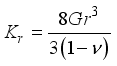 (3)
(3) 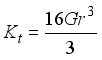 (4)
(4) 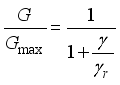 (5)
(5) 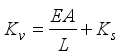 (6)
(6) 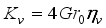 (7)
(7) 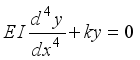 (8)
(8) 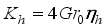 (9)
(9) 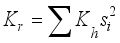 (10)
(10) 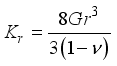 (11)
(11)  (12)
(12) 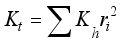 (13)
(13) 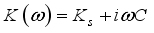 (14)
(14)  (15)
(15)  (16)
(16) 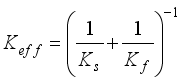 (17)
(17)  (18)
(18) Soil Type | Period Increase | Settlement Increase | Drift Amplification |
|---|---|---|---|
Dense Sand | 5–10% | Low | Low |
Medium Sand | 10–20% | Moderate | Moderate |
Soft Clay | 20–45% | High | High |
Clayey–Sandy Soil | 15–35% | Moderate–High | Significant |
Foundation Type | Vertical Stiffness | Rocking Resistance | Settlement Control | SSI Sensitivity |
|---|---|---|---|---|
Isolated footings | Moderate | Low | Low | High |
Raft foundation | High | Moderate | High | Moderate |
Pile foundation | Very High | High | Very High | Moderate |
Pile–raft System | Optimized | Very High | Excellent | Low |
Author | Main Findings |
|---|---|
Veletsos and Meek [ 6] | SSI increases natural period |
Gazetas [ 10] | Developed dynamic impedance equations |
Wolf [ 7] | Developed substructure SSI method |
Stewart et al. [ 12] | SSI modifies ductility demand |
Mylonakis and Gazetas [ 13] | SSI may amplify seismic demand |
Poulos [ 28] | Pile raft systems improve performance |
Anastasopoulos [ 29] | Controlled rocking improves resilience |
Author | Vertical Stiffness | Horizontal Stiffness | Rocking Stiffness | Torsional Stiffness |
|---|---|---|---|---|
Novak [ 31] | Dynamic impedance | Dynamic impedance | Frequency-dependent | Frequency-dependent |
Gazetas [ 10] | Elastic continuum | Elastic continuum | Closed-form solution | Closed-form solution |
Wolf [ 7] | Cone model | Cone model | Substructure method | Substructure method |
Poulos [ 28] | Pile–raft interaction | Group interaction | Rotational stiffness | Group torsion |
Authors | Soil Type | Structure Type | Loading Type | Main SSI Observation | Quantitative Result |
|---|---|---|---|---|---|
Veletsos & Meek [ 6] | Soft clay | Tall frame structures | Seismic | Structural period elongation | +15% to +40% increase in natural period |
Gazetas [ 10] | Compressible sandy clay | Embedded foundations | Dynamic vibration | Foundation damping increases significantly | 20–35% damping increase |
Mylonakis & Gazetas [ 13] | Soft cohesive soils | High-rise buildings | Earthquake | SSI may amplify seismic response | Base drift amplified up to 30% |
Stewart et al. [ 12] | Soft alluvial soils | Multistory buildings | Seismic | Ductility demand modified by SSI | Drift increase up to 25% |
Paolucci [ 27] | Soft deposits | Slender towers | Earthquake | Displacement amplification observed | 35–50% displacement increase |
Wolf & Deeks [ 26] | Clayey soils | Flexible foundations | Harmonic vibration | Radiation damping dominates | Frequency-dependent damping observed |
Poulos [ 28] | Clayey–sandy soils | Piled raft towers | Wind + seismic | Pile-raft systems improve stability | Settlement reduction >50% |
Randolph [ 53] | Soft layered soils | Pile groups | Dynamic loading | Group interaction reduces stiffness | 10–30% stiffness reduction |
Gajan & Kutter [ 26] | Soft clay | Rocking foundations | Earthquake | Controlled rocking dissipates energy | Base shear reduction up to 40% |
Anastasopoulos [ 29] | Compressible clay | Rocking systems | Seismic shock | Rocking isolation beneficial | Collapse prevention improved |
Authors | Building Height | Foundation Type | Wind Effect | Main Observation | Quantitative Findings |
|---|---|---|---|---|---|
Venanzi et al. [ 54] | 150–250 m | Raft foundation | Wind vibration | SSI modifies internal force distribution | 15–20% drift increase |
Liu et al. [ 55] | High-rise towers | Tuned mass damper + SSI | Wind | SSI reduces effectiveness of TMD | Acceleration increase observed |
Prendergast et al. [ 56] | Tall buildings on soft soils | Embedded foundation | Wind-induced vibration | Soil damping dominant | Damping contribution up to 60% |
Fernández et al. [ 57] | 100 m building | Compressible soils | Dynamic wind loading | SSI modifies overturning moments | Moment increase up to 18% |
Zhang & Far [ 58] | High-rise buildings | Deep foundations | Seismic + wind | SSI may be beneficial or detrimental | Drift increase up to 32% |
Zhang et al. [ 59] | >300 m supertall towers | Large pile groups | Wind excitation | SSI strongly affects RMS acceleration | RMS acceleration amplified by 25% |
CAARC numerical model [ 60] | CAARC benchmark tower | Flexible soil support | Aeroelastic vibration | Soil support alters instability modes | Reduced aeroelastic instability |
Foundation Type | Vertical Stiffness | Horizontal Stiffness | Rocking Stiffness | Torsional Stiffness | Dynamic Performance |
|---|---|---|---|---|---|
Isolated Footings | Moderate | Low | Low | Low | Large settlements and rocking |
Raft Foundation | High | Moderate | Moderate | Moderate | Good drift control |
Deep Pile Foundation | Very High | High | High | High | Excellent seismic stability |
Pile–Raft Hybrid | Optimized | Very High | Very High | Very High | Best overall dynamic response |
Embedded Foundation | High | High | High | Moderate | Improved radiation damping |
Region | Soil Condition | Main Hazard | Amplification Observed | Key Researchers |
|---|---|---|---|---|
Mexico City | Soft lacustrine clay | Earthquake | Extreme resonance amplification | Seed et al. |
Japan (Tohoku) | Soft coastal deposits | Seismic shock | Large rocking response | Mylonakis & Gazetas |
Turkey | Compressible alluvium | Earthquake | Severe SSI-induced drift | Stewart et al. |
Netherlands | Soft organic clay | Wind vibration | Foundation damping dominant | Prendergast et al. |
China | Soft urban deposits | Adjacent tower interaction | Structure-soil-structure interaction amplification | Gan et al. |
Italy | Layered soft soils | Earthquake | Foundation rotation critical | Conti & Viggiani |
UAE / Gulf Region | Sandy compressible soils | Wind loading | Long-period amplification | Tall building studies |
Structural Parameter | Fixed Base | Flexible Foundation with SSI | Typical Increase |
|---|---|---|---|
Natural Period | Lower | Higher | +10% to +45% |
Interstory Drift | Lower | Higher | +15% to +40% |
Rocking Rotation | Negligible | Significant | Strong amplification |
Foundation Settlement | Low | Moderate–High | Up to 300% |
Base Shear | Higher | Sometimes reduced | −10% to −35% |
Torsional Response | Moderate | Amplified | +20% to +50% |
RMS Wind Acceleration | Lower | Higher | +15% to +30% |
Soil Category | Shear Modulus (Approx.) | SSI Severity | Main Structural Consequences |
|---|---|---|---|
Dense Sand | High | Low | Minor amplification |
Medium Sand | Moderate | Moderate | Moderate drift increase |
Soft Clay | Very Low | Severe | Large settlements and rocking |
Clayey–Sandy Soil | Low–Moderate | High | Significant torsional amplification |
Organic Soft Soil | Extremely Low | Very Severe | Resonance and instability risk |
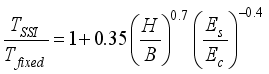 (19)
(19) 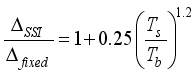 (20)
(20) 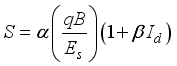 (21)
(21) 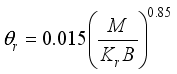 (22)
(22) 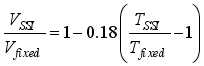 (23)
(23) 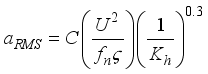 (24)
(24) 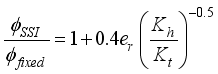 (25)
(25) 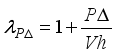 (26)
(26) 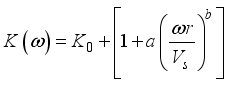 (27)
(27) Response parameter | Regression variable | Main influencing factors |
|---|---|---|
Natural period | TSSI/Tfixed | Soil stiffness, slenderness |
Drift amplification | ΔSSI/Δfixed | Soil period resonance |
Settlement | S | Soil modulus, pressure |
Rocking rotation | θr | Rocking stiffness |
Base shear reduction | VSSI/Vfixed | Period elongation |
Wind acceleration | aRMS | Horizontal stiffness |
Torsional amplification | ϕSSI/ϕfixed | Eccentricity, torsion |
P–Δ amplification | λPΔ | Displacement demand |
ASCE | American Society of Civil Engineers |
BEM | Boundary Element Method |
CBD | Capacity-Based Design |
DAF | Dynamic Amplification Factor |
EC8 | Eurocode 8 – Design of Structures for Earthquake Resistance |
FEMA | Federal Emergency Management Agency |
FEM | Finite Element Method |
HRB | High-Rise Building |
NLTHA | Nonlinear Time-History Analysis |
P–Δ | Second-Order (P-Delta) Effect |
PBGD | Performance-Based Geotechnical Design |
RMS | Root Mean Square |
SSI | Soil–Structure Interaction |
TMD | Tuned Mass Damper |
| [1] | Kausel, E. (1974). “Forced Vibrations of Circular Foundations on Layered Media.” Research Report R74-11, MIT. |
| [2] | Kausel, E., and Roesset, J. M. (1975). “Dynamic Stiffness Matrices for Layered Soils.” Bulletin of the Seismological Society of America, 65(6), 1743–1761. |
| [3] | Bowles, J. E. (1996). Foundation Analysis and Design (5th ed.). McGraw-Hill. |
| [4] | Kramer, S. L. (1996). Geotechnical Earthquake Engineering. Prentice Hall. |
| [5] | Veletsos, A. S., and Wei, Y. T. (1971). “Lateral and Rocking Vibrations of Footings.” Journal of Soil Mechanics and Foundations Division, ASCE, 97(SM9), 1227–1248. |
| [6] | Veletsos, A. S., and Meek, J. W. (1974). “Dynamic Behaviour of Building–Foundation Systems.” Earthquake Engineering and Structural Dynamics, 3(2), 121–138. |
| [7] | Wolf, J. P. (1985). Dynamic Soil–Structure Interaction. Prentice Hall. |
| [8] | Gazetas, G. (1983). “Analysis of Machine Foundation Vibrations: State of the Art.” Soil Dynamics and Earthquake Engineering, 2(1), 2–42. |
| [9] | Gazetas, G. (1991). “Foundation Vibrations.” In Foundation Engineering Handbook (2nd ed.), Van Nostrand Reinhold. |
| [10] | Gazetas, G. (2004). “Seismic Design Procedures and Soil–Structure Interaction.” Proceedings of the 13th World Conference on Earthquake Engineering. |
| [11] | Seed, H. B., Romo, M. P., Sun, J. I., Jaime, A., and Lysmer, J. (1988). “Relationships Between Soil Conditions and Earthquake Ground Motions in Mexico City.” Earthquake Spectra, 4(4), 687–729. |
| [12] | Stewart, J. P., Seed, R. B., and Fenves, G. L. (1999). “Seismic Soil–Structure Interaction in Buildings.” Journal of Geotechnical and Geoenvironmental Engineering, 125(1), 26–37. |
| [13] | Mylonakis, G., and Gazetas, G. (2000). “Seismic Soil–Structure Interaction: Beneficial or Detrimental?” Journal of Earthquake Engineering, 4(3), 277–301. |
| [14] | Hardin, B. O., and Drnevich, V. P. (1972). “Shear Modulus and Damping in Soils.” Journal of Soil Mechanics and Foundations Division, ASCE, 98(SM7), 667–692. |
| [15] | Seed, H. B., and Idriss, I. M. (1970). “Soil Moduli and Damping Factors for Dynamic Response Analyses.” Report EERC 70-10, University of California, Berkeley. |
| [16] | Idriss, I. M. (1990). “Response of Soft Soil Sites During Earthquakes.” Proceedings of H. Bolton Seed Memorial Symposium, 2, 273–289. |
| [17] | Idriss, I. M., and Boulanger, R. W. (2008). Soil Liquefaction During Earthquakes. Earthquake Engineering Research Institute. |
| [18] | Lamb, H. (1904). “On the Propagation of Tremors Over the Surface of an Elastic Solid.” Philosophical Transactions of the Royal Society A, 203, 1–42. |
| [19] | Reissner, H. (1936). “Stationary Oscillations of Plates in Elastic Media.” Journal of Applied Mathematics and Mechanics, 16, 339–346. |
| [20] | Biot, M. A. (1937). “Bending of an Infinite Beam on an Elastic Foundation.” Journal of Applied Mechanics, 4(3), A1–A7. |
| [21] | Lysmer, J. (1965). “Vertical Motion of Rigid Footings.” Report No. UCB/SESM-1965/15, University of California, Berkeley. |
| [22] | Richart, F. E., Hall, J. R., and Woods, R. D. (1970). Vibrations of Soils and Foundations. Prentice Hall. |
| [23] | Gan, X., Zhang, R., and Li, H. (2021). “Structure–Soil–Structure Interaction Between Adjacent Tall Buildings.” Engineering Structures, 242, 112549. |
| [24] | Pais, A., and Kausel, E. (1988). “Approximate Formulas for Dynamic Stiffnesses of Rigid Foundations.” Soil Dynamics and Earthquake Engineering, 7(4), 213–227. |
| [25] | Gajan, S., and Kutter, B. L. (2008). “Capacity, Settlement, and Energy Dissipation of Shallow Rocking Foundations.” Journal of Geotechnical and Geoenvironmental Engineering, 134(8), 1129–1141. |
| [26] | Wolf, J. P., and Deeks, A. J. (2004). Foundation Vibration Analysis Using Simple Physical Models. Elsevier. |
| [27] |
Paolucci, R. (1997). “Amplification of Earthquake Ground Motion in Soft Soil Deposits.” Earthquake Engineering and Structural Dynamics, 26(7), 751–769.
https://doi.org/10.1002/(SICI)1096-9845(199707)26:7<751::AID-EQE672>3.0.CO;2-P |
| [28] | Poulos, H. G. (2001). “Piled Raft Foundations: Design and Applications.” Geotechnique, 51(2), 95–113. |
| [29] | Novak, M., and El Sharnouby, B. (1983). “Stiffness Constants and Load Distribution for Pile Groups.” Canadian Geotechnical Journal, 20(4), 715–721. |
| [30] | Poulos, H. G., and Davis, E. H. (1980). Pile Foundation Analysis and Design. Wiley. |
| [31] | Novak, M. (1974). “Dynamic Stiffness and Damping of Piles.” Canadian Geotechnical Journal, 11(4), 574–598. |
| [32] | Gazetas, G., and Dobry, R. (1984). “Horizontal Response of Piles in Layered Soils.” Journal of Geotechnical Engineering, 110(1), 20–40. |
| [33] | Winkler, E. (1867). The Theory of Elasticity and Strength. Prague. |
| [34] | Anastasopoulos, I. (2014). “Seismic rocking isolation of shallow foundations subjected to strong ground motions.” Soil Dynamics and Earthquake Engineering, 58, 1–17. |
| [35] | Novak, M., and Sachs, K. (1974). “Torsional and Coupled Vibrations of Embedded Footings.” Earthquake Engineering and Structural Dynamics, 2(1), 11–33. |
| [36] | Randolph, M. F. (1994). “Design Methods for Pile Groups and Piled Rafts.” Proceedings of the 13th International Conference on Soil Mechanics and Foundation Engineering, 5, 61–82. |
| [37] | Deng, L., and Kutter, B. L. (2012). “Dynamic Centrifuge Modeling of Soil–Foundation–Structure Interaction.” Journal of Geotechnical and Geoenvironmental Engineering, 138(6), 728–737. |
| [38] | Bardet, J. P. (1997). Experimental Soil Mechanics. Prentice Hall. |
| [39] | Dobry, R., and Gazetas, G. (1986). “Dynamic Response of Foundations.” Geotechnical Special Publication, ASCE, 12, 1–27. |
| [40] | Finn, W. D. L. (2000). “State-of-the-Art of Geotechnical Earthquake Engineering Practice.” Soil Dynamics and Earthquake Engineering, 20(1–4), 1–15. |
| [41] | Eurocode 8. (2004). Design of Structures for Earthquake Resistance. European Committee for Standardization. |
| [42] | FEMA 273. (1997). NEHRP Guidelines for the Seismic Rehabilitation of Buildings. Federal Emergency Management Agency. |
| [43] | FEMA 356. (2000). Prestandard and Commentary for the Seismic Rehabilitation of Buildings. Federal Emergency Management Agency. |
| [44] | FEMA 440. (2005). Improvement of Nonlinear Static Seismic Analysis Procedures. Federal Emergency Management Agency. |
| [45] | Hall, J. F. (2006). “Problems Encountered from the Use (or Misuse) of Rayleigh Damping.” Earthquake Engineering and Structural Dynamics, 35(5), 525–545. |
| [46] | Elgamal, A. (2002). “Modeling of Cyclic Mobility in Saturated Cohesionless Soils.” International Journal of Plasticity, 18(5–6), 883–905. |
| [47] | Barkan, D. D. (1962). Dynamics of Bases and Foundations. McGraw-Hill. |
| [48] | Bray, J. D. (2018). Earthquake Geotechnical Engineering. Springer. |
| [49] | Bray, J. D., and Stewart, J. P. (2000). “Characterization of Soil Response During Strong Ground Motion Earthquakes.” Earthquake Spectra, 16(1), 1–20. |
| [50] | Chopra, A. K. (2017). Dynamics of Structures: Theory and Applications to Earthquake Engineering (5th ed.). Pearson. |
| [51] | Clough, R. W., and Penzien, J. (2003). Dynamics of Structures (3rd ed.). Computers and Structures Inc. |
| [52] | Mylonakis, G. (2001). “Simplified Model for Seismic Soil–Pile–Structure Interaction.” Earthquake Engineering and Structural Dynamics, 30(6), 891–908. |
| [53] | Randolph, M. F., and Wroth, C. P. (1978). “Analysis of Deformation of Vertically Loaded Piles.” Journal of Geotechnical Engineering Division, ASCE, 104(GT12), 1465–1488. |
| [54] | Venanzi, I., et al. (2014). “Soil–Structure Interaction Effects on Wind-Excited Tall Buildings.” Engineering Structures, 79, 117–130. |
| [55] | Liu, W., Chen, Y., and Zhao, X. (2019). “Influence of Soil–Structure Interaction on Tuned Mass Dampers in Tall Buildings.” Journal of Wind Engineering and Industrial Aerodynamics, 188, 34–48. |
| [56] | Prendergast, L. J., et al. (2018). “Dynamic Soil–Structure Interaction Effects Under Wind Excitation.” Engineering Structures, 165, 183–196. |
| [57] | Fernández, G., López, A., and Martínez, J. (2022). “Wind-Induced Soil–Structure Interaction Effects in Tall Buildings.” Engineering Structures, 251, 113471. |
| [58] | Zhang, Y., and Far, H. (2024). “Combined Wind–Seismic SSI Effects in High-Rise Buildings.” Soil Dynamics and Earthquake Engineering, 176, 108245. |
| [59] | Zhang, R., Gan, X., and Li, H. (2021). “Wind-Induced Dynamic Response of Supertall Buildings Considering SSI.” Journal of Wind Engineering and Industrial Aerodynamics, 213, 104593. |
| [60] | FEMA P-58. (2012). Seismic Performance Assessment of Buildings. Federal Emergency Management Agency. |
| [61] | Luco, J. E. (1986). “Soil–Structure Interaction Effects on Nuclear Power Plants.” Nuclear Engineering and Design, 97(1), 1–18. |
| [62] | Conti, R., and Viggiani, G. (2010). “Soil–Structure Interaction in Tall Buildings Founded on Soft Soils.” Soils and Foundations, 50(6), 847–860. |
| [63] | Prakash, S. (1981). Soil Dynamics. McGraw-Hill. |
| [64] | Pecker, A. (2003). Advanced Earthquake Engineering. Springer. |
| [65] | API RP2A-WSD. (2014). Recommended Practice for Planning, Designing and Constructing Fixed Offshore Platforms. American Petroleum Institute. |
| [66] | ASCE 4-16. (2016). Seismic Analysis of Safety-Related Nuclear Structures. American Society of Civil Engineers. |
| [67] | ASCE 7-22. (2022). Minimum Design Loads and Associated Criteria for Buildings and Other Structures. American Society of Civil Engineers. |
| [68] | ASCE 41-17. (2017). Seismic Evaluation and Retrofit of Existing Buildings. American Society of Civil Engineers. |
| [69] | Das, B. M. (2010). Principles of Foundation Engineering (7th ed.). Cengage Learning. |
| [70] | Meyerhof, G. G. (1951). “The Ultimate Bearing Capacity of Foundations.” Geotechnique, 2(4), 301–332. |
| [71] | Poulos, H. G. (2017). Tall Building Foundation Design. CRC Press. |
| [72] | Stewart, J. P. (2003). “Foundation Damping Effects in Seismic Response.” Journal of Structural Engineering, 129(5), 605–615. |
APA Style
Michel-Norbert, M. D., Ambassa, Z., Landry, D. K., Robert, N. (2026). Capacity Based Design Review of Tall Buildings Under Extreme Multidirectional Dynamic Loading Considering Nonlinear Soil Structure Interaction and Foundation Effects. American Journal of Civil Engineering, 14(4), 226-244. https://doi.org/10.11648/j.ajce.20261404.12
ACS Style
Michel-Norbert, M. D.; Ambassa, Z.; Landry, D. K.; Robert, N. Capacity Based Design Review of Tall Buildings Under Extreme Multidirectional Dynamic Loading Considering Nonlinear Soil Structure Interaction and Foundation Effects. Am. J. Civ. Eng. 2026, 14(4), 226-244. doi: 10.11648/j.ajce.20261404.12
AMA Style
Michel-Norbert MD, Ambassa Z, Landry DK, Robert N. Capacity Based Design Review of Tall Buildings Under Extreme Multidirectional Dynamic Loading Considering Nonlinear Soil Structure Interaction and Foundation Effects. Am J Civ Eng. 2026;14(4):226-244. doi: 10.11648/j.ajce.20261404.12
@article{10.11648/j.ajce.20261404.12,
  author = {Moukam Dzogang Michel-Norbert and Zoa Ambassa and Djopkop Kouanang Landry and Nzengwa Robert},
  title = {Capacity Based Design Review of Tall Buildings Under Extreme Multidirectional Dynamic Loading Considering Nonlinear Soil Structure Interaction and Foundation Effects},
  journal = {American Journal of Civil Engineering},
  volume = {14},
  number = {4},
  pages = {226-244},
  doi = {10.11648/j.ajce.20261404.12},
  url = {https://doi.org/10.11648/j.ajce.20261404.12},
  eprint = {https://article.sciencepublishinggroup.com/pdf/10.11648.j.ajce.20261404.12},
  abstract = {High-rise buildings increasingly rest on soft and compressible clayey-sandy soils, where soil–structure interaction (SSI) significantly affects dynamic behavior, seismic safety, serviceability, and collapse resistance. Traditional fixed-base approaches neglect the flexibility of soil and foundation systems, leading to inaccurate predictions of natural periods, damping ratios, internal forces, overturning moments, torsional response, and second-order effects. This review aims to synthesize and evaluate more than seventy-three major scientific contributions spanning geotechnical earthquake engineering, structural dynamics, and foundation engineering, with particular focus on the implications of SSI for safe capacity-based design of tall buildings subjected to multidirectional extreme loading. The review covers analytical formulations, finite-element approaches, centrifuge testing, nonlinear time-history analyses, and performance-based design methods. Special attention is devoted to shallow foundations, raft foundations, pile foundations, and hybrid pile-raft systems, with systematic comparison of their effects on vertical stiffness, horizontal stiffness, torsional stiffness, and rocking stiffness. Comparative results from major international researchers are tabulated and discussed. The results consistently demonstrate that soil compressibility amplifies displacement demand, extends structural periods, and intensifies rocking and torsional effects, particularly for slender towers. Among all foundation systems examined, pile–raft foundations provide the most balanced performance in terms of stiffness, settlement control, and energy dissipation. Engineering recommendations are proposed for safe capacity-based design of tall buildings subjected to seismic, wind-induced, blast, and machine-generated multidirectional vibrations.},
 year = {2026}
}
TY  - JOUR
T1  - Capacity Based Design Review of Tall Buildings Under Extreme Multidirectional Dynamic Loading Considering Nonlinear Soil Structure Interaction and Foundation Effects
AU  - Moukam Dzogang Michel-Norbert
AU  - Zoa Ambassa
AU  - Djopkop Kouanang Landry
AU  - Nzengwa Robert
Y1  - 2026/07/22
PY  - 2026
N1  - https://doi.org/10.11648/j.ajce.20261404.12
DO  - 10.11648/j.ajce.20261404.12
T2  - American Journal of Civil Engineering
JF  - American Journal of Civil Engineering
JO  - American Journal of Civil Engineering
SP  - 226
EP  - 244
PB  - Science Publishing Group
SN  - 2330-8737
UR  - https://doi.org/10.11648/j.ajce.20261404.12
AB  - High-rise buildings increasingly rest on soft and compressible clayey-sandy soils, where soil–structure interaction (SSI) significantly affects dynamic behavior, seismic safety, serviceability, and collapse resistance. Traditional fixed-base approaches neglect the flexibility of soil and foundation systems, leading to inaccurate predictions of natural periods, damping ratios, internal forces, overturning moments, torsional response, and second-order effects. This review aims to synthesize and evaluate more than seventy-three major scientific contributions spanning geotechnical earthquake engineering, structural dynamics, and foundation engineering, with particular focus on the implications of SSI for safe capacity-based design of tall buildings subjected to multidirectional extreme loading. The review covers analytical formulations, finite-element approaches, centrifuge testing, nonlinear time-history analyses, and performance-based design methods. Special attention is devoted to shallow foundations, raft foundations, pile foundations, and hybrid pile-raft systems, with systematic comparison of their effects on vertical stiffness, horizontal stiffness, torsional stiffness, and rocking stiffness. Comparative results from major international researchers are tabulated and discussed. The results consistently demonstrate that soil compressibility amplifies displacement demand, extends structural periods, and intensifies rocking and torsional effects, particularly for slender towers. Among all foundation systems examined, pile–raft foundations provide the most balanced performance in terms of stiffness, settlement control, and energy dissipation. Engineering recommendations are proposed for safe capacity-based design of tall buildings subjected to seismic, wind-induced, blast, and machine-generated multidirectional vibrations.
VL  - 14
IS  - 4
ER  -
Laboratory of Mechanic and Materials (LMEMA)-Department of Civil Engineering, National Higher Polytechnic School of Douala, University of Douala, Douala, Cameroon; Department of Digital Sciences-Advanced School of Town Planning and Tourism, University of Bertoua, Abong-Mbang, Cameroon

Information



 Share This Article
 Twitter
 Linked In
 Facebook
 Copy
Copy Download