Research Article | | Peer-Reviewed

Application of IoT-enabled Piezoelectric Sensors for Strength Monitoring of Concrete by Direct and Indirect Transmission

Received: 12 June 2026     Accepted: 23 June 2026     Published: 8 July 2026
Views:       Downloads:
Abstract

Concrete strength monitoring plays an important role in ensuring the safety and performance of civil engineering structures. Conventional methods used for determining compressive strength are generally destructive in nature and do not allow continuous monitoring of concrete behavior during the curing period. In the present study, an Internet of Things (IoT)-enabled monitoring system using piezoelectric sensors was developed to assess the strength development of M40 grade concrete. Two sensor configurations, namely direct transmission mode and indirect transmission mode, were considered for monitoring the propagation of stress waves through concrete cube specimens. Standard concrete cube specimens measuring 150 mm × 150 mm × 150 mm were prepared and tested at curing ages of 7, 14, and 28 days. A function generator operating at a frequency of 10 kHz was used to excite the actuator sensor, while the received signal was processed through an electronic signal-conditioning circuit consisting of an LM324 operational amplifier and supporting components. The amplitude response obtained from the sensors was transmitted using a NodeMCU ESP8266 module and visualized through the ThingSpeak cloud platform. The compressive strength of the concrete specimens was determined using a Compression Testing Machine (CTM) following completion of the monitoring process. The experimental observations indicated that the amplitude values increased with the gain in concrete strength for both transmission modes. Correlation analysis showed a strong relationship between amplitude response and compressive strength, demonstrating the suitability of the developed IoT-enabled piezoelectric monitoring system for non-destructive concrete strength evaluation.

Published in American Journal of Civil Engineering (Volume 14, Issue 4)
DOI 10.11648/j.ajce.20261404.11
Page(s) 213-225
Creative Commons

This is an Open Access article, distributed under the terms of the Creative Commons Attribution 4.0 International License (http://creativecommons.org/licenses/by/4.0/), which permits unrestricted use, distribution and reproduction in any medium or format, provided the original work is properly cited.

Copyright

Copyright © The Author(s), 2026. Published by Science Publishing Group

Keywords

Concrete Strength, IoT, Piezoelectric Sensors, Direct and Indirect Transmission, Nondestructive Test

1. Introduction
Concrete is one of the most crucial and extensively used materials in civil engineering and has a wide range of structural applications. The durability, performance, and overall stability of a structure are closely related to the quality of concrete construction practices. With the rapid expansion of civil engineering infrastructure, concerns regarding construction quality have attracted significant attention. Although concrete possesses several advantages and desirable properties, its performance during construction is influenced by multiple factors. Improper control of construction parameters may adversely affect the quality and mechanical performance of concrete. Common challenges in concrete construction include improper material selection, inaccurate mix proportions, and inadequate control during mixing, placement, and curing. These factors may lead to defects if not managed properly and can significantly influence the mechanical performance of concrete . According to (Huang et al.), effective quality control plays an important role in concrete construction, as it directly influences workability, structural performance, and long-term durability. To improve existing construction practices, the researchers proposed an advanced approach for real-time monitoring of concrete quality during the mixing stage. A twin-shaft concrete mixer was developed to continuously monitor important operational parameters such as rotational speed, power consumption, and torque. These parameters provide valuable information regarding the quality and consistency of the cement mortar being produced. By collecting data in real time, the system enables more efficient and data-driven decision-making during the mixing process. The study further integrates IoT technology to establish a connected monitoring system capable of collecting, transmitting, and analysing data throughout the construction process .
Traditionally, concrete strength is determined using destructive methods such as compression tests, which are time-consuming and labor-intensive. Even commonly used non-destructive tests require extensive calibration and expert handling, which limits their practical efficiency. To address these limitations, a system was developed that uses piezoelectric sensors in concrete to capture electromechanical impedance (EMI) signals . (Evangelista et al.) focused on the effectiveness of non-destructive testing methods in estimating the properties and strength of concrete. The study highlights that even though NDT techniques are widely used, their accuracy often depends on the operator’s expertise and the correlation models used to interpret the results. To improve prediction accuracy, the study demonstrates the use of multiple regression analysis by combining data from different NDT methods . (Pajalić et al.) studied the effect of chemical admixtures on the surface properties of concrete using the Schmidt rebound hammer test. Concrete cubes were cast under controlled laboratory conditions, with some concrete mixes containing admixtures such as plasticizers, while other mixes were prepared without admixtures. After curing, the cubes underwent rebound hammer testing at multiple locations on each specimen to determine surface hardness. The results showed that concrete mixes containing chemical admixtures produced higher rebound numbers compared to concrete mixes without admixtures. Overall, the research demonstrated the use of the rebound hammer test as a practical non-destructive method for determining the surface quality of concrete .
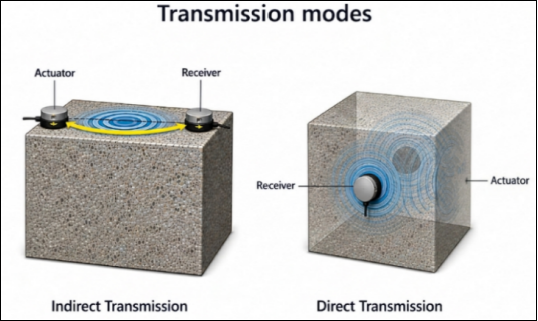
(Miller et al). studied the importance of monitoring early-age compressive strength in concrete, which plays a crucial role in ensuring quality control, safety, and project efficiency. Traditional testing methods often rely on manual data collection, making continuous monitoring in field conditions impractical. To tackle this limitation, the researchers developed an Internet of Things (IoT)-enabled monitoring system capable of monitoring concrete strength development in real time. The system uses temperature-based sensors connected through a long-range wireless communication network, allowing data to be transmitted automatically to a cloud-based platform for storage and analysis. The predicted strength values showed good agreement with laboratory-tested compressive strength results. The study emphasized the potential of IoT-based sensing technologies to automate concrete monitoring and provide continuous strength estimation, which can support rapid decision-making on construction sites by improving accuracy and reducing dependency on manual testing procedures . (Duddi et al.) study explains the application of piezoelectric sensors for in-situ vibroacoustic monitoring of concrete structures to improve early damage detection and prevent structural failures. Embedded piezoelectric sensors were developed that are capable of simultaneously measuring both vibration and acoustic emission signals in concrete. This integrated system allows continuous real-time monitoring of structural behavior from within the material itself. The sensors’ performance was evaluated by comparing their measurements with those obtained from standard acoustic emission sensors and accelerometers. A three-point bending test was conducted on a concrete beam to study crack initiation and propagation. The embedded sensors' results were correlated with crack patterns and strain fields obtained using digital image correlation (DIC). The results demonstrated that the piezoelectric sensors can serve as a reliable and efficient tool for continuous structural health monitoring . (Quah et al.) study explains the use of the electro-mechanical impedance (EMI) technique with embedded piezoelectric sensors for structural health monitoring in 3D-printed concrete elements. The study focuses on observing and tracking changes in electrical impedance, where the variations reflect the mechanical behavior of the structure caused by bending, cracking, or damage. Experimental work on 3D-printed specimens subjected to flexural loading until failure was carried out. The study also investigated how different sensor housing materials and thicknesses affect the performance of the embedded piezoelectric sensors. The study revealed that while protective coatings and housing improve durability, they can also contribute slightly to structural reinforcement. However, protective coatings and housing materials also affect the sensitivity of the sensor, and thicker coatings tend to reduce the sensor's ability to detect damage. Overall, the study demonstrated that despite these limitations, the embedded PZT sensors, in integration with the EMI technique, can effectively identify crack formation and structural changes . (Pham et al.) study investigates the feasibility of using PZT sensors for impedance-based damage monitoring in prestressed concrete anchorage systems. The researchers developed a system in which piezoelectric sensors are integrated within structural components, forming a system referred to as the “smart rebar aggregate” system. This arrangement enables the sensors to directly capture variations in the internal conditions of the concrete, specifically in regions that are difficult to monitor. Both experimental investigations and numerical simulations were carried out on concrete specimens subjected to axial load to evaluate the effectiveness of the proposed method. The variations in electrical impedance responses were analyzed to identify changes related to applied stress and potential damage. Based on these observations, empirical relationships were developed to link impedance with compressive stress levels. The proposed method was further validated through testing on prestressed concrete anchorage at full scale, with embedded sensors placed at different locations. According to the study, the sensors were capable of detecting variations in structural response . (Narayanan and Subramaniam) work emphasizes the application of PZT sensors for continuous monitoring of damage in concrete structures. The researchers adopted a method that involves bonding piezoelectric sensors onto the surface of concrete elements, where the PZT sensors respond to changes in structural condition through variations in their electromechanical behavior. The study focuses on how damage within the concrete, specifically in the form of microcracks, influences the electrical conductance signature of the piezoelectric sensors. According to the observations of the study, as damage progresses, noticeable shifts occur in the resonant peaks of the conductance response. The capability of the method to identify early-stage deterioration is indicated by the changes that can be detected even before visible cracks appear on the surface. The study employs statistical measures such as root mean square deviation (RMSD) to quantify the extent of damage. This parameter correlates well with the level of damage, providing a reliable means of assessment . (Kumar et al.) illustrate an experimental method for evaluating retrofitting effectiveness and detecting damage in reinforced concrete beams using piezoelectric sensors. The study also adopts sustainability by partially replacing cement with refuse-derived fuel (RDF) fly ash, emphasizing the potential of integrating eco-friendly construction materials with structural health monitoring. The monitoring technique adopts the electromechanical impedance method, where changes in the sensor's electrical response are used to identify structural deterioration. The concrete beam specimens were subjected to progressive levels of damage, including concrete chipping, 50% steel bar cutting (partial), and 100% steel bar cutting (complete). The sensor signal changes were analyzed using RMSD analysis and conductance variations to quantify the extent of damage . (Govindaraju and Basha) introduce an IoT-based system developed for real-time monitoring of strength in structural frameworks. The study emphasizes the limitations of conventional testing methods, which are periodic and require destructive sampling, making them less effective for providing timely data on strength progression. To overcome these limitations, the researchers introduced a framework that enables continuous in-situ monitoring. The framework combines electrochemical and fiber optic sensors to capture parameters influencing concrete behavior. Electrochemical sensors track variations in the chemical environment of concrete related to strength development, while fiber optic sensors provide insights into structural response under different conditions by measuring strain and temperature variations. The data collected by these sensors are analyzed using analytical techniques such as the Plowman method and regression curve analysis to detect early-age strength and predict its progression over time. Additionally, the system incorporates wireless communication to transmit data to a cloud-based platform for storage, processing, and visualization. Overall, the study demonstrates that such IoT-enabled monitoring systems can significantly improve quality control and support long-term structural health monitoring . (Narwade and Jadhav) discuss the use of an IoT-based monitoring system integrated with piezoelectric sensors for determining early-age concrete strength and damage detection. Conventional methods for determining strength are often time-consuming and require destructive sampling. The study incorporates piezoelectric sensors attached to the concrete surface using a surface bonding technique. Concrete specimens were tested at 7, 14, and 28 days to track strength development. The sensor data was transmitted through a wireless monitoring system, where the receiver sensor transmits output data to a microcontroller, which further transfers the data to the ThingSpeak platform. The ThingSpeak platform ensures smooth data transfer between the sensors and the microcontroller, such as NodeMCU. The sensor responses were compared with compressive strength results to verify the reliability of the experimental method. Correlation analysis was performed, which showed a strong relationship between compressive strength and amplitude . (Andi et al.) focus on the UPV test as a simple non-destructive method for determining concrete quality. The study compares the direct, semi-direct, and indirect UPV methods to evaluate variations in test results obtained from identical concrete specimens. Reinforced concrete beam specimens of different grades were tested. According to the results obtained from the study, the pulse velocity values of the direct method were invariably lower than those from the indirect and semi-direct methods. These variations in pulse velocity emphasize the influence of the testing method and wave transmission path on UPV measurements. The study developed a regression-based relationship that converts results between different testing methods. The developed equations assist in improving consistency and make interpretation of ultrasonic pulse velocity data easier across different testing methods . The study highlights that the use of correlation and correction factors can improve the accuracy of UPV testing methods. Figure 1 illustrates the transmission modes used in the study.
(Artiyasa et al.) study emphasizes the rapidly developing role of the Internet of Things in enabling smart systems capable of automating everyday tasks. The study particularly focuses on smart home applications, where room lighting is controlled using the ESP8266-based NodeMCU microcontroller. NodeMCU is a compact device that integrates built-in Wi-Fi with processing capability, making it suitable for systems that can be operated through smartphones or laptops . (Nasution and Nusa) studied the application of the Internet of Things for lamp control and monitoring systems to improve energy efficiency, as lamps may remain switched on unnecessarily, leading to energy wastage. To address this problem, the researchers proposed a web-based lighting control system. The system incorporates the NodeMCU ESP8266 microcontroller, which acts as a communication medium between the lighting device and the online monitoring platform. The NodeMCU acquires data and transmits it through Wi-Fi. For visualization and data handling, the researchers integrated ThingSpeak as the cloud-based platform. The ThingSpeak platform receives data from the NodeMCU microcontroller, stores it, and visualizes it through an internet-based dashboard that can be accessed via a website. The smooth interaction between ThingSpeak and NodeMCU enables real-time communication, where sensor information and control commands are continuously exchanged through the Internet .
The correlation coefficient (r or R) is a statistical measure used to describe the relationship between two variables by quantifying the degree of linear association between them. These variables are typically obtained from observed sample data. The coefficient can vary between −1 and +1, where values closer to +1 indicate a strong positive relationship, values closer to −1 represent a strong negative relationship, and a value of 0 suggests that no linear relationship exists between the variables. (Schober et al.) emphasize that among the various types of correlation coefficients, the Pearson correlation coefficient is one of the most commonly used. It is used to evaluate the linear relationship between two continuous variables. Table 1 illustrates the degree to which the variables are related, whether the association is strong or weak .
Figure 1. Transmission modes of PZT sensors.
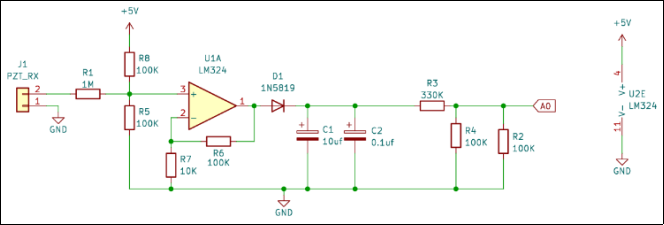
Table 1. Correlation coefficient ranges and their interpretation.

Correlation Coefficient Range (R)

Degree of Relationship

1.00 to 0.90

Very Strong

0.89 to 0.70

Strong

0.69 to 0.40

Moderate

0.39 to 0.10

Weak

0.10 to 0.00

Negligible

Earlier studies primarily focused on integrating Internet of Things (IoT) systems with piezoelectric (PZT) sensors for real-time monitoring of concrete behavior and strength development. Previous investigations, including the study by (Narwade and Jadhav), demonstrated the feasibility of IoT-PZT-based monitoring and established a correlation between amplitude response and compressive strength for conventional concrete grades. However, these studies did not comprehensively examine the influence of different sensor transmission configurations on stress wave propagation and signal response behavior. In contrast, the present study investigates both indirect and direct transmission modes of piezoelectric (PZT) sensors under identical experimental conditions and evaluates their influence on amplitude response characteristics. In addition, correlation analysis between amplitude response and compressive strength was carried out separately for both transmission modes under M40 grade concrete conditions, representing comparatively denser and higher-strength concrete behavior. The use of higher-grade M40 concrete enables the evaluation of stress wave propagation and amplitude response under relatively compact concrete conditions, thereby extending the applicability of IoT-PZT-based monitoring techniques for higher-strength concrete applications. The comparative evaluation of two transmission configurations, along with higher-grade concrete conditions, contributes toward improving the understanding and reliability of IoT-enabled real-time concrete strength monitoring systems.
2. Methodology
This study was carried out to monitor concrete strength using piezoelectric sensors. The system was developed around a single signal processing circuit, as shown in Figure 2: PZT signal-conditioning and data acquisition circuit. The circuit consists of components such as the LM324 operational amplifier, capacitors, resistors, and a Schottky diode for signal rectification and conditioning. The experimental apparatus, shown in Figure 3, consists of a function generator operating at a 10 kHz frequency, the signal processing circuit, a NodeMCU (ESP8266) microcontroller, and a laptop for data acquisition and data monitoring. The selected excitation frequency of 10 kHz was chosen based on preliminary experimental observations, as it provided a stable amplitude response and consistent signal transmission through the concrete specimens without excessive signal attenuation or noise interference. A pair of commercially available Shokitech lead zirconate titanate (PZT) patch sensors, 35 mm in diameter and approximately 0.4 mm in thickness, were used in the study. One sensor acted as an actuator for transmitting the input signal generated from the function generator, while the other sensor acted as a receiver for collecting the output response and transmitting it to the NodeMCU for processing. The sensors were surface-mounted on the concrete specimens using epoxy adhesive to maintain proper contact between the sensor surface and concrete during signal transmission and reception. A uniform manual contact pressure was maintained during sensor attachment to ensure consistent bonding conditions throughout the experimental program. Shielded connecting wires with clip connections were used to minimize external electrical interference and cable-induced noise during data acquisition. Prior to testing, preliminary trial measurements and calibration checks were performed under identical experimental conditions to verify stable signal response and repeatability of the acquired amplitude measurements. Two transmission configurations, as shown in Figure 4, were adopted: direct transmission, where the actuator and receiver were mounted at the center of the concrete specimen on opposite faces, and indirect transmission, where both sensors were placed on the same face of the concrete specimen with a center-to-center spacing of 115 mm. The received signals were processed through the circuit and transmitted to the NodeMCU microcontroller. The ESP8266 board was configured in the development environment, and a communication port was assigned for real-time data acquisition. The processed data was then transmitted wirelessly to the ThingSpeak platform, enabling continuous monitoring, visualization, and analysis of the amplitude response. The developed IoT-enabled framework allowed continuous real-time acquisition and storage of amplitude response data, enabling correlation-based evaluation of concrete strength development during different curing stages without repeated manual measurements.
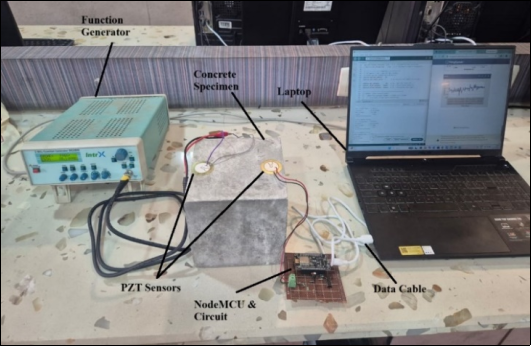
Figure 2. PZT Signal conditioning and data acquisition circuit.
Figure 3. Experimental apparatus.
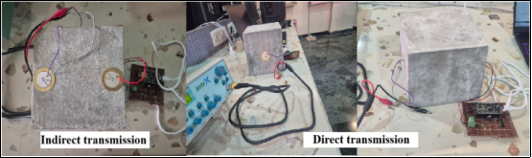
Figure 4. Experimental setup showing indirect and direct transmission configurations of PZT sensors.
In this study, M40 grade concrete was used for preparing concrete specimens. The materials used for casting cube specimens were selected carefully to maintain consistency in experimental results. The mix consisted of coarse aggregates of 10 mm and 20 mm sizes, crushed sand as fine aggregate, Ordinary Portland Cement (OPC 53 grade), fly ash, water, and a chemical admixture (plasticizer) to achieve the desired workability and strength characteristics. The coarse aggregates used in the study were clean and free from visible impurities, while the crushed sand was used to ensure proper particle packing within the concrete matrix. Fly ash was incorporated as a supplementary cementitious material to improve the workability and densification characteristics of concrete. The adopted concrete mix possessed a water-to-binder ratio of 0.38. The detailed mix proportions adopted for the M40 grade concrete are shown in Table 2.
In accordance with the provisions of IS 456:2000 and IS 516:1959, a total of nine cube specimens were cast, each having standard dimensions of 150 mm × 150 mm × 150 mm . For each curing age of 7, 14, and 28 days, three specimens were tested to evaluate the strength development of concrete. After casting, the specimens were demoulded after 24 hours and cured under normal water-curing conditions until the respective testing age. Before carrying out compressive strength testing, the same set of specimens was used for piezoelectric sensor-based measurements under both transmission modes. The IoT-enabled monitoring framework allowed automated acquisition and wireless transmission of sensor response data during different stages of concrete curing. Once the non-destructive readings were recorded, the cubes were tested using a Compressive Testing Machine (CTM). This procedure enabled a direct comparison between the sensor-based measurements and the actual strength values, thereby facilitating correlation analysis.
Table 2. Mix proportion of M40 grade concrete.

Sr. No

Material

kg/m3

By Weight

Volumetric Equivalent

1

Cement (OPC 53 Grade)

430

50 kg

1 bag

2

Fly Ash

115

13.4 kg

8.5 liter

3

Fine Aggregate (Crushed Sand)

777

90.3 kg

58.0 liter

4

Coarse Aggregate (20 mm)

571

66.3 kg

44.5 liter

5

Coarse Aggregate (10 mm)

397

46.1 kg

30.8 liter

6

Water

207

24.0 liter

24.0 liter

7

Admixture (Plasticizer)

6

0.70 liter

0.70 liter

3. Results & Discussions
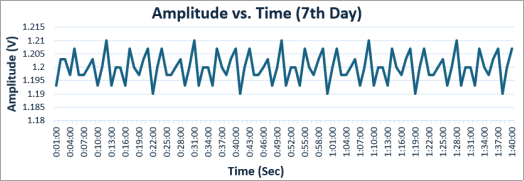
The experimental results obtained from the proposed IoT-enabled monitoring system were examined for both transmission modes at different concrete curing ages, specifically on the 7th, 14th, and 28th days. The acquired response signals were represented graphically by plotting amplitude (V) against time (sec) for each testing condition. Prior to conducting the compressive strength test using the CTM machine, continuous monitoring of each concrete specimen was carried out, and 100 sequential amplitude readings were recorded for each specimen through the same experimental setup. These time-dependent readings were used to study the variation in sensor response with respect to concrete strength gain. The amplitude values presented in Table 3 for the indirect transmission mode represent the mean amplitude obtained from 100 sequential readings recorded for each concrete specimen during the monitoring period. For the indirect transmission mode, comparatively higher amplitude values were observed throughout the testing period. As shown in Figure 5, the readings recorded on the 7th day are mainly within the range of 1.15 to 1.25 V. Similarly, as shown in Figure 6, the readings recorded on the 14th day fall within the range of 1.26 to 1.33 V. A noticeable rise is observed on the 28th day, as shown in Figure 7, where the values vary from 1.40 to 1.48 V.
Table 3. Amplitude values obtained from IoT-enabled testing using indirect transmission mode.

Amplitude (V) Indirect mode

Days

Cube 1

Cube 2

Cube 3

Average

7

1.18

1.2

1.22

1.2

14

1.27

1.32

1.29

1.29

28

1.44

1.41

1.47

1.44

Figure 5. Amplitude vs. time graph for 7ᵗʰ day specimens using indirect transmission mode.
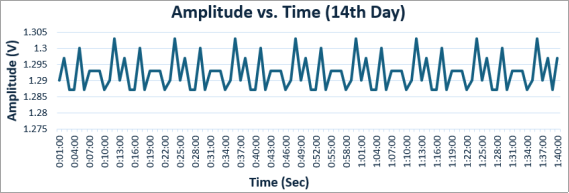
Figure 6. Amplitude vs. time graph for 14th day concrete specimens using indirect transmission mode.
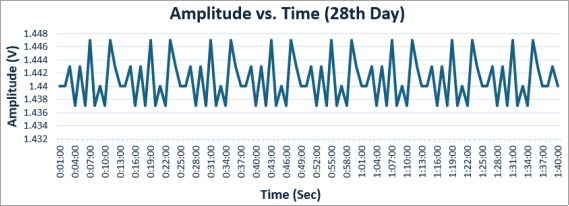
Figure 7. Amplitude vs. time graph for 28th day concrete specimens using indirect transmission mode.
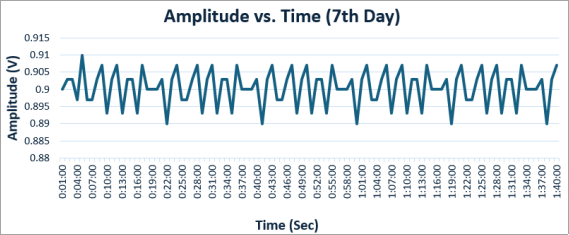
In the direct transmission mode, the amplitude values were relatively lower compared to those observed in the indirect transmission mode. The amplitudes measured on the 7th day were generally within the range of 0.87–0.93 V, as shown in Figure 8. Similarly, as shown in Figure 9, the values recorded on the 14th day increased slightly and were mostly within the range of 0.94 V to 0.98 V. The 28th day readings showed a further increase, with amplitudes varying approximately from 1.09 V to 1.12 V, as shown in Figure 10. The amplitude values presented in Table 4 for the direct transmission mode represent the mean amplitude obtained from 100 sequential readings recorded for each concrete specimen during the monitoring period.
Figure 8. Amplitude vs. time graph for 7th day concrete specimens using direct transmission mode.
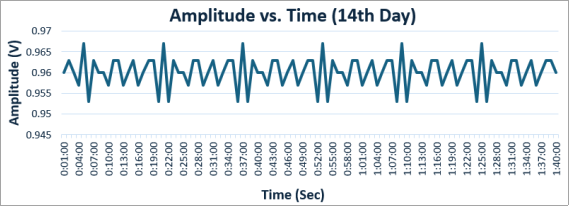
Figure 9. Amplitude vs. time graph for 14th day concrete specimens using direct transmission mode.
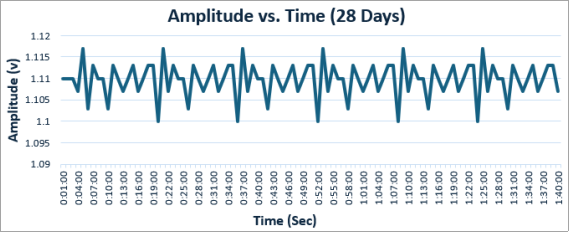
Figure 10. Amplitude vs. time graph for 28th day concrete specimens using direct transmission mode.
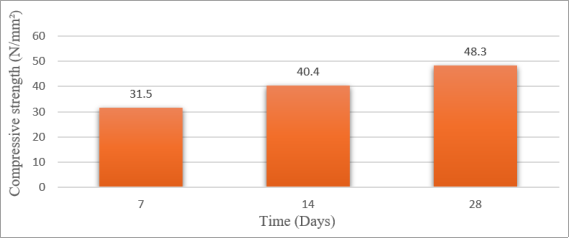
Table 4. Amplitude values obtained from IoT-enabled testing using direct transmission mode.

Amplitude (V) Direct mode

Days

Cube 1

Cube 2

Cube 3

Average

7

0.88

0.9

0.92

0.9

14

0.95

0.95

0.98

0.96

28

1.11

1.1

1.12

1.11

In addition to the IoT-enabled monitoring system, compressive strength testing was carried out using a Compression Testing Machine (CTM) to evaluate the strength development of M40 grade concrete at 7, 14, and 28 days of curing. Three cube specimens of size 150 mm × 150 mm × 150 mm were tested for each curing period, and the average compressive strength values were determined. Prior to testing, the specimen surfaces were cleaned to ensure proper contact between the cube surface and the loading plates of the CTM machine. The compressive strength tests were conducted in accordance with the provisions of IS 516:1959 under a gradual and continuous loading condition until specimen failure . Preliminary calibration checks of the CTM machine were performed before the testing program to ensure reliable load measurements. The CTM results were further compared with the amplitude responses obtained from both transmission modes of the PZT sensors.
According to IS 456:2000, the target mean compressive strength of concrete can be calculated using Equation (1).
fck′=fck+1.65s(1)
where fck' is the target mean compressive strength, fckis the characteristic compressive strength, and s is the standard deviation value recommended in IS 456:2000, taken as 5 N/mm² for M40 grade concrete .
The calculated target mean compressive strength for M40 grade concrete was found to be 48.25 N/mm². The CTM test results are presented in Table 5 and graphically illustrated in Figure 11. A steady increase in compressive strength was observed with curing age, and the average 28th-day compressive strength was found to be 48.3 N/mm², satisfying the required strength criteria for M40 grade concrete.
Table 5. CTM test results of concrete cubes at different curing ages.

Compressive strength (CTM)

Days

Cube 1

Cube 2

Cube 3

Average

7

30.6

31.3

32.5

31.5

14

40.5

39.6

41.2

40.4

28

49.1

48.5

47.2

48.3

Figure 11. CTM test compressive strength results.
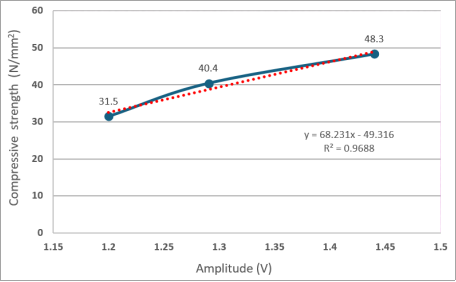
To examine the relationship between sensor amplitude and compressive strength of concrete cubes, regression analysis was carried out using the average values obtained from CTM testing and IoT-enabled monitoring. The graphical plots for both indirect and direct transmission modes are presented in Figure 12 and Figure 13, respectively. In the plots, the solid line represents the experimental observations, whereas the dotted line indicates the regression trendline.
For the indirect transmission mode, a very strong correlation was observed between amplitude and compressive strength, with a coefficient of determination of R² = 0.9688, which was comparatively stronger than that of the direct transmission mode. The regression equation for the indirect transmission mode is expressed in Equation (2).
y = 68.2313 ∙ x + (-49.316)(2)
Similarly, the direct transmission mode also showed a very strong correlation between amplitude and compressive strength. The obtained regression coefficient was R² = 0.9253, indicating a very strong relationship between the sensor response and CTM results, although comparatively weaker than the indirect transmission mode. The regression equation for the direct transmission mode is expressed in Equation (3).
y = 74.7436 ∙ x + (-33.929)(3)
Figure 12. Correlation between amplitude and compressive strength using indirect transmission mode.
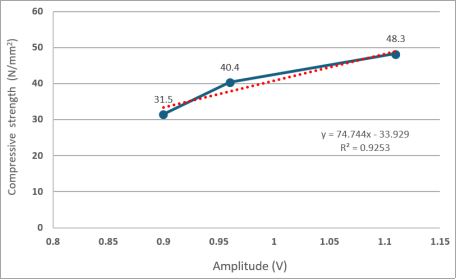
Figure 13. Correlation between amplitude and compressive strength using direct transmission mode.
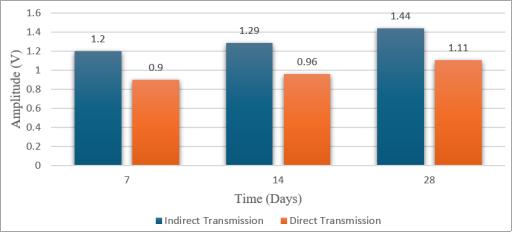
Figure 14. Comparison of amplitude values between direct and indirect transmission modes.

For comparison, the average amplitude values obtained from direct and indirect transmission modes for concrete strength monitoring are presented in Figure 14 using the data summarized in Tables 3 and 4. The results indicate that the indirect transmission mode consistently produced higher amplitude values than the direct transmission mode for the 7th, 14th, and 28th day specimens. The difference between the two transmission configurations was found to vary approximately between 0.30 and 0.33 V.
4. Conclusion
The present study evaluated the feasibility of using piezoelectric (PZT) sensors integrated with an IoT-enabled monitoring system for assessing the strength development of M40 grade concrete. Two different sensor configurations, namely indirect and direct transmission modes, were studied and compared using amplitude response data collected at 7, 14, and 28 days of curing. The experimental observations obtained from the monitoring system were further validated through conventional compressive strength testing using a CTM machine. The average 28th-day compressive strength was found to be 48.3 N/mm², which closely satisfied the calculated target mean compressive strength of 48.25 N/mm² for M40 grade concrete. The developed IoT framework enabled automated real-time acquisition, storage, and remote visualization of amplitude response data during different curing stages, thereby reducing repeated manual monitoring and improving the continuity of strength assessment.
The results obtained from both transmission modes showed a gradual increase in amplitude with the increase in curing age and compressive strength of concrete. This behavior indicates that the propagation characteristics of stress waves are influenced by the internal hardening and densification of concrete. Among the two configurations, the indirect transmission mode produced comparatively higher amplitude values because the actuator and receiver were positioned on the same face of the specimen, resulting in lower signal attenuation. In contrast, the direct transmission mode showed slightly lower amplitude values due to the longer wave travel path through the concrete.
Regression analysis carried out between amplitude and compressive strength demonstrated a very strong positive correlation for both transmission modes. The direct transmission mode yielded an R² value of 0.9253, while the indirect transmission mode exhibited a comparatively stronger correlation with an R² value of 0.9688. The obtained results confirm that both methods are capable of monitoring concrete strength development effectively, although the indirect transmission mode showed better consistency with the CTM results in the present study. The study further demonstrates that IoT-assisted monitoring combined with PZT sensor response can be effectively utilized for continuous non-destructive strength assessment and real-time observation of concrete behavior during the curing period.
Future studies may investigate the applicability of the proposed IoT-enabled PZT monitoring system to different concrete grades and larger structural members under practical field conditions. Further research may also focus on increasing the number of test specimens and monitoring conditions to improve the reliability of the relationship between amplitude response and compressive strength, thereby enhancing the effectiveness of real-time concrete strength assessment.
Abbreviations

PZT

Lead Zirconate Titanate

EMI

Electromechanical Impedance

NDT

Non-Destructive Test

IoT

Internet of Things

DIC

Digital Image Correlation

MCU

Microcontroller Unit

kHz

Kilohertz

CTM

Compression Testing Machine

N/mm2

Newton Per Square Millimetre

OPC

Ordinary Portland Cement

Wi-Fi

Wireless Fidelity

Kg

Kilograms

m3

Cubic Metre

IS

Indian Standard

UPV

Ultrasonic Pulse Velocity

Author Contributions
Yash Janardhan Rasal: Conceptualization, Data curation, Formal Analysis, Investigation, Methodology, Visualization, Writing – original draft
Raju Narwade: Funding acquisition, Project administration, Resources, Software, Supervision, Writing – review & editing
Conflicts of Interest
The authors declare no conflicts of interest.
References
[1] Guo, Y. Analysis on Concrete Construction Technology in Civil Engineering Construction. Journal of Physics Conference Series. 2021, 2011(1), 012023.
[2] Huang, F., Zhang, J., Zhou, G., Gao, H., Li, S. & Fu, M. IoT-Based Quality Control Technology for Concrete Pavement Construction. Advances in Computer and Materials Science Research. 2026, 6(1), 190-200.
[3] Han, G., Su, Y. F., He, R., Huang, C., Kong, Z., Lin, G., Feng, Y. & Lu, N. Real-time concrete strength monitoring using piezoelectric sensors and deep learning. Nature Communications. 2025, 17(1), 473.
[4] Evangelista, A., Arumugam, A. & Abate, M. S. Evaluation of the Parameters Influencing the Results of Non-Destructive Testing Methods for Concrete Strength. Preprints.org. 2025.
[5] Pajalić, A., Dekić, E., Crnkić, H., Muratović, A., Japić, A. & Kozlica, E. Monitoring the development of concrete strength using a sclerometer. 15th International Scientific Conference on Manufacturing Engineering Development and Modernization of Manufacturing, Sarajevo, Bosnia and Herzegovina, 2025, 403-410.
[6] Miller, D., Ho, N. M., Talebian, N. & Javanbakht, Z. Real time Monitoring of Early Age Compressive Strength of Concrete using an IoT enabled Monitoring System: An Investigative Study. Innovative Infrastructure Solutions. 2023, 8(2), 75.
[7] Duddi, M., Kocherla, A. & Subramaniam, K. In-situ Vibroacoustic sensing of Concrete Structures with Embedded Smart PZT Sensors. Preprint. 2024.
[8] Quah, T. K. N., Vo, K., Tay, Y. W. D., Tan, M. J., Wong, T. N. & Li, K. H. H. Real Time Assessment of Smart Concrete Inspection with Piezoelectric Sensors. Electronics. 2023, 12(18), 3762.
[9] Pham, Q. Q., Dang, N. L. & Kim, J. T. Smart PZT-Embedded Sensors for Impedance Monitoring in Prestressed Concrete Anchorage. Sensors. 2021, 21(23), 7918.
[10] Narayanan, A., Subramaniam, K. Damage Assessment in Concrete Structures using PZT patches Damage Assessment in Concrete Structures using PZT patches. 2nd RN Raikar Memorial Intl. Conference & Banthia-Basheer Intl. Symposium on Advances in Science & Technology of Concrete. Mumbai, India.
[11] Kumar, J., Sharma, D., Bansal, T. & Choi, S. J. Monitoring and Retrofitting of Reinforced Concrete Beam Incorporating Refuse-Derived Fuel Fly Ash Through Piezoelectric Sensors. Materials. 2026, 19(2), 432.
[12] Govindaraju, S., Basha, G. T. M. N. A. Real-time concrete strength monitoring: an IoT-enabled framework integrating electrochemical and fiber optic sensors for structural integrity assessment. Revista Matéria. 2025, 30, e20240784.
[13] Narwade, R. P., Jadhav, R. Concrete strength monitoring and damage detection using piezoelectric-based wireless sensor. Challenge Journal of Concrete Research Letters. 2025, 16(1), 40-50.
[14] Andi, M., Baehaki. & Khadafi, D. A. Correlation of reinforcement concrete quality based on variations in UPV testing methods. IOP Conference Series: Materials Science and Engineering. 2019, 673(1), 012043.
[15] Artiyasa, M., Kusumah, I. H., Suryana, A., Edwinanto., Sidik, A. D. W. M. & Junfithrana, A. P. Comparative Study of Internet of Things (IoT) Platform for Smart Home Lighting Control Using NodeMCU with Thingspeak and Blynk Web Applications. Fidelity: Jurnal Teknik Elektro. 2020, 2(1), 1-6.
[16] Nasution, W. S. L., Nusa, P. Implementation of the Internet of Things (IoT) for Remote Light Control using NodeMCU Esp8266 and Thingspeak Via Website-based Internet. Journal of Computer Science and Technology. 2023, 3(1), 33-39.
[17] Schober, P., Boer, C. & Schwarte L. A. Correlation coefficients: Appropriate use and interpretation. Anesthesia & Analgesia. 2018, 126(5), 1763-1768.
[18] IS 516:1959 (1959). Indian Standard Methods of test for Strength of Concrete (Reaffirmed 2004). Bureau of Indian Standards, Manak Bhavan. 9 Bahadur Shah Zafar Marg, New Delhi, India.
[19] IS 456:2000 (2000). Indian Standard Plain and Reinforced Concrete – Code of Practice (Reaffirmed 2005). Bureau of Indian Standards, Manak Bhavan. 9 Bahadur Shah Zafar Marg, New Delhi, India.
Cite This Article
  • APA Style

    Rasal, Y. J., Narwade, R. (2026). Application of IoT-enabled Piezoelectric Sensors for Strength Monitoring of Concrete by Direct and Indirect Transmission. American Journal of Civil Engineering, 14(4), 213-225. https://doi.org/10.11648/j.ajce.20261404.11

    Copy | Download

    ACS Style

    Rasal, Y. J.; Narwade, R. Application of IoT-enabled Piezoelectric Sensors for Strength Monitoring of Concrete by Direct and Indirect Transmission. Am. J. Civ. Eng. 2026, 14(4), 213-225. doi: 10.11648/j.ajce.20261404.11

    Copy | Download

    AMA Style

    Rasal YJ, Narwade R. Application of IoT-enabled Piezoelectric Sensors for Strength Monitoring of Concrete by Direct and Indirect Transmission. Am J Civ Eng. 2026;14(4):213-225. doi: 10.11648/j.ajce.20261404.11

    Copy | Download

  • @article{10.11648/j.ajce.20261404.11,
      author = {Yash Janardhan Rasal and Raju Narwade},
      title = {Application of IoT-enabled Piezoelectric Sensors for Strength Monitoring of Concrete by Direct and Indirect Transmission},
      journal = {American Journal of Civil Engineering},
      volume = {14},
      number = {4},
      pages = {213-225},
      doi = {10.11648/j.ajce.20261404.11},
      url = {https://doi.org/10.11648/j.ajce.20261404.11},
      eprint = {https://article.sciencepublishinggroup.com/pdf/10.11648.j.ajce.20261404.11},
      abstract = {Concrete strength monitoring plays an important role in ensuring the safety and performance of civil engineering structures. Conventional methods used for determining compressive strength are generally destructive in nature and do not allow continuous monitoring of concrete behavior during the curing period. In the present study, an Internet of Things (IoT)-enabled monitoring system using piezoelectric sensors was developed to assess the strength development of M40 grade concrete. Two sensor configurations, namely direct transmission mode and indirect transmission mode, were considered for monitoring the propagation of stress waves through concrete cube specimens. Standard concrete cube specimens measuring 150 mm × 150 mm × 150 mm were prepared and tested at curing ages of 7, 14, and 28 days. A function generator operating at a frequency of 10 kHz was used to excite the actuator sensor, while the received signal was processed through an electronic signal-conditioning circuit consisting of an LM324 operational amplifier and supporting components. The amplitude response obtained from the sensors was transmitted using a NodeMCU ESP8266 module and visualized through the ThingSpeak cloud platform. The compressive strength of the concrete specimens was determined using a Compression Testing Machine (CTM) following completion of the monitoring process. The experimental observations indicated that the amplitude values increased with the gain in concrete strength for both transmission modes. Correlation analysis showed a strong relationship between amplitude response and compressive strength, demonstrating the suitability of the developed IoT-enabled piezoelectric monitoring system for non-destructive concrete strength evaluation.},
     year = {2026}
    }
    

    Copy | Download

  • TY  - JOUR
    T1  - Application of IoT-enabled Piezoelectric Sensors for Strength Monitoring of Concrete by Direct and Indirect Transmission
    AU  - Yash Janardhan Rasal
    AU  - Raju Narwade
    Y1  - 2026/07/08
    PY  - 2026
    N1  - https://doi.org/10.11648/j.ajce.20261404.11
    DO  - 10.11648/j.ajce.20261404.11
    T2  - American Journal of Civil Engineering
    JF  - American Journal of Civil Engineering
    JO  - American Journal of Civil Engineering
    SP  - 213
    EP  - 225
    PB  - Science Publishing Group
    SN  - 2330-8737
    UR  - https://doi.org/10.11648/j.ajce.20261404.11
    AB  - Concrete strength monitoring plays an important role in ensuring the safety and performance of civil engineering structures. Conventional methods used for determining compressive strength are generally destructive in nature and do not allow continuous monitoring of concrete behavior during the curing period. In the present study, an Internet of Things (IoT)-enabled monitoring system using piezoelectric sensors was developed to assess the strength development of M40 grade concrete. Two sensor configurations, namely direct transmission mode and indirect transmission mode, were considered for monitoring the propagation of stress waves through concrete cube specimens. Standard concrete cube specimens measuring 150 mm × 150 mm × 150 mm were prepared and tested at curing ages of 7, 14, and 28 days. A function generator operating at a frequency of 10 kHz was used to excite the actuator sensor, while the received signal was processed through an electronic signal-conditioning circuit consisting of an LM324 operational amplifier and supporting components. The amplitude response obtained from the sensors was transmitted using a NodeMCU ESP8266 module and visualized through the ThingSpeak cloud platform. The compressive strength of the concrete specimens was determined using a Compression Testing Machine (CTM) following completion of the monitoring process. The experimental observations indicated that the amplitude values increased with the gain in concrete strength for both transmission modes. Correlation analysis showed a strong relationship between amplitude response and compressive strength, demonstrating the suitability of the developed IoT-enabled piezoelectric monitoring system for non-destructive concrete strength evaluation.
    VL  - 14
    IS  - 4
    ER  - 

    Copy | Download

Author Information