Abstract
Tropical residual soils constitute the predominant natural foundation and construction materials in many tropical regions of the world, particularly in Nigeria, where they are widely utilized in road construction, building foundations, embankments, and other civil engineering works. Despite their abundance and economic advantages, the engineering performance of these soils varies considerably due to differences in parent rock composition, weathering intensity, climatic conditions, and mineralogical characteristics. Inadequate characterization and improper utilization of these soils have contributed significantly to numerous cases of structural distress, pavement deterioration, and foundation failures. This study investigates the physical, index, and mechanical properties of tropical residual soils collected from selected locations in Edo State, Nigeria, namely Auchi, Ikpeshi, and Igarra, with the objective of assessing their suitability for multipurpose structural and geotechnical applications. Comprehensive laboratory investigations were carried out, including determination of natural moisture content, particle size distribution, Atterberg limits, specific gravity, compaction characteristics, California Bearing Ratio (CBR), and direct shear strength parameters. The results revealed relatively low natural moisture contents ranging from 4.14% to 9.69%, non-plastic to slightly plastic characteristics, satisfactory specific gravity values, and moderate shear strength properties. The soils exhibited varying load-bearing capacities and compaction responses depending on their geological origin and location. Although the materials generally demonstrated acceptable engineering properties for light- to medium-duty construction applications, a noticeable reduction in strength and bearing capacity was observed under soaked conditions, indicating susceptibility to moisture-induced performance deterioration. Consequently, the study emphasizes the importance of adequate compaction, effective drainage systems, and where necessary, soil stabilization measures to enhance long-term performance. The findings provide valuable site-specific geotechnical data and practical recommendations for the sustainable utilization of tropical residual soils in foundation engineering, pavement construction, and other multipurpose infrastructure projects within tropical environments.
|
Published in
|
American Journal of Civil Engineering (Volume 14, Issue 3)
|
|
DOI
|
10.11648/j.ajce.20261403.17
|
|
Page(s)
|
205-212 |
|
Creative Commons
|

This is an Open Access article, distributed under the terms of the Creative Commons Attribution 4.0 International License (http://creativecommons.org/licenses/by/4.0/), which permits unrestricted use, distribution and reproduction in any medium or format, provided the original work is properly cited.
|
|
Copyright
|
Copyright © The Author(s), 2026. Published by Science Publishing Group
|
Keywords
Tropical Residual Soil, Laterite, Geotechnical Properties, CBR, Multipurpose Structures, Edo State
1. Introduction
Tropical residual soils are a significant geological feature found in equatorial regions, characterized by their formation through weathering of underlying bedrock. These soils are shaped by intense heat, heavy rainfall, and biological activity over extended periods. Their composition varies widely but often includes elements like aluminum and iron oxides, giving them distinct red or yellow hues
| [6] | Indrawan, I. G. B., & Rahardjo, H. (2021). Behavior of tropical residual soils under rainfall-induced loading. Engineering Geology, 291, 106232. |
[6]
.
Tropical residual soils are types of soil found in tropical regions, covering over 30% of the Earth’s land surface
| [14] | Yang, X., & Zhu, H. (2022). Laboratory evaluation of shear strength parameters of soils. Geotechnical Testing Journal, 45(4), 1234-1246. |
[14]
. They are soils formed through the weathering of rocks and are characterized by their high content of iron and aluminum oxides, which give them unique physical and mechanical properties
| [10] | Smith, J. A. (2021). Structural performance of foundations on residual soils. Journal of Civil Structural Engineering, 8(2), 55-67. |
[10]
. Tropical residual soils are essential construction material in tropical regions due to their availability, cost-effectiveness, and use
| [2] | Brown, R. E. (2019). Sustainable use of local soils in tropical infrastructure development. Construction Materials, 172(6), 289-298. |
[2]
.
However, tropical residual soil poses significant challenges to construction projects due to their complex behavior under different loading conditions
| [14] | Yang, X., & Zhu, H. (2022). Laboratory evaluation of shear strength parameters of soils. Geotechnical Testing Journal, 45(4), 1234-1246. |
[14]
. Their low strength, high compressibility, and high sensitivity to erosion and landslides make them prone to structural failures, which can result in significant economic losses and human casualties
| [13] | Wang, Y., & Zhang, L. (2023). Mechanical and mineralogical controls on tropical residual soils. Engineering Geology, 313, 106964. |
[13]
.
Furthermore, the lack of standard guidelines and recommendations for the use of tropical residual soils in construction projects exacerbates the problem
| [2] | Brown, R. E. (2019). Sustainable use of local soils in tropical infrastructure development. Construction Materials, 172(6), 289-298. |
[2]
. Multipurpose structures such as buildings, roads, and bridges are critical infrastructure in tropical regions, and their design and construction require a thorough understanding of the soil properties and behavior
| [10] | Smith, J. A. (2021). Structural performance of foundations on residual soils. Journal of Civil Structural Engineering, 8(2), 55-67. |
[10]
. The use of tropical residual soils in these structures can lead to significant cost savings and environmental benefits but also requires careful consideration of their characteristics and limitations
| [10] | Smith, J. A. (2021). Structural performance of foundations on residual soils. Journal of Civil Structural Engineering, 8(2), 55-67. |
[10]
. Despite the importance of tropical residual soils in construction projects, there is a significant knowledge gap in understanding their properties and behavior
| [7] | Jones, B., Robinson, P., & White, K. (2020). Assessment of strength parameters of tropical residual soils. International Journal of Geomechanics, 20(4), 04020028. |
[7]
. Existing research has focused mainly on geotechnical properties of tropical residual soils with limited attention to their suitability for multipurpose structures to address the challenges associated with their use
| [3] | Brown, R. E. (2021). Design challenges associated with tropical residual soils. International Journal of Civil Engineering, 19(2), 175-187. |
[3]
.
The research aims to investigate the physical and mechanical properties of tropical residual soils, evaluate their suitability for multipurpose structures, and develop guidelines for their use in construction projects
| [14] | Yang, X., & Zhu, H. (2022). Laboratory evaluation of shear strength parameters of soils. Geotechnical Testing Journal, 45(4), 1234-1246. |
[14]
. The findings of this research will contribute to the development of sustainable and cost-effective construction practices in tropical regions, reducing the risk of structural failures and improving the overall quality of life
| [13] | Wang, Y., & Zhang, L. (2023). Mechanical and mineralogical controls on tropical residual soils. Engineering Geology, 313, 106964. |
[13]
.
Despite the abundance of tropical residual soils in many parts of the world, their characteristics and behavior are not well understood, resulting to difficulties designing and constructing a multipurpose structure that is not safe, durable and cost-effective. The current lack of comprehensive knowledge on the geotechnical properties of tropical residual soils, particularly their shear strength, settlement behavior and susceptibility to erosion, thus resulting construction challenges such as:
1) Inadequate design and construction practices;
2) increased risk of structural failure and collapses;
3) Higher construction cost due to over design.
This study investigates tropical residual soil characteristics for a multi-purpose structure. It is undertaken in a bid to addressing the challenges inherent in the use of in use tropical residual soil for multi-purpose structure.
Literature Review
The increasing demand for infrastructure development in tropical regions has highlighted the need for a comprehensive understanding of the local soil condition. Tropical residual soil pose significant challenges due to their complex and variable properties. These soils are characterized by high plasticity, compressibility and susceptibility to erosion, which can lead to structural instability and failure
| [14] | Yang, X., & Zhu, H. (2022). Laboratory evaluation of shear strength parameters of soils. Geotechnical Testing Journal, 45(4), 1234-1246. |
[14]
.
Despite their widespread occurrence, tropical residual soils remains poorly understood and their behavior under different loading condition is not well documented. The lack of reliable data and design guidelines for these soils has resulted in costly construction delays, repairs and even catastrophic failures. Therefore it is essential to investigate the characteristics of tropical residual soils to develop appropriate design and construction strategies for multipurpose structures such as buildings, roads and bridges
| [1] | Ali, F. H., & Mohd, N. A. (2022). Performance of residual soils in tropical environments under varying moisture conditions. Soils and Foundations, 62(3), 101-114. |
[1]
. By examining the characteristics of tropical residual soils, this investigation seeks to provide valuable insights for engineers, researchers and policy makers, ultimately contributing to the development of safe, sustainable and resilient infrastructure in tropical regions
| [8] | Oyelami, C. A., Adewumi, J. R., & Adeyemi, G. O. (2022). Compaction and strength characteristics of lateritic soils. International Journal of Pavement Engineering, 23(6), 1879-1892. |
[8]
.
2. Materials and Methods
2.1. Study Area
Soil samples were collected from three locations in Edo State: Auchi (Etsako West LGA), Ikpeshi, and Igarra (Akoko-Edo LGA). Akoko-Edo lies within the Basement Complex terrain dominated by granite and gneiss, while Auchi is located in a sedimentary environment influenced by sandstone and shale formations. These contrasting settings provide a basis for comparative evaluation.
2.2. Sample Collection
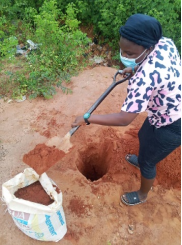
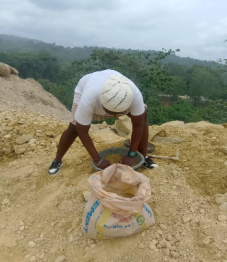
Disturbed soil samples were collected (
Figure 1) at a depth of approximately 1.0 m below ground level to minimize organic influence. The samples were sealed in polythene bags, labeled, and transported to the laboratory for analysis.
Figure 1. Sample Collection (A).
Figure 2. Sample Collection (B).
Figure 3. Sample Collection (C).
2.3. Laboratory Testing
All tests were conducted in accordance with
| [6] | Indrawan, I. G. B., & Rahardjo, H. (2021). Behavior of tropical residual soils under rainfall-induced loading. Engineering Geology, 291, 106232. |
[6]
. The laboratory program included:
Natural moisture content
Moisture content is the ratio of the mass of water in a soil sample to the solid mass of particles in that material, expressed as a percentage (see Equation (
1)).
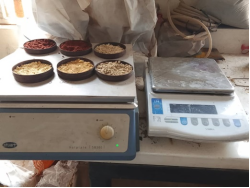
The natural moisture content of each soil sample was determined using the oven-drying method. A representative portion of the soil was weighed and then placed in an oven at 105-110°C for 24 hours. After drying, the sample was re-weighed, and the moisture content was calculated as the ratio of weight loss to the oven-dried weight, expressed as a percentage.
Figure 4. Dry Moisture Content Samples.
1) Atterberg limits
The Atterberg limits tests were conducted to assess the consistency and plasticity characteristics of the soil. The liquid limit was determined using the Casagrande apparatus, where the number of blows required to close a standard groove in a soil paste was recorded. The plastic limit was determined by rolling soil threads until they crumbled at a diameter of 3 mm. The plasticity index was calculated as the difference between the liquid limit and plastic limit. These parameters provide insight into the soil’s compressibility, workability, and susceptibility to volume changes under varying moisture conditions.
2) Sieve Analysis
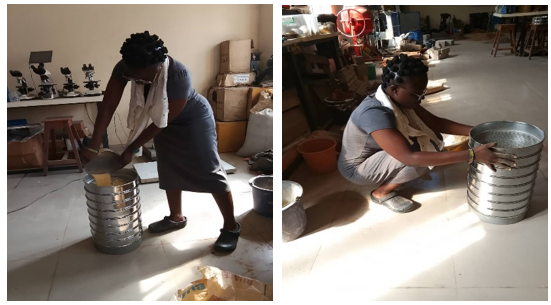
Sieve analysis is a laboratory test used to determine the particle size distribution of a soil sample. It involves passing the soil through a series of sieves with progressively smaller openings to separate the particles into different size fractions
| [15] | Zhong, R., Li, H., & Chen, Y. (2024). Compaction and moisture sensitivity of residual soils in humid climates. Construction and Building Materials, 372, 131699. |
[15]
. The soil was first oven-dried to remove moisture, then placed on a nest of standard sieves and mechanically shaken. The mass of soil retained on each sieve was recorded, and the percentage distribution of different particle sizes was calculated.
Figure 5. Sieving of Soil Samples being Sieved.
3) Specific gravity
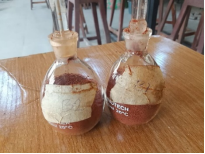
The specific gravity test is a laboratory experiment used to determine the specific gravity (relative density) of soils. Specific gravity is a dimensionless quantity that represents the ratio of the density of a material to the density of water.
The specific gravity of the soil solids was determined using a pycnometer. A known mass of ovendried soil was added to the pycnometer containing distilled water. The volume of water displaced by the soil was measured, and the specific gravity was calculated as the ratio of the mass of the soil solids to the mass of an equal volume of water. Specific gravity is an important parameter used in calculating void ratios, porosity, and compaction characteristics of soils.
Figure 6. Sample in the Density Bottle (Pycnometer) with stopper.
4) Compaction Test
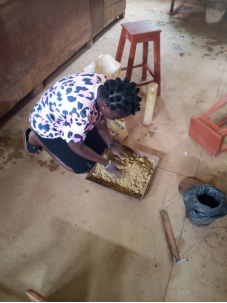
The compaction test is a laboratory procedure used to determine the relationship between the moisture content and the dry density of soil when subjected to a specified compactive effort. In the compaction test, a known weight of soil is mixed with varying amounts of water and compacted in layers inside a mould using a standard rammer. After compaction, the bulk density of each specimen is determined, and the corresponding moisture content is measured. From these results, a graph of dry density against moisture content is plotted to obtain the Maximum Dry Density (MDD) and the Optimum Moisture Content (OMC). The OMC and MDD values provide essential data on the load-bearing capacity, stability, and overall suitability of these soils for multipurpose structures such as foundations, roads, and embankments
| [12] | Smith, P., & Zinnert, J. C. (2023). Particle size distribution and soil behavior. Soil Science Society of America Journal, 87(1), 45-58. |
| [11] | Smith, J. A., & Johnson, L. R. (2022). Knowledge gaps in tropical soil engineering. Geotechnical Engineering Journal, 53(4), 401-415. |
[12, 11]
.
Figure 7. Mixing of Sample in a Tray.
5) California Bearing Ratio (CBR)
The California Bearing Ratio (CBR) test is a penetration test developed by the California Division of Highways to evaluate the strength of soils and aggregate materials used in pavements and foundations. The CBR test was carried out to evaluate the strength and load-bearing capacity of the soil, particularly for pavement and subgrade applications. Soil samples were compacted at their optimum moisture content into a standard mould. Both soaked and unsoaked tests were performed, where a standard plunger was allowed to penetrate the soil at a constant rate, and the corresponding load was measured. The CBR value was then expressed as a percentage of the standard load. This test provides essential data for pavement design and determines the suitability of the soil for supporting multipurpose structures.
6) Direct shear test
The direct shear test is a laboratory test used to determine the shear strength of a soil sample. It involves applying a constant vertical load and measuring the shear stress required to cause failure along a predetermined failure plane
| [11] | Smith, J. A., & Johnson, L. R. (2022). Knowledge gaps in tropical soil engineering. Geotechnical Engineering Journal, 53(4), 401-415. |
| [15] | Zhong, R., Li, H., & Chen, Y. (2024). Compaction and moisture sensitivity of residual soils in humid climates. Construction and Building Materials, 372, 131699. |
[11, 15]
.
A re-molded soil sample was placed in a shear box and subjected to vertical normal stress. Horizontal force was applied until the sample failed along a predetermined plane. The shear stress at failure was recorded and used to compute the shear strength parameters. This test is critical for understanding slope stability, foundation design, and the general behavior of soils under lateral loading.
3. Results and Discussion
3.1. Natural Moisture Content
The soils exhibited low natural moisture contents ranging from 4.14% to 9.69%, consistent with sandy to silty residual soils. These values indicate low susceptibility to volumetric changes, which is advantageous for foundation and pavement applications. The values obtained are presented in the Table below:
Table 1. Average Value of Natural Moisture Content.
Test Name | Red Soil | Yellow Soil | Grey Soil |
Moisture Content (%) | 9.69 | 4.14 | 4.14 |
The values obtained for the three soils (4.14-9.69%) therefore fall within the expected range for sandy or silty soils, confirming their non-plastic, coarse-grained nature as was already shown by the Atterberg limits and compaction test results. The red soil, with the highest natural moisture content of 9.69%, may indicate slightly higher fines or organic matter compared to the others, while the yellow soil, with the lowest value of 4.14%, appears to be the driest and coarser of the three.
3.2. Atterberg Limits
The Atterberg Limit Test was conducted to determine the consistency limits of the soil. The parameters obtained include the Liquid Limit (LL), Plastic Limit (PL) and Plasticity Index (PI), which describe the soil’s plasticity and workability. The values obtained are presented in the Table below:
Table 2. Atterberg Limit Casagrade Method.
Test Name | Red Soil | Yellow Soil | Grey Soil |
Liquid Limit & PI (%) | 16.25. & 16.25 | 11.50. & 11.50 | 13.25. & 13.25 |
With LL values below 20%, the soils are classified by
| [4] | British Standards Institution. (1990). BS 1377: Methods of test for soils for civil engineering purposes. London: BSI. |
[4]
as non-plastic silts or sands. They have low cohesion, low com-pressibility, and minimal volume change, making them stable under moisture variation but weak in strength and prone to erosion. To improve their performance, stabilization, good compaction, and proper drainage are recommended. Overall, the soils show limited natural strength and very low shrinkage potential, consistent with their non-clayey nature.
3.3. Sieve Analysis Test
This test classifies the soil into different fractions (gravel, sand, silt, and clay) and helps assess grading characteristics. The values obtained are presented in the Table below:
Table 3. Weight of Retained Soil in each Sieve.
Sieve size | Red Soil | Grey Soil | Yellow Soil |
4.75 | 21.15 | 50.15 | 24.95 |
3.35 | 19.40 | 82.23 | 35.94 |
2.36 | 31.62 | 71.62 | 32.63 |
1.25 | 73.01 | 89.60 | 45.59 |
0.6 | 460.46 | 246.28 | 293.49 |
0.25 | 355.22 | 392.74 | 541.75 |
0.18 | 20.73 | 37.52 | 11.32 |
0.125 | 9.95 | 17.74 | 8.43 |
Sieve Collector | 8.10 | 11.94 | 4.97 |
According to
| [4] | British Standards Institution. (1990). BS 1377: Methods of test for soils for civil engineering purposes. London: BSI. |
[4]
test procedure, the particle size distribution of the tropical residual soils was determined, and based on the USCS classification system, all three soils fall within the silty sand -sand silt mixtures category. This shows that the soils are predominantly sandy with a notable amount of silt and very little or no clay fraction.
3.4. Specific Gravity
The Specific Gravity Test Was Carried Out to Determine the Ratio of the Weight of Soil Solids to the Weight of an Equal Volume of Water. The Parameter Is Important for Identifying Soil Type, Computing Void Ratio and Degree of Saturation. The Results Obtained Are Presented in the Table below:
Table 4. Specific Gravity Summary & Discussion.
Samples | Laboratory Tests | Experimental Values | BS 1377 Specification |
1 | Specific gravity | 2.36 | 2.60. to 2.80 |
2 | Specific gravity | 2.55 | 2.60. to 2.80 |
3 | Specific gravity | 2.51 | 2.60. to 2.80 |
The specific gravity values obtained for the tropical residual soils were 2.36 for the Red soil, 2.55 for the Grey soil, and 2.51 for the Yellow soil. According to
| [6] | Indrawan, I. G. B., & Rahardjo, H. (2021). Behavior of tropical residual soils under rainfall-induced loading. Engineering Geology, 291, 106232. |
[6]
, the specific gravity of most mineral soils falls within the range of 2.60 to 2.80, with an average of about 2.65. From this comparison, it is clear that the values of the three soils fall below the standard range.
3.5. Compaction Characteristics
This process reduces settlement, decreases permeability, and enhances shear strength. The test results are important for determining the Optimum Moisture Content (OMC) and Maximum Dry Density (MDD), which guide field compaction for stability and strength. The results obtained from compacting the samples are tabulated in
Table 5:
Table 5. Compaction Summary and Discussion.
Samples | Laboratory Tests | Experimental Values | BS 1377 Specification |
1 | OMC and MDD | 7.32% and 2.02g/cm | 5 to 15% and 1.6g/cm to 2.20g/cm |
2 | OMC and MDD | 8.33% and 2.26g/cm | 5 to 15% and 1.6g/cm to 2.20g/cm |
3 | OMC and MDD | 5.99% and 2.26% | 5 to 15% and 1.6g/cm to 2.20g/cm |
These results show that the soils have low OMC and relatively high MDD values, which are desirable for construction purposes. Low OMC means less water is needed to achieve compaction, making them cost-effective in the field, while high MDD indicates good strength and load-bearing capacity. These soils can therefore be considered suitable for use in road subgrades, embankments, and other geotechnical works, though the slightly lower density of the red soil may require additional compactive effort compared to the grey and yellow soils.
3.6. California Bearing Ratio
The California Bearing Ratio (CBR) test was carried out to evaluate the strength of the soil and its suitability for use in pavements and subgrade construction. The values obtained are presented in the Table below:
Table 6. CBR Summary and Discussion.
Samples | Laboratory Tests | Experimental Values | BS 1377 Specification |
1 | CBR | 28 | 20-50 |
2 | CBR | 22 | 20-50 |
3 | CBR | 16 | 20-50 |
In general, the California Bearing Ratio (CBR) is a key test in highway and geotechnical engineering because it provides a direct measure of the strength of soils for use in pavement design. Higher CBR values indicate stronger soils that can withstand heavier traffic loads and require thinner pavement layers, while lower CBR values signify weaker soils that will need thicker pavement sections or stabilisation measures
| [9] | Robinson, P., & White, K. (2019). Sustainable geotechnical practices in tropical construction. Construction and Building Materials, 229, 116885. |
[9]
. In this study, the soils tested produced moderate to high CBR values, confirming that tropical residual soils, despite their non-plastic nature, can still serve as useful subgrade materials. The variations in the results between the red, grey, and yellow soils further demonstrate how soil composition and degree of weathering influence bearing capacity.
3.7. Shear Strength Parameters
The direct shear test was conducted to obtain the shear strength parameters of the soil, namely cohesion (c), and the angle of internal friction (𝜃). The values obtained are presented in the Table below:
Table 7. Shear Strength Summary and Discussion.
Samples | Laboratory Test | Experimental Values (c, q) | BS 1377 Specification (Allowable Bearing Pressure) |
1 | Shear Strength | 2, 39, 85. KN/m2 | 50-200KN/m2 |
2 | Shear Strength | 2, 37, 69.82 KN/m2 | 50-200KN/m2 |
3 | Shear Strength | 2, 36, 62.22 KN/m2 | 50-200KN/m2 |
The shear strength parameters of the tropical residual soils were used to determine their bearing capacities. After applying a factor of safety of 3, the allowable bearing capacities were obtained as 85.03 kN/m
2 for the red soil, 69.82 kN/m
2 for the grey soil, and 62.22 kN/m
2 for the yellow soil. These values fall within the lower range of allowable bearing pressures specified for sandy and silty soils according to
| [4] | British Standards Institution. (1990). BS 1377: Methods of test for soils for civil engineering purposes. London: BSI. |
[4]
, which typically gives values between 50-200 kN/m
2 for such soil types.
In summary, the bearing capacity results confirm that tropical residual soils can serve as foundation materials, but their suitability depends on the degree of weathering and soil texture. The red soil is the most reliable, the grey soil moderately suitable, and the yellow soil the least favorable without treatment. Proper compaction, control of groundwater, or stabilization may be required in practice to enhance performance, especially for the weaker soils
| [5] | Giweta, M. (2020). Role of climate in soil formation: A review. Journal of Earth Science & Climatic Change, 11(3), 1-7. |
[5]
.
4. Conclusion
(i) The results showed that the red, grey, and yellow soils are non-plastic with low natural moisture contents and moderate specific gravity values, indicating low clay content, minimal volume change with moisture variation, and good compaction potential.
(ii) Compaction test results indicated that the soils attained high maximum dry densities at low optimum moisture contents, demonstrating favourable compaction characteristics for construction purposes.
(iii) Based on sieve analysis, the soils were classified as silty sands (SM). The red and grey soils exhibited higher CBR values and bearing capacities, making them suitable for road subgrades, embankments, and shallow foundations, while the yellow soil showed comparatively lower strength and may require improvement before use.
(iv) Despite the generally satisfactory engineering performance, the silty sand nature of the soils makes them susceptible to erosion and strength reduction under saturated conditions. Therefore, adequate drainage provision and appropriate soil stabilization measures are recommended for improved performance in construction applications.\
Abbreviations
SM | Silty Sands |
CBR | California Bearing Ratio |
OMC | Optimum Moisture Content |
MDD | Maximum Dry Density |
Author Contributions
Ibrahim Abdulrazaq Olayinka: Supervision
Eberiga Oremeyi Mercy: Data curation, Methodology
Uchola Victor Onuche: Funding acquisition
John Wasiu: Validation
Obebe Monisola Dorcas: Visualization
Conflicts of Interest
The author(s) declare that there is no conflict of interest.
References
| [1] |
Ali, F. H., & Mohd, N. A. (2022). Performance of residual soils in tropical environments under varying moisture conditions. Soils and Foundations, 62(3), 101-114.
|
| [2] |
Brown, R. E. (2019). Sustainable use of local soils in tropical infrastructure development. Construction Materials, 172(6), 289-298.
|
| [3] |
Brown, R. E. (2021). Design challenges associated with tropical residual soils. International Journal of Civil Engineering, 19(2), 175-187.
|
| [4] |
British Standards Institution. (1990). BS 1377: Methods of test for soils for civil engineering purposes. London: BSI.
|
| [5] |
Giweta, M. (2020). Role of climate in soil formation: A review. Journal of Earth Science & Climatic Change, 11(3), 1-7.
|
| [6] |
Indrawan, I. G. B., & Rahardjo, H. (2021). Behavior of tropical residual soils under rainfall-induced loading. Engineering Geology, 291, 106232.
|
| [7] |
Jones, B., Robinson, P., & White, K. (2020). Assessment of strength parameters of tropical residual soils. International Journal of Geomechanics, 20(4), 04020028.
|
| [8] |
Oyelami, C. A., Adewumi, J. R., & Adeyemi, G. O. (2022). Compaction and strength characteristics of lateritic soils. International Journal of Pavement Engineering, 23(6), 1879-1892.
|
| [9] |
Robinson, P., & White, K. (2019). Sustainable geotechnical practices in tropical construction. Construction and Building Materials, 229, 116885.
|
| [10] |
Smith, J. A. (2021). Structural performance of foundations on residual soils. Journal of Civil Structural Engineering, 8(2), 55-67.
|
| [11] |
Smith, J. A., & Johnson, L. R. (2022). Knowledge gaps in tropical soil engineering. Geotechnical Engineering Journal, 53(4), 401-415.
|
| [12] |
Smith, P., & Zinnert, J. C. (2023). Particle size distribution and soil behavior. Soil Science Society of America Journal, 87(1), 45-58.
|
| [13] |
Wang, Y., & Zhang, L. (2023). Mechanical and mineralogical controls on tropical residual soils. Engineering Geology, 313, 106964.
|
| [14] |
Yang, X., & Zhu, H. (2022). Laboratory evaluation of shear strength parameters of soils. Geotechnical Testing Journal, 45(4), 1234-1246.
|
| [15] |
Zhong, R., Li, H., & Chen, Y. (2024). Compaction and moisture sensitivity of residual soils in humid climates. Construction and Building Materials, 372, 131699.
|
Cite This Article
-
APA Style
Olayinka, I. A., Mercy, E. O., Onuche, U. V., Wasiu, J., Dorcas, O. M. (2026). Characteristics of Tropical Residual Soils for Multipurpose Structural Applications in Edo State, Nigeria. American Journal of Civil Engineering, 14(3), 205-212. https://doi.org/10.11648/j.ajce.20261403.17
 Copy
|
Copy
|
 Download
ACS Style
Olayinka, I. A.; Mercy, E. O.; Onuche, U. V.; Wasiu, J.; Dorcas, O. M. Characteristics of Tropical Residual Soils for Multipurpose Structural Applications in Edo State, Nigeria. Am. J. Civ. Eng. 2026, 14(3), 205-212. doi: 10.11648/j.ajce.20261403.17
Copy
|
Download
AMA Style
Olayinka IA, Mercy EO, Onuche UV, Wasiu J, Dorcas OM. Characteristics of Tropical Residual Soils for Multipurpose Structural Applications in Edo State, Nigeria. Am J Civ Eng. 2026;14(3):205-212. doi: 10.11648/j.ajce.20261403.17
Copy
|
Download
-
@article{10.11648/j.ajce.20261403.17,
  author = {Ibrahim Abdulrazaq Olayinka and Eberiga Oremeyi Mercy and Uchola Victor Onuche and John Wasiu and Obebe Monisola Dorcas},
  title = {Characteristics of Tropical Residual Soils for Multipurpose Structural Applications in Edo State, Nigeria},
  journal = {American Journal of Civil Engineering},
  volume = {14},
  number = {3},
  pages = {205-212},
  doi = {10.11648/j.ajce.20261403.17},
  url = {https://doi.org/10.11648/j.ajce.20261403.17},
  eprint = {https://article.sciencepublishinggroup.com/pdf/10.11648.j.ajce.20261403.17},
  abstract = {Tropical residual soils constitute the predominant natural foundation and construction materials in many tropical regions of the world, particularly in Nigeria, where they are widely utilized in road construction, building foundations, embankments, and other civil engineering works. Despite their abundance and economic advantages, the engineering performance of these soils varies considerably due to differences in parent rock composition, weathering intensity, climatic conditions, and mineralogical characteristics. Inadequate characterization and improper utilization of these soils have contributed significantly to numerous cases of structural distress, pavement deterioration, and foundation failures. This study investigates the physical, index, and mechanical properties of tropical residual soils collected from selected locations in Edo State, Nigeria, namely Auchi, Ikpeshi, and Igarra, with the objective of assessing their suitability for multipurpose structural and geotechnical applications. Comprehensive laboratory investigations were carried out, including determination of natural moisture content, particle size distribution, Atterberg limits, specific gravity, compaction characteristics, California Bearing Ratio (CBR), and direct shear strength parameters. The results revealed relatively low natural moisture contents ranging from 4.14% to 9.69%, non-plastic to slightly plastic characteristics, satisfactory specific gravity values, and moderate shear strength properties. The soils exhibited varying load-bearing capacities and compaction responses depending on their geological origin and location. Although the materials generally demonstrated acceptable engineering properties for light- to medium-duty construction applications, a noticeable reduction in strength and bearing capacity was observed under soaked conditions, indicating susceptibility to moisture-induced performance deterioration. Consequently, the study emphasizes the importance of adequate compaction, effective drainage systems, and where necessary, soil stabilization measures to enhance long-term performance. The findings provide valuable site-specific geotechnical data and practical recommendations for the sustainable utilization of tropical residual soils in foundation engineering, pavement construction, and other multipurpose infrastructure projects within tropical environments.},
 year = {2026}
}
Copy
|
Download
-
TY  - JOUR
T1  - Characteristics of Tropical Residual Soils for Multipurpose Structural Applications in Edo State, Nigeria
AU  - Ibrahim Abdulrazaq Olayinka
AU  - Eberiga Oremeyi Mercy
AU  - Uchola Victor Onuche
AU  - John Wasiu
AU  - Obebe Monisola Dorcas
Y1  - 2026/06/30
PY  - 2026
N1  - https://doi.org/10.11648/j.ajce.20261403.17
DO  - 10.11648/j.ajce.20261403.17
T2  - American Journal of Civil Engineering
JF  - American Journal of Civil Engineering
JO  - American Journal of Civil Engineering
SP  - 205
EP  - 212
PB  - Science Publishing Group
SN  - 2330-8737
UR  - https://doi.org/10.11648/j.ajce.20261403.17
AB  - Tropical residual soils constitute the predominant natural foundation and construction materials in many tropical regions of the world, particularly in Nigeria, where they are widely utilized in road construction, building foundations, embankments, and other civil engineering works. Despite their abundance and economic advantages, the engineering performance of these soils varies considerably due to differences in parent rock composition, weathering intensity, climatic conditions, and mineralogical characteristics. Inadequate characterization and improper utilization of these soils have contributed significantly to numerous cases of structural distress, pavement deterioration, and foundation failures. This study investigates the physical, index, and mechanical properties of tropical residual soils collected from selected locations in Edo State, Nigeria, namely Auchi, Ikpeshi, and Igarra, with the objective of assessing their suitability for multipurpose structural and geotechnical applications. Comprehensive laboratory investigations were carried out, including determination of natural moisture content, particle size distribution, Atterberg limits, specific gravity, compaction characteristics, California Bearing Ratio (CBR), and direct shear strength parameters. The results revealed relatively low natural moisture contents ranging from 4.14% to 9.69%, non-plastic to slightly plastic characteristics, satisfactory specific gravity values, and moderate shear strength properties. The soils exhibited varying load-bearing capacities and compaction responses depending on their geological origin and location. Although the materials generally demonstrated acceptable engineering properties for light- to medium-duty construction applications, a noticeable reduction in strength and bearing capacity was observed under soaked conditions, indicating susceptibility to moisture-induced performance deterioration. Consequently, the study emphasizes the importance of adequate compaction, effective drainage systems, and where necessary, soil stabilization measures to enhance long-term performance. The findings provide valuable site-specific geotechnical data and practical recommendations for the sustainable utilization of tropical residual soils in foundation engineering, pavement construction, and other multipurpose infrastructure projects within tropical environments.
VL  - 14
IS  - 3
ER  -
Copy
|
Download





 Share This Article
 Twitter
 Linked In
 Facebook