
The production of ordinary Portland cement (OPC) is associated with substantial CO2 emissions, while reinforced concrete structures exposed to marine or deicing-salt environments require improved resistance to chloride-induced deterioration. Although supplementary cementitious materials (SCMs) and fine mineral powder (FMP) have been used to reduce cement consumption, further clarification is needed regarding how binder composition and curing condition jointly influence strength development, shrinkage, carbonation, chloride binding, and chloride transport. This study investigated the mechanical properties and chloride penetration resistance of low-carbon concrete with blended binder systems incorporating ground granulated blast-furnace slag (GGBS), fly ash (FA), silica fume (SF), and FMP. Concrete mixtures with design compressive strength levels of 30 and 45 MPa were prepared using OPC, GGBS, and FA binder systems with FMP substitution, and an 80 MPa ternary binder mixture containing FA and SF was also examined. The experimental program included compressive strength, flexural strength, splitting tensile strength, static modulus of elasticity, drying shrinkage, accelerated carbonation, salt-water immersion, water-soluble chloride, total chloride, chloride binding ratio, and apparent chloride diffusion coefficient evaluations. The results showed that FMP substitution increased compressive strength, reduced carbonation rate coefficients, increased chloride binding ratio, and decreased the apparent diffusion coefficient, particularly in blended binder systems. These findings indicate that optimized blended binder systems can contribute to low-carbon concrete with enhanced durability in chloride-bearing environments, provided that mechanical performance, dimensional stability, carbonation resistance, and chloride binding capacity are considered together.
| Published in | American Journal of Civil Engineering (Volume 14, Issue 3) |
| DOI | 10.11648/j.ajce.20261403.16 |
| Page(s) | 193-204 |
| Creative Commons |
This is an Open Access article, distributed under the terms of the Creative Commons Attribution 4.0 International License (http://creativecommons.org/licenses/by/4.0/), which permits unrestricted use, distribution and reproduction in any medium or format, provided the original work is properly cited. |
| Copyright |
Copyright © The Author(s), 2026. Published by Science Publishing Group |
Low-carbon Concrete, Blended Binder Systems, Supplementary Cementitious Materials, Fine Mineral Powder, Chloride Penetration Resistance, Carbonation Resistance, Durability
Material | Symbol | Density (g/cm3) | F.M. |
|---|---|---|---|
Ordinary Portland cement | OPC | 3.16 | - |
Blast-furnace slag fine powder | GGBS | 2.91 | - |
Fly ash, Type II | FA | 2.28 | - |
Silica fume | SF | 2.25 | - |
Fine mineral powder | FMP | 2.37 | - |
Sea sand | S | 2.57 | 2.51 |
Crushed stone | CA | 2.92 | 6.60 |
High-range water-reducing admixture | HRWRA | 1.05 | - |
Material | SiO2 | Al2O3 | Fe2O3 | CaO |
|---|---|---|---|---|
GGBS | 27.9 | 11.6 | 0.27 | 39.3 |
FA | 49.4 | 18.1 | 4.03 | 2.51 |
SF | 84.4 | 0.51 | 0.52 | 0.18 |
FMP | 57.9 | 29.2 | 0.63 | 0.06 |
Fc (MPa) | Mixture ID | W/B (%) | s/a | W | C | GGBS | FA | SF | FMP | S | CA | SL/Sf (cm) | Air (%) | C.T. (°C) | Cl- (kg/m3) |
|---|---|---|---|---|---|---|---|---|---|---|---|---|---|---|---|
30 | C30-OPC | 48 | 41.3 | 165 | 324 | - | - | - | 20 | 748 | 1206 | 9.5 | 1.9 | 29.0 | 0.076 |
30 | C30-GGBS | 46 | 40.7 | 165 | 231 | 108 | - | - | 20 | 728 | 1206 | 11.0 | 1.0 | 30.0 | 0.083 |
30 | C30-FA | 40 | 38.2 | 165 | 297 | - | 100 | - | 20 | 657 | 1206 | 12.5 | 1.8 | 26.0 | 0.065 |
45 | C45-OPC | 37 | 38.5 | 165 | 426 | - | - | - | 20 | 665 | 1206 | 12.5 | 1.1 | 26.0 | 0.080 |
45 | C45-GGBS | 35 | 37.4 | 165 | 310 | 141 | - | - | 20 | 634 | 1206 | 13.0 | 1.7 | 25.0 | 0.064 |
45 | C45-FA | 32 | 35.2 | 165 | 396 | - | 100 | - | 20 | 577 | 1206 | 14.5 | 1.6 | 25.0 | 0.030 |
80 | C80-FA-SF | 25 | 44.9 | 150 | 450 | - | 90 | 60 | - | 724 | 1008 | 65.5 | 1.2 | 30.0 | 0.032 |
Category | Test item | Test method |
|---|---|---|
Mechanical properties | Compressive strength | ASTM C39/C39M |
Flexural strength | ASTM C78/C78M | |
Splitting tensile strength | ASTM C496/C496M | |
Static modulus of elasticity | ASTM C469/C469M | |
Durability | Drying shrinkage | ASTM C157/C157M |
Accelerated carbonation | EN 12390-12:2020 | |
Apparent diffusion coefficient of chloride ion | ASTM C1556 | |
Water-soluble chloride content | ASTM C1218/C1218M | |
Acid-soluble chloride content / total chloride content | ASTM C1152/C1152M |
Type | Property | Value at 1 d | Value at 14 d | Value at 28 d | Increase at 1 d (%) | Increase at 14 d (%) | Increase at 28 d (%) |
|---|---|---|---|---|---|---|---|
C30-OPC-W | fc | - | 53.4 | 61.1 | - | 33.6 | 38.2 |
C30-OPC-W | fb | - | 6.00 | 7.17 | - | 10.6 | 11.6 |
C30-OPC-W | fst | - | 3.73 | 4.69 | - | 6.7 | 35.3 |
C30-OPC-W | Ec | - | 39.9 | 44.4 | - | 12.8 | 21.6 |
C30-OPC-S | fc | 24.7 | 49.1 | 55.2 | 40.2 | 43.1 | 53.2 |
C30-OPC-S | fb | - | 5.47 | 4.96 | - | 55.4 | 4.8 |
C30-OPC-S | fst | - | 3.86 | 3.73 | - | 44.0 | 11.3 |
C30-OPC-S | Ec | - | 38.0 | 41.4 | - | 23.1 | 26.6 |
C30-GGBS-W | fc | - | 62.4 | 70.6 | - | 33.3 | 35.0 |
C30-GGBS-W | fb | - | 7.27 | 8.17 | - | 22.3 | 34.8 |
C30-GGBS-W | fst | - | 4.16 | 5.00 | - | 15.2 | 28.1 |
C30-GGBS-W | Ec | - | 42.5 | 44.3 | - | 18.1 | 16.1 |
C30-GGBS-S | fc | 25.2 | 57.1 | 60.7 | 55.8 | 58.3 | 61.5 |
C30-GGBS-S | fb | - | 4.53 | 5.33 | - | 22.7 | 24.8 |
C30-GGBS-S | fst | - | 3.70 | 4.10 | - | 37.4 | 42.0 |
C30-GGBS-S | Ec | - | 42.1 | 38.2 | - | 34.8 | 19.6 |
C30-FA-W | fc | - | 58.1 | 66.1 | - | 32.1 | 33.3 |
C30-FA-W | fb | - | 6.51 | 7.11 | - | 14.9 | 25.3 |
C30-FA-W | fst | - | 4.25 | 4.79 | - | 46.2 | 48.7 |
C30-FA-W | Ec | - | 41.9 | 45.8 | - | 9.3 | 18.3 |
C30-FA-S | fc | 27.1 | 52.5 | 55.9 | 33.0 | 38.8 | 39.3 |
C30-FA-S | fb | - | 4.45 | 4.68 | - | 7.6 | 9.5 |
C30-FA-S | fst | - | 3.45 | 4.03 | - | 23.3 | 41.8 |
C30-FA-S | Ec | - | 36.5 | 36.7 | - | 10.5 | 7.6 |
C80-FA-SF-W | fc | - | 95.6 | 116 | - | - | - |
C80-FA-SF-W | Ec | - | 47.7 | 49.5 | - | - | - |
Type | Property | Value at 1 d | Value at 14 d | Value at 28 d | Increase at 1 d (%) | Increase at 14 d (%) | Increase at 28 d (%) |
|---|---|---|---|---|---|---|---|
C45-OPC-W | fc | - | 70.5 | 77.5 | - | 33.1 | 34.5 |
C45-OPC-W | fb | - | 7.03 | 8.35 | - | 16.4 | 22.6 |
C45-OPC-W | fst | - | 4.29 | 4.80 | - | 17.4 | 20.1 |
C45-OPC-W | Ec | - | 43.6 | 45.1 | - | 7.4 | 6.6 |
C45-OPC-S | fc | 34.9 | 62.4 | 69.4 | 40.0 | 43.2 | 40.7 |
C45-OPC-S | fb | - | 5.03 | 5.20 | - | 13.0 | 9.6 |
C45-OPC-S | fst | - | 4.08 | 4.28 | - | 29.4 | 31.0 |
C45-OPC-S | Ec | - | 42.1 | 42.3 | - | 17.7 | 6.1 |
C45-GGBS-W | fc | - | 78.1 | 83.5 | - | 18.7 | 20.2 |
C45-GGBS-W | fb | - | 8.93 | 9.69 | - | 22.9 | 23.2 |
C45-GGBS-W | fst | - | 4.90 | 5.61 | - | 12.5 | 12.7 |
C45-GGBS-W | Ec | - | 44.1 | 45.7 | - | 3.2 | 2.4 |
C45-GGBS-S | fc | 34.6 | 71.4 | 75.5 | 28.1 | 35.5 | 31.2 |
C45-GGBS-S | fb | - | 5.26 | 4.96 | - | 15.3 | -7.1 |
C45-GGBS-S | fst | - | 4.28 | 4.45 | - | 18.5 | 18.8 |
C45-GGBS-S | Ec | - | 41.2 | 41.4 | - | 12.3 | 5.6 |
C45-FA-W | fc | - | 68.9 | 76.8 | - | 22.5 | 19.2 |
C45-FA-W | fb | - | 7.17 | 8.67 | - | 39.4 | 21.3 |
C45-FA-W | fst | - | 4.68 | 4.91 | - | 28.8 | 23.7 |
C45-FA-W | Ec | - | 45.2 | 44.7 | - | 20.0 | 8.2 |
C45-FA-S | fc | 36.1 | 60.2 | 66.1 | 40.6 | 26.7 | 28.3 |
C45-FA-S | fb | - | 4.33 | 4.50 | - | -0.7 | -9.6 |
C45-FA-S | fst | - | 3.78 | 4.39 | - | 19.2 | 18.1 |
C45-FA-S | Ec | - | 43.4 | 39.8 | - | 20.8 | 7.9 |
C80-FA-SF-C | fc | 31.1 | 101 | 105 | - | - | - |
C80-FA-SF-C | Ec | - | 46.2 | 48.4 | - | - | - |
| [1] | Scrivener, K. L., John, V. M., and Gartner, E. M., Eco-efficient cements: Potential economically viable solutions for a low-CO2 cement-based materials industry, Cement and Concrete Research, Vol. 114, pp. 2-26, 2018. |
| [2] | Flower, D. J. M., and Sanjayan, J. G., Greenhouse gas emissions due to concrete manufacture, The International Journal of Life Cycle Assessment, Vol. 12, No. 5, pp. 282-288, 2007. |
| [3] | Lothenbach, B., Scrivener, K., and Hooton, R. D., Supplementary cementitious materials, Cement and Concrete Research, Vol. 41, No. 12, pp. 1244-1256, 2011. |
| [4] | Bentz, D. P., Ferraris, C. F., Jones, S. Z., Lootens, D., and Zunino, F., Limestone and silica powder replacements for cement: Early-age performance, Cement and Concrete Composites, Vol. 78, pp. 43-56, 2017. |
| [5] | Thomas, M. D. A., and Bamforth, P. B., Modelling chloride diffusion in concrete: Effect of fly ash and slag, Cement and Concrete Research, Vol. 29, No. 4, pp. 487-495, 1999. |
| [6] | Papadakis, V. G., Effect of supplementary cementing materials on concrete resistance against carbonation and chloride ingress, Cement and Concrete Research, Vol. 30, No. 2, pp. 291-299, 2000. |
| [7] | Thomas, M. D. A., Hooton, R. D., Scott, A., and Zibara, H., The effect of supplementary cementitious materials on chloride binding in hardened cement paste, Cement and Concrete Research, Vol. 42, No. 1, pp. 1-7, 2012. |
| [8] | Zhang, T., and Gjørv, O. E., Diffusion behavior of chloride ions in concrete, Cement and Concrete Research, Vol. 26, No. 6, pp. 907-917, 1996. |
| [9] | Glass, G. K., and Buenfeld, N. R., The presentation of the chloride threshold level for corrosion of steel in concrete, Corrosion Science, Vol. 39, No. 5, pp. 1001-1013, 1997. |
| [10] | Sanjuán, M. Á., Estévez, E., Argiz, C., and del Barrio, D., Chloride diffusion in concrete made with coal fly ash, ternary and ground granulated blast-furnace slag Portland cements, Materials, Vol. 15, No. 24, Article 8914, 2022. |
| [11] | von Greve-Dierfeld, S., Lothenbach, B., Vollpracht, A., et al., Understanding the carbonation of concrete with supplementary cementitious materials: A critical review by RILEM TC 281-CCC, Materials and Structures, Vol. 53, Article 136, 2020. |
| [12] | Gjørv, O. E., Durability Design of Concrete Structures in Severe Environments, 2nd ed., CRC Press, Boca Raton, 2014. |
| [13] | Mehta, P. K., and Monteiro, P. J. M., Concrete: Microstructure, Properties, and Materials, 4th ed., McGraw-Hill Education, New York, 2014. |
| [14] | Neville, A. M., Properties of Concrete, 5th ed., Pearson Education, Harlow, 2011. |
| [15] | ACI Committee 222, Protection of Metals in Concrete Against Corrosion, ACI 222R-19, American Concrete Institute, Farmington Hills, MI, 2019. |
| [16] | ASTM International, ASTM C39/C39M: Standard Test Method for Compressive Strength of Cylindrical Concrete Specimens, ASTM International, West Conshohocken, PA. |
| [17] | ASTM International, ASTM C1556: Standard Test Method for Determining the Apparent Chloride Diffusion Coefficient of Cementitious Mixtures by Bulk Diffusion, ASTM International, West Conshohocken, PA. |
| [18] | EN 12390-12, Testing Hardened Concrete - Part 12: Determination of the Carbonation Resistance of Concrete - Accelerated Carbonation Method, European Committee for Standardization, Brussels, 2020. |
| [19] | Bernal, S. A., Dhandapani, Y., Elakneswaran, Y., et al., Report of RILEM TC 281-CCC: A critical review of the standardised testing methods to determine carbonation resistance of concrete, Materials and Structures, Vol. 57, Article 173, 2024. |
| [20] | Abd El-Fattah, H., Abd El-Zaher, Y., and Kohail, M., A study of chloride binding capacity of concrete containing supplementary cementitious materials, Scientific Reports, Vol. 14, Article 12970, 2024. |
| [21] | Georget, F., Babaahmadi, A., Machner, A., et al., Measuring chloride binding in cementitious materials: A review by RILEM TC 298-EBD, Materials and Structures, Vol. 58, Article 348, 2025. |
| [22] | De Weerdt, K., Chloride binding in concrete: Recent investigations and recognised knowledge gaps, Materials and Structures, Vol. 54, Article 214, 2021. |
| [23] | Sui, S., Wilson, W., Georget, F., Maraghechi, H., Kazemi-Kamyab, H., Sun, W., and Scrivener, K., Quantification methods for chloride binding in Portland cement and limestone systems, Cement and Concrete Research, Vol. 125, 105864, 2019. |
| [24] | Babaahmadi, A., Machner, A., Kunther, W., Figueira, J., Hemstad, P., and De Weerdt, K., Chloride binding in Portland composite cements containing metakaolin and silica fume, Cement and Concrete Research, Vol. 161, 106924, 2022. |
APA Style
Kim, N. W., Ryu, S. S. (2026). Mechanical Properties and Chloride Penetration Resistance of Low-Carbon Concrete with Blended Binder Systems. American Journal of Civil Engineering, 14(3), 193-204. https://doi.org/10.11648/j.ajce.20261403.16
ACS Style
Kim, N. W.; Ryu, S. S. Mechanical Properties and Chloride Penetration Resistance of Low-Carbon Concrete with Blended Binder Systems. Am. J. Civ. Eng. 2026, 14(3), 193-204. doi: 10.11648/j.ajce.20261403.16
@article{10.11648/j.ajce.20261403.16,
  author = {Nam Wook Kim and Seung Soo Ryu},
  title = {Mechanical Properties and Chloride Penetration Resistance of Low-Carbon Concrete with Blended Binder Systems},
  journal = {American Journal of Civil Engineering},
  volume = {14},
  number = {3},
  pages = {193-204},
  doi = {10.11648/j.ajce.20261403.16},
  url = {https://doi.org/10.11648/j.ajce.20261403.16},
  eprint = {https://article.sciencepublishinggroup.com/pdf/10.11648.j.ajce.20261403.16},
  abstract = {The production of ordinary Portland cement (OPC) is associated with substantial CO2 emissions, while reinforced concrete structures exposed to marine or deicing-salt environments require improved resistance to chloride-induced deterioration. Although supplementary cementitious materials (SCMs) and fine mineral powder (FMP) have been used to reduce cement consumption, further clarification is needed regarding how binder composition and curing condition jointly influence strength development, shrinkage, carbonation, chloride binding, and chloride transport. This study investigated the mechanical properties and chloride penetration resistance of low-carbon concrete with blended binder systems incorporating ground granulated blast-furnace slag (GGBS), fly ash (FA), silica fume (SF), and FMP. Concrete mixtures with design compressive strength levels of 30 and 45 MPa were prepared using OPC, GGBS, and FA binder systems with FMP substitution, and an 80 MPa ternary binder mixture containing FA and SF was also examined. The experimental program included compressive strength, flexural strength, splitting tensile strength, static modulus of elasticity, drying shrinkage, accelerated carbonation, salt-water immersion, water-soluble chloride, total chloride, chloride binding ratio, and apparent chloride diffusion coefficient evaluations. The results showed that FMP substitution increased compressive strength, reduced carbonation rate coefficients, increased chloride binding ratio, and decreased the apparent diffusion coefficient, particularly in blended binder systems. These findings indicate that optimized blended binder systems can contribute to low-carbon concrete with enhanced durability in chloride-bearing environments, provided that mechanical performance, dimensional stability, carbonation resistance, and chloride binding capacity are considered together.},
 year = {2026}
}
TY  - JOUR
T1  - Mechanical Properties and Chloride Penetration Resistance of Low-Carbon Concrete with Blended Binder Systems
AU  - Nam Wook Kim
AU  - Seung Soo Ryu
Y1  - 2026/06/29
PY  - 2026
N1  - https://doi.org/10.11648/j.ajce.20261403.16
DO  - 10.11648/j.ajce.20261403.16
T2  - American Journal of Civil Engineering
JF  - American Journal of Civil Engineering
JO  - American Journal of Civil Engineering
SP  - 193
EP  - 204
PB  - Science Publishing Group
SN  - 2330-8737
UR  - https://doi.org/10.11648/j.ajce.20261403.16
AB  - The production of ordinary Portland cement (OPC) is associated with substantial CO2 emissions, while reinforced concrete structures exposed to marine or deicing-salt environments require improved resistance to chloride-induced deterioration. Although supplementary cementitious materials (SCMs) and fine mineral powder (FMP) have been used to reduce cement consumption, further clarification is needed regarding how binder composition and curing condition jointly influence strength development, shrinkage, carbonation, chloride binding, and chloride transport. This study investigated the mechanical properties and chloride penetration resistance of low-carbon concrete with blended binder systems incorporating ground granulated blast-furnace slag (GGBS), fly ash (FA), silica fume (SF), and FMP. Concrete mixtures with design compressive strength levels of 30 and 45 MPa were prepared using OPC, GGBS, and FA binder systems with FMP substitution, and an 80 MPa ternary binder mixture containing FA and SF was also examined. The experimental program included compressive strength, flexural strength, splitting tensile strength, static modulus of elasticity, drying shrinkage, accelerated carbonation, salt-water immersion, water-soluble chloride, total chloride, chloride binding ratio, and apparent chloride diffusion coefficient evaluations. The results showed that FMP substitution increased compressive strength, reduced carbonation rate coefficients, increased chloride binding ratio, and decreased the apparent diffusion coefficient, particularly in blended binder systems. These findings indicate that optimized blended binder systems can contribute to low-carbon concrete with enhanced durability in chloride-bearing environments, provided that mechanical performance, dimensional stability, carbonation resistance, and chloride binding capacity are considered together.
VL  - 14
IS  - 3
ER  -
Department of Civil Engineering, Joongbu University, Goyang, Republic of Korea
Soo Engineering Co., Cheonan, Republic of Korea
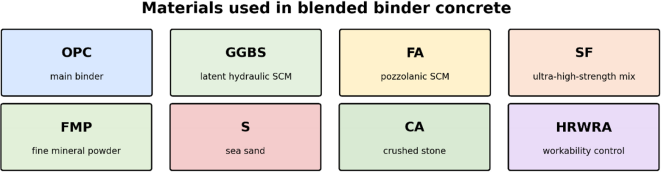
Figure 1. Materials and binder components used in this study.

Figure 2. Schematic flow of the experimental program.
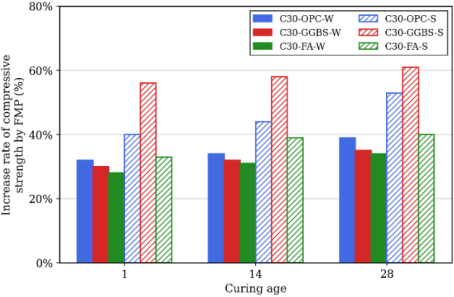
Figure 3. Increase rate of compressive strength by FMP for C30 mixtures.
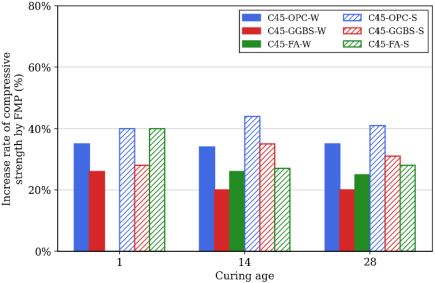
Figure 4. Increase rate of compressive strength by FMP for C45 mixtures.
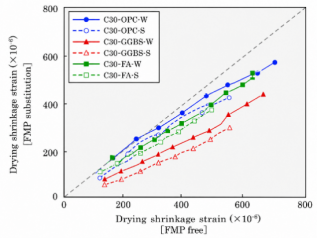
Figure 5. Relationship between drying shrinkage strain of FMP-free and FMP-substituted C30 mixtures.
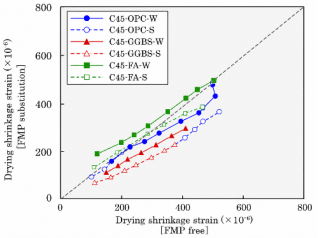
Figure 6. Relationship between drying shrinkage strain of FMP-free and FMP-substituted C45 mixtures.
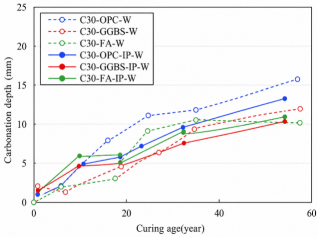
Figure 7. Carbonation depth of C30 mixtures under standard curing.
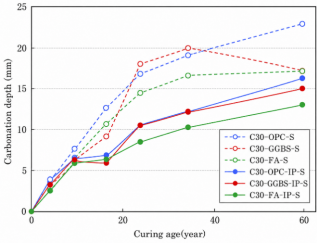
Figure 8. Carbonation depth of C30 mixtures under steam curing.
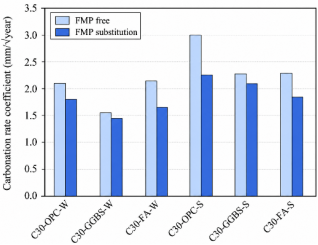
Figure 9. Carbonation rate coefficient of C30 mixtures with and without FMP substitution.
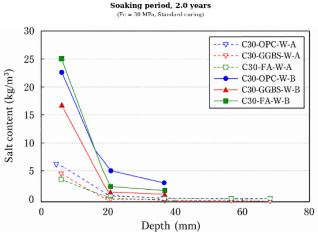
Figure 10. Salt content profile after 2.0-year soaking for C30 mixtures under standard curing.
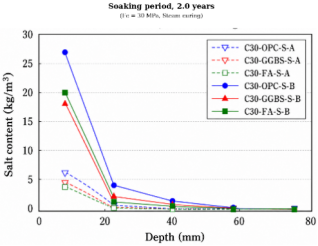
Figure 11. Salt content profile after 2.0-year soaking for C30 mixtures under steam curing.
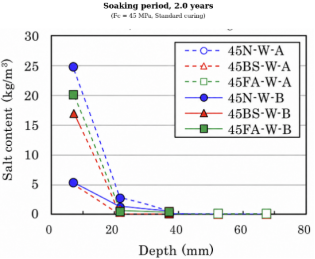
Figure 12. Salt content profile after 2.0-year soaking for C45 mixtures under standard curing.
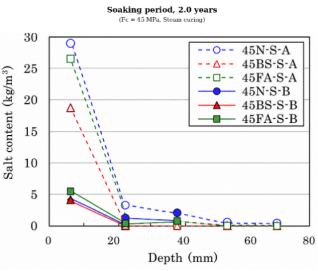
Figure 13. Salt content profile after 2.0-year soaking for C45 mixtures under steam curing.
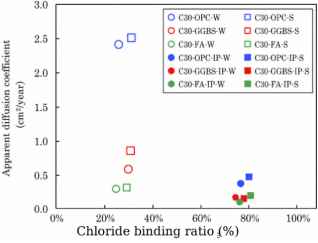
Figure 14. Relationship between chloride binding ratio and apparent diffusion coefficient for C30 mixtures.
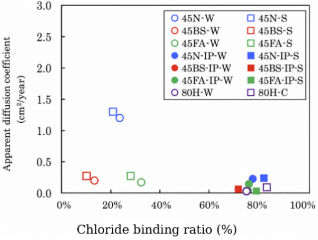
Figure 15. Relationship between chloride binding ratio and apparent diffusion coefficient for C45 mixtures.
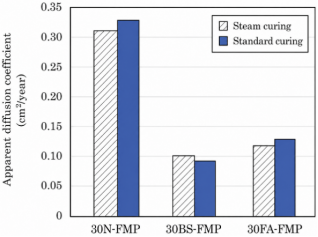
Figure 16. Apparent diffusion coefficient of C30 FMP mixtures according to curing condition.
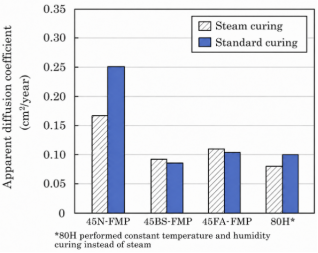
Figure 17. Apparent diffusion coefficient of C45 FMP and 80H mixtures according to curing condition.

Information



 Share This Article
 Twitter
 Linked In
 Facebook
 Copy
Copy Download