Abstract
The essence of enduring architecture lies in harmony between form and structure. Throughout history, the most successful architectural works derived their beauty, economy, and permanence from structural truth, where geometry evolved naturally from the flow of forces. In much of contemporary parametric and sculptural architecture, however, visual fluidity and formal abstraction often precede and dominate structural reasoning. This paper examines how unconventional architectural forms may conflict with the natural regime of load transfer and equilibrium, compelling engineers to introduce concealed supports, redundant framing systems, and artificial load paths to stabilize geometries that do not inherently follow structural logic. The resulting condition is compared metaphorically to “a knot in a straight thread,” where continuity of force flow is interrupted despite apparent external elegance. The discussion further highlights how asymmetric massing and irregular geometries under seismic and wind excitation can induce torsional amplification, phase drift, and dynamic instability, potentially leading to progressive deformation and localized structural distress. At the same time, the paper demonstrates that unconventional geometry need not oppose structural principles. Forms such as the hyperbolic paraboloid exemplify how abstract architecture can still embody structural efficiency through membrane action, anticlastic curvature, and continuity of load paths. Drawing upon examples from contemporary architecture and structural philosophy, the paper argues that true architectural freedom emerges not from defying structural principles, but from integrating imagination with equilibrium, material behaviour, and force flow. It concludes that lasting architectural beauty is achieved when form and structure coexist in natural harmony rather than in opposition.
|
Published in
|
American Journal of Civil Engineering (Volume 14, Issue 3)
|
|
DOI
|
10.11648/j.ajce.20261403.14
|
|
Page(s)
|
170-174 |
|
Creative Commons
|

This is an Open Access article, distributed under the terms of the Creative Commons Attribution 4.0 International License (http://creativecommons.org/licenses/by/4.0/), which permits unrestricted use, distribution and reproduction in any medium or format, provided the original work is properly cited.
|
|
Copyright
|
Copyright © The Author(s), 2026. Published by Science Publishing Group
|
Keywords
Architectural Form, Structural Equilibrium, Dynamic Instability, Asymmetric Massing, Hyperbolic Paraboloid,
Structural Aesthetics, Seismic and Wind Response, Form-Structure Harmony
1. Introduction
Before proceeding, the author wishes to clarify that this paper is not intended to criticize the works of Zaha Hadid Architects and other architects stated or any particular design philosophy. Their contribution to contemporary architectural language is immense. The intent here is analytical — to highlight that departing from structural regime can at times introduce uncertain behaviour under seismic loading, and that excessive reliance on computational modeling may obscure physical understanding of how forces travel and equilibrate within a structure. What occurs inside the “black box” of the computer may achieve equilibrium numerically but not necessarily convey insight into the why of structural response.
Throughout history, the finest works of architecture — from Gothic cathedrals to modern shells
| [1] | Candela, F. (1958). 'Shells and Structural Aesthetics.' Journal of the American Concrete Institute. |
| [2] | Nervi, P. L. (1956). Structures. McGraw-Hill. |
[1, 2]
and bridges {cable stayed etc.
| [3] | Otto, F. (1973). Tensile Structures. MIT Press. |
[3]
have derived their beauty from the honesty of their structure. The lines of thrust and tension defined the geometry, and form followed the natural path of forces. Structural rationality was inseparable from architectural expression.
In recent decades, however, a striking shift has occurred. With the advent of parametric modeling
| [4] | Schumacher, P. (2010). The Autopoiesis of Architecture. Wiley. |
[4]
and digital fabrication by use of scripting
| [5] | Burry, M. (2011). Scripting Cultures: Architectural Design and Programming. Wiley. |
[5]
, architecture has gained an unprecedented freedom of form. Buildings now twist, flow, and fold like sculptures, liberated from the apparent constraints of geometry. Yet this visual emancipation often comes at a price: the detachment of architecture from its structural roots.
2. Historical Convergence of Form and Structure
The dialogue between architectural form and structural logic is as old as architecture itself. From the earliest stone vaults to the soaring cathedrals of Europe, the most successful designs have been those where geometry, material, and load path formed an inseparable unity. These buildings were not engineered after conception — they were born from the structural principle itself.
In ancient architecture, structure was form. The Egyptian pyramids and Greek temples embodied structural clarity through simple geometries governed by gravity, proportion, and stability. The Gothic builders of the Middle Ages refined the thrust line through pointed arches, ribbed vaults, and flying buttresses to achieve greater height and lightness. Later masters such as Gaudí, Maillart, Candela, and Nervi saw in nature’s geometry a profound truth: that form and force could be made one.
3. Conflict in Contemporary Architecture — The Case of Parametric and Sculptural Forms
Parametric design has redefined architectural aesthetics. Empowered by algorithms and digital fabrication, architects can now conceive geometries that twist, lean, and flow. Few exemplify this more than Zaha Hadid, whose works transformed architecture into spatial sculpture. However, when geometry is chosen for its spatial drama rather than its structural logic, the engineer must design retroactively — forcing load paths within pre-determined forms. This often demands redundant or concealed support systems — hidden frames, trusses, and thickened skins — that serve to stabilize, not optimize.
Such systems act as structural prosthetics: compensations for geometric inefficiency. The result, while visually continuous, is structurally fragmented — akin to tying a knot in a straight thread. The load reaches the ground, but through distorted and energy-inefficient routes. When the structure’s truth is masked by sculptural surfaces, the architecture may achieve spectacle but lose integrity.
It may not be lost sight of that for highly unusual architectural forms—especially those from the De-constructivist and Para-metricism movements—it's common for the initial computer output to fall short of a clear, intuitive guidance for physical load transfer.
3.1. Technical and Risk Implications of Irregular Architectural Forms
While sculptural and freeform architecture offers unprecedented artistic freedom, it simultaneously introduces significant structural and operational challenges. Unlike regular geometries, where load transfer is predictable and well-defined, irregular forms disrupt natural stress trajectories and amplify dynamic effects during seismic or wind loading.
3.1.1. Structural and Seismic Vulnerabilities
Architectural forms lacking symmetry tend to exhibit torsional irregularities and uneven stiffness distribution, which can trigger unexpected dynamic behavior under earthquake motion. In seismic zones, this can magnify rotational modes and 3 differential accelerations, leading to localized overstressing or premature cracking — issues far less likely in symmetric or orthogonal structures. Thus, when visual fluidity is achieved at the expense of regularity, the structural regime is jeopardized, and the design may demand artificial stiffening, redundancy, or damping to restore equilibrium.
3.1.2. Engineering and Computational Challenge
Designing non-standard geometries involves complex finite-element modeling, mesh irregularities, and boundary-condition uncertainties. Although advanced simulation tools can reconcile shape and stress, they also risk becoming 'black boxes,' producing results that are numerically correct but physically opaque. Engineers may lose intuitive understanding of load flow — the very essence of structural design — if reliance on computation replaces conceptual reasoning.
3.1.3. Economic and Constructability Risks
Freeform structures inherently carry higher material and fabrication costs due to customized elements and specialized workmanship. Small deviations in geometry during construction can lead to major realignment issues, as load paths are non-redundant and geometry-dependent. When feasibility checks are overlooked, the project may face delays, cost overruns, or even design failure — consequences exacerbated by the difficulty of retrofitting irregular forms.
3.1.4. Functional and Maintenance Issues
Abnormal geometry often produces non-orthogonal spaces that challenge practical usability and environmental performance. Over time, the maintenance of such complex envelopes — particularly at curvilinear joints and irregular panels — becomes expensive and technically demanding. Weathering, corrosion, or vibration fatigue can accumulate disproportionately in geometrically stressed zones, further affecting durability and seismic resilience.
Beyond these static and maintenance concerns, dynamic instability arising from asymmetric massing requires special attention.
3.2. Dynamic Instability in Asymmetric Massing — Seismic and Wind Response
Unconventional architectural forms frequently position their major masses asymmetrically with respect to the structural system. Such eccentric distribution of weight and stiffness shifts the centre of mass (CM) away from the centre of rigidity (CR), creating inherent torsional eccentricity. Under lateral excitation—whether seismic or aerodynamic—the structure no longer moves purely in translation; it twists about its base, subjecting certain members to amplified deformation while others remain relatively unstressed. The symmetry that once governed the natural flow of forces is lost, and the building begins to fight against its own geometry.
3.2.1. Torsional Amplification and Phase Drift
During earthquake motion, asymmetric structures experience coupled translational–torsional modes. With each cycle of shaking, small differences in stiffness and damping between opposing sides accumulate into phase drift, causing portions of the structure to move out of sync. Once this de-synchronisation occurs, restoring forces no longer act uniformly; plastic hinges form unevenly, and permanent lateral offsets may remain after the motion ceases. Inwind-excited systems, similar effects appear as vortex-induced torsion and cross-wind resonance, particularly in taller sculpturally twisted buildings. In both cases, the structure departs from the assumed elastic pattern and enters a regime of uncertain dynamic behaviour.
3.2.2. Progressive Deformation and Failure Potential
Repeated cycles of unsymmetrical response induce localised yielding, cracking, and connection fatigue. Over time the structure learns a distorted shape—a permanent set—and its dynamic characteristics change. This evolutionary shift in stiffness further amplifies eccentric response, sometimes culminating in progressive deformation or partial collapse if ductility reserves are exhausted. Post-earthquake investigations repeatedly reveal that irregular massing magnifies damage at corners and re-entrant zones where torsion concentrates.
3.2.3. Engineering Mitigation and Design Ethics
Mitigation begins by aligning mass with stiffness wherever possible. Symmetrical cores, balanced floor plans, and continuous diaphragms restrain torsion naturally. Where geometry forbids perfect balance, engineers employ tuned mass dampers, viscous or friction devices, or even torsional isolation systems to moderate rotational motion. Yet such interventions remain compensatory: they treat symptoms, not causes. The more fundamental solution lies in respecting equilibrium at the conceptual stage—allowing the form itself to anticipate the rhythm of forces rather than forcing structure to correct it.
3.2.4. Philosophical Implication
Dynamic instability thus exposes the moral of the “knot in the thread.” When architecture imposes asymmetry without structural conscience, every cycle of motion tightens that knot a little more. The structure ceases to breathe uniformly; it strains, twists, and finally yields. In contrast, when form and balance coexist, motion itself becomes harmonic—a dialogue between geometry and gravity rather than a contest. The lesson extends beyond mechanics: in architecture as in nature, symmetry and continuity remain the guardians of resilience.
The cumulative outcome of these technical and dynamic considerations reaffirms the central theme of this paper—that true architectural equilibrium begins with structural balance.
4. The “Knot in the Thread” Analogy and Its Structural Implications
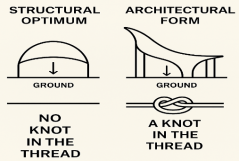
A structure is a medium through which forces seek equilibrium. In every sound design, these forces travel smoothly to the ground, minimizing internal energy. Introducing artificial props or geometric deviations disturbs this flow, producing local stress concentrations. This condition resembles tying a knot in a thread: continuity is lost, and weakness introduced. From an engineering viewpoint, each deviation increases strain energy and demands additional material reinforcement. The apparent form may remain unchanged, but its inner logic becomes forced.
Figure 1 represents the analogy stated above.
Figure 1. Structural Optimum vs Architectural Form.
Comparison illustrating the 'knot in the thread' analogy. The left diagram, labeled 'No Knot in the Thread,' represents the natural and efficient flow of forces — the structural optimum; the right diagram, labeled 'A Knot in the Thread,' shows architectural defiance with redundant supports and interrupted load transfer. The illustration symbolically contrasts continuity of load path with distortion introduced by forced geometry.
In the
Figure 1, the arch demonstrates the natural transfer of load through pure compression — the essence of structural efficiency. In contrast, the right Figure represents a complex geometry that depends on concealed frameworks or props to maintain equilibrium, thereby altering the genuine flow of forces.
5. Form Follows Forces: Restoring Structural Truth in the Age of Expression
Architecture has always been a dialogue between imagination and gravity. The most lasting works testify that beauty arises when structural necessity becomes visual poetry. In the digital era, form sometimes precedes structure, leading to inefficiencies and concealed complexity. The 'knot in the thread' metaphor warns against forcing structure to serve preordained geometry. Yet technology now allows a higher synthesis where form follows forces once again. A building aligned with the natural flow of loads consumes less, endures longer, and tells the truth of its own making. When form grows from structure, architecture reclaims its integrity and achieves equilibrium between art and science.
6. Reconciling Form and Structure — Toward a New Synthesis
The relationship between architecture and structure must be seen not as one of submission or hierarchy, but as mutual dialogue. While aesthetic expression gives a building its identity, structure grants it permanence. Architectural abstraction, when detached from structural logic, often yields imbalance — the structure becomes reactive, forced to serve geometry instead of nature. Yet, not all unconventional forms defy these principles. The hyperbolic paraboloid, for instance, despite its sculptural appearance, follows structural logic impeccably. Its anticlastic curvature promotes membrane action, allowing loads to flow naturally in tension and compression with minimal bending. It thus stands as a form of art born from equilibrium — a geometry that looks abstract but behaves rationally.
This contrast reveals an essential truth: it is not the freedom of form that challenges structure, but the absence of structural reasoning in its creation. Forms that emerge from an understanding of load paths, material continuity, and stiffness distribution seldom violate equilibrium. In contrast, purely visual geometries often require redundant supports and hidden bracing to restore what nature would otherwise achieve effortlessly. The cost of such artistic defiance is not only material or financial; it is conceptual — a departure from the harmony between geometry and gravity.
Engineering today possesses the computational means to simulate any conceivable shape, but this technological freedom must not erode physical understanding. The engineer’s role extends beyond analysis; it involves restoring moral equilibrium between imagination and structure. Every line in a sketch implies a flow of force, every curve a stress trajectory. When these are drawn without comprehension, architecture becomes an image, not an organism.
True innovation therefore lies not in opposing structural principles, but in expanding their vocabulary. The future of architecture depends on rediscovering form as structure itself — where geometry, function, and material coalesce in natural unity. This is not a constraint upon creativity but its highest expression: to achieve freedom through discipline.
7. Conclusion
Architecture and structure are partners in an unspoken contract with nature. When one dominates, the other compensates — and equilibrium is lost. The examples of geometries like the hyperbolic paraboloid remind us that even the most daring forms can embody structural honesty when conceived with understanding. The ultimate lesson is timeless: beauty is most profound when it arises from balance.
The cumulative outcome of these reflections reaffirms the central theme of this paper — that true architectural equilibrium begins with structural balance.
8. Summary Conclusion
Architectural form and structural logic must coexist as complementary expressions of equilibrium. When geometry disregards load flow, structure becomes reactive and artificial. Yet, not all unconventional forms defy these laws—emphasizing again, the hyperbolic paraboloid exemplifies how abstract geometry can embody structural truth through membrane action and balanced curvature. The challenge lies not in curbing creativity but in guiding it through understanding. Modern architecture must rediscover form as structure itself, where aesthetics and mechanics unite in natural harmony. True beauty, in both art and engineering, arises only when imagination honours equilibrium.
Abbreviations
CM | Centre of Mass |
CR | Centre of Rigidity |
Author Contributions
Vijay Kumar Khanna: Conceptualization, Data Curation, Formal Analysis, Funding acquisition, Investigation, Methodology, Project administration, Resources, Supervision, Validation, Visualization, Writing – original draft
Conflicts of Interest
The author declares there is no conflicts of interest.
References
| [1] |
Candela, F. (1958). 'Shells and Structural Aesthetics.' Journal of the American Concrete Institute.
|
| [2] |
Nervi, P. L. (1956). Structures. McGraw-Hill.
|
| [3] |
Otto, F. (1973). Tensile Structures. MIT Press.
|
| [4] |
Schumacher, P. (2010). The Autopoiesis of Architecture. Wiley.
|
| [5] |
Burry, M. (2011). Scripting Cultures: Architectural Design and Programming. Wiley.
|
Cite This Article
-
APA Style
Khanna, V. K. (2026). When Form Competes with Structure: Rethinking Architectural Expression and Structural Truth in the Parametric Era. American Journal of Civil Engineering, 14(3), 170-174. https://doi.org/10.11648/j.ajce.20261403.14
 Copy
|
Copy
|
 Download
ACS Style
Khanna, V. K. When Form Competes with Structure: Rethinking Architectural Expression and Structural Truth in the Parametric Era. Am. J. Civ. Eng. 2026, 14(3), 170-174. doi: 10.11648/j.ajce.20261403.14
Copy
|
Download
AMA Style
Khanna VK. When Form Competes with Structure: Rethinking Architectural Expression and Structural Truth in the Parametric Era. Am J Civ Eng. 2026;14(3):170-174. doi: 10.11648/j.ajce.20261403.14
Copy
|
Download
-
@article{10.11648/j.ajce.20261403.14,
  author = {Vijay Kumar Khanna},
  title = {When Form Competes with Structure: Rethinking Architectural Expression and Structural Truth in the Parametric Era},
  journal = {American Journal of Civil Engineering},
  volume = {14},
  number = {3},
  pages = {170-174},
  doi = {10.11648/j.ajce.20261403.14},
  url = {https://doi.org/10.11648/j.ajce.20261403.14},
  eprint = {https://article.sciencepublishinggroup.com/pdf/10.11648.j.ajce.20261403.14},
  abstract = {The essence of enduring architecture lies in harmony between form and structure. Throughout history, the most successful architectural works derived their beauty, economy, and permanence from structural truth, where geometry evolved naturally from the flow of forces. In much of contemporary parametric and sculptural architecture, however, visual fluidity and formal abstraction often precede and dominate structural reasoning. This paper examines how unconventional architectural forms may conflict with the natural regime of load transfer and equilibrium, compelling engineers to introduce concealed supports, redundant framing systems, and artificial load paths to stabilize geometries that do not inherently follow structural logic. The resulting condition is compared metaphorically to “a knot in a straight thread,” where continuity of force flow is interrupted despite apparent external elegance. The discussion further highlights how asymmetric massing and irregular geometries under seismic and wind excitation can induce torsional amplification, phase drift, and dynamic instability, potentially leading to progressive deformation and localized structural distress. At the same time, the paper demonstrates that unconventional geometry need not oppose structural principles. Forms such as the hyperbolic paraboloid exemplify how abstract architecture can still embody structural efficiency through membrane action, anticlastic curvature, and continuity of load paths. Drawing upon examples from contemporary architecture and structural philosophy, the paper argues that true architectural freedom emerges not from defying structural principles, but from integrating imagination with equilibrium, material behaviour, and force flow. It concludes that lasting architectural beauty is achieved when form and structure coexist in natural harmony rather than in opposition.},
 year = {2026}
}
Copy
|
Download
-
TY  - JOUR
T1  - When Form Competes with Structure: Rethinking Architectural Expression and Structural Truth in the Parametric Era
AU  - Vijay Kumar Khanna
Y1  - 2026/05/29
PY  - 2026
N1  - https://doi.org/10.11648/j.ajce.20261403.14
DO  - 10.11648/j.ajce.20261403.14
T2  - American Journal of Civil Engineering
JF  - American Journal of Civil Engineering
JO  - American Journal of Civil Engineering
SP  - 170
EP  - 174
PB  - Science Publishing Group
SN  - 2330-8737
UR  - https://doi.org/10.11648/j.ajce.20261403.14
AB  - The essence of enduring architecture lies in harmony between form and structure. Throughout history, the most successful architectural works derived their beauty, economy, and permanence from structural truth, where geometry evolved naturally from the flow of forces. In much of contemporary parametric and sculptural architecture, however, visual fluidity and formal abstraction often precede and dominate structural reasoning. This paper examines how unconventional architectural forms may conflict with the natural regime of load transfer and equilibrium, compelling engineers to introduce concealed supports, redundant framing systems, and artificial load paths to stabilize geometries that do not inherently follow structural logic. The resulting condition is compared metaphorically to “a knot in a straight thread,” where continuity of force flow is interrupted despite apparent external elegance. The discussion further highlights how asymmetric massing and irregular geometries under seismic and wind excitation can induce torsional amplification, phase drift, and dynamic instability, potentially leading to progressive deformation and localized structural distress. At the same time, the paper demonstrates that unconventional geometry need not oppose structural principles. Forms such as the hyperbolic paraboloid exemplify how abstract architecture can still embody structural efficiency through membrane action, anticlastic curvature, and continuity of load paths. Drawing upon examples from contemporary architecture and structural philosophy, the paper argues that true architectural freedom emerges not from defying structural principles, but from integrating imagination with equilibrium, material behaviour, and force flow. It concludes that lasting architectural beauty is achieved when form and structure coexist in natural harmony rather than in opposition.
VL  - 14
IS  - 3
ER  -
Copy
|
Download





 Share This Article
 Twitter
 Linked In
 Facebook