1. Introduction
Concrete is a heterogenous mixture of cement, aggregates, and water in the right mixes. Many researchers have opined that it is the most used construction material globally in comparison to other building materials, such as timber, plastic, steel and aluminum
| [1] | Mehta, P. K., Monteiro, P. J. M. Concrete: Microstructure, Properties, and Materials, 4th ed. McGraw-Hill Education, New York, NY, USA, 2014. |
| [2] | Neville, A. M. Properties of Concrete, 5th ed. Pearson Education Limited, United Kingdom, Uk, 2011. |
[1, 2]
. Concrete is widely used in construction because of some advantages it possesses over other construction materials. Some of such advantages include high compressive strength, fire resistance, and durability. Another advantage of concrete is its versatility; it can be molded into different shapes and sizes, making it suitable for various applications such as basic foundations, exterior surfaces, superstructures, floor construction, wastewater treatment facilities, and parking structures
| [3] | Brown, T., Patel, S., and Kim, J. Versatility in Concrete Applications. Construction Materials Journal, 2023; 10(3): 200-215. |
[3]
. It is used in the construction of civil engineering structures, such as; bridges, culverts, buildings, dams, tunnels, rigid pavements, where mechanical resistance is essential
| [4] | Johnson, L., and Lee, K. (2022). Portland Cement in Civil Engineering. International Journal Construction Science, 2022; 18: 255-270. |
[4]
.
Aggregates are raw materials that are produced from natural or artificial sources and extracted from pits and quarries
| [5] | Gambhir, M. L. Concrete Technology: Theory and Practice. Tata McGraw-Hill Education, India, 2013. |
[5]
. The common natural sources include gravel, crushed stone, and sand. They are used with a binding medium to form compound materials like asphalt concrete and Portland cement concrete, helping to make mixes more compact, and reduces the consumption of cement and water
| [6] | Martinez, F., and Chen, H. Aggregate Properties and Their Impact on Concrete. Journal of Materials in Civil Engineering, 2023; 17(5): 310-325. |
[6]
. Additionally, aggregates contribute to the mechanical strength of concrete, making them indispensable in the construction of rigid structures
| [7] | Wang, X. The Role of Aggregates in Concrete Strength. Journal of Structural Engineering, 2022; 19(6): 400-412. |
[7]
.
According to particle size, there are mainly two kinds of aggregates namely, fine and coarse aggregates. The fine aggregate includes particles that pass through the 4.75mm sieve and retained on 0.075mm sieve. Natural sand is generally used as fine aggregate. Silt and clay also come under this category. Coarse aggregates are particles that are retained on the 4,75mm sieve and pass through the 76.2mm screen
| [8] | Jackson, N., Dhir, R. K. Civil Engineering Materials, 5th ed. MacMillan International Higher Education, London, England, 1996. |
[8]
. The coarser the aggregate, the more economical the mix. Larger pieces offer less surface area of the particles than an equivalent volume of small pieces. The use of the largest permissible maximum size of coarse aggregate permits a reduction in cement and water requirements. However, using aggregates larger than the maximum size of coarse aggregates permitted can result in interlock and obstruction with a concrete form. That allows the area to become a void, or at best, to become filled with finer particles of sand
| [8] | Jackson, N., Dhir, R. K. Civil Engineering Materials, 5th ed. MacMillan International Higher Education, London, England, 1996. |
[8]
.
Coarse aggregates are the constituent of concrete that determines its dimensional stability, elastic, and thermal characteristics
| [9] | Aginam, C. H., Chidolue, C. A., Nwakaire, C. Investigating the effects of coarse aggregates type on the compressive strength of concrete. International Journal of Engineering Research and Applications, 2013; 1140-1144. |
[9]
. Aggregates occupy about 60% to 75% of the volume of concrete i.e. over 70% to 85% by mass and are stiffer than the concrete paste. The fact that they fill more than 60% of the volume of concrete, has an impact over various characteristics of the concrete including its modulus of elasticity. Due to their relatively high hydraulic conductivity value compared to most soils, aggregates are widely used in drainage application, such as foundations, roadside edge drains, retaining wall drains, and septic drain field
| [10] | Das, B. M. Principles of Geotechnical Engineering, 8th ed. Cengage Learning, Boston, USA, 2014. |
| [11] | Holtz, R. D., Kovacs, W. D., & Sheahan, T. C. An Introduction to Geotechnical Engineering. Pearson Education, United Kingdom, UK, 2011. |
[10, 11]
.
The modulus of elasticity measures material stiffness and is an indicator of strength. Adams
| [12] | Adams, R. Concrete Strength and Elasticity. Journal of Civil Engineering, 2024; 15(2): 145-156. |
[12]
explains it as the ratio of stress to strain, with stress defined as the deforming force per unit area (F/A) and strain as the deformation caused by stress (i.e. change in length over the original length, ∆L/L]. The elastic modulus of concrete is the ratio of normal stress to corresponding strain for tensile or compressive stresses below the proportional limit of the concrete material
. It is dependent on the compressive strength of concrete, the proportion of aggregates in the concrete, proportion of coarse aggregates, quality of cement pastes and addition of mineral admixtures.
Concrete with higher elastic modulus values develops high resistance to deformation. The higher the compressive strength of a given concrete, the higher the elastic modulus of that concrete, although the relationship is not directly proportional
. Elastic modulus of concrete is required for the estimation of the deformation of buildings and its members and is as important as the water-cement ratio of the concrete mixture. A higher modulus of elasticity will result in reduced deflection and increased tensile strength.
Building collapses are becoming common in Nigeria, Africa’s most populous country, with more than a dozen such incidents recorded in the last two years
| [14] | Aljazeera News. “At least 22 killed after school building collapses in Nigeria” July 12, 2024. Available at
Aljazeera.com/news/2024/7/12/several-children-killed-after-school-collapse-in-nigeria |
[14]
. Authorities often blame such disasters on a failure to enforce building safety regulations, the use of substandard construction materials and poor maintenance. In July 2024 a minimum of 22 persons, including students, lost their lives when a two-story school building located in Busa Buji community in Plateau State Nigeria collapsed
| [14] | Aljazeera News. “At least 22 killed after school building collapses in Nigeria” July 12, 2024. Available at
Aljazeera.com/news/2024/7/12/several-children-killed-after-school-collapse-in-nigeria |
[14]
. The increase in building collapses due to forces that cause deformation in concrete, particularly from earth tremors, is a growing concern in structural engineering and urban safety. The phenomenon is influenced by several factors, including the nature of seismic forces, material properties, and construction practices
| [15] | Cai, W., Chen, Y., and Zhao, J. Demand Analysis of Coarse Aggregates in Urbanization. Resources, Conservation and Recycling, 2020; 156: 104705. |
[15]
.
According to Council of Regulation of Engineering in Nigeria (COREN), Nigeria recorded twenty-two building collapses between January and July 2024
. In Lagos State alone, over 91 buildings have collapsed leading to the death of more than 354 people between 2012 and 2024. This frequent trend of concrete building collapse has led to loss of lives and properties. Poor elasticity of locally made concrete has been seen as part of the contributing factor for such collapse
| [17] | Ezeagu, C. A., Obasi, K. C. Empirical elasticity models of concrete made with local aggregates used in Nigeria. International Journal of Engineering Research and Application, 2015; 5(36), 36-45. |
[17]
. Hence the need to experiment the elastic properties of concrete made from locally available coarse aggregates in Nigeria.
The demand for coarse aggregates in concrete production has surged due to urbanization and infrastructure development, leading to higher prices. As populations grow, the need for housing, roads, and other infrastructure projects increases the demand for concrete, which relies heavily on coarse aggregates. The rise in demand for this aggregate has led to the increase in prices of granite, gravel, washed stones, etc. which are often used as coarse aggregates in concrete. The exploration of coarse aggregates such as granite, stones, etc. from naturally occurring rocks has some adverse effect on the environment. Some of the negative impacts include erosion, and loss of natural beauty of the environment.
This high cost of building materials coupled with very elevated inflation in Nigeria has evolved to the use of various alternatives to the generally accepted coarse aggregate materials. Many riverine people now depend on periwinkle shells as an alternative material to reduce the cost of importing conventional granite chippings to their islands from the mainland. Concrete produced from this material is sometimes used for structural purposes. However, previous studies have proved that the palm kernel shell generates low strength concrete. Low quality concrete usually has reduced compressive strength which will in turn lead to low value of modulus of elasticity. This also could be a potential cause of building collapse as concrete with low modulus of elasticity will develop little resistance to deformation.
Hence, the study on some selected coarse aggregate generally used in Nigeria (especially the palm kernel shell) will help provide more recent finding towards developing green technology to solving real-life challenges in concrete technology. Also, findings from this study can be referred to when designing PKS concrete since it is not accounted for in conventional concrete codes of practice.
Palm kernel shells (PKS) are the hard outer shells of the palm kernel fruits that are left as a by-product after the extraction of palm oil. Their disposal presents a significant environmental challenge, especially in regions where there is high production of palm oil. This threat is because of high volume of PKS that are produced during the processing of palm oil
| [18] | Kumar, P., Singh, R. Environmental Impact of Palm oil production and its management. Environmental Science and Pollution Research, 2020; 27(15), 18600-18612. |
[18]
. Often at time, to dispose of these palm kernel shells, they are burned. This in turn lead to the release of wide range of pollutants, including carbon monoxide, particulate matter, volatile organic compounds, etc. into the surroundings. These pollutants degrade air quality and pose serious health implications for nearby communities
| [19] | Mongkon, T., & Intharathirat, R. Waste Management of Palm Kernel Shells: A Review. Waste Management, 2021; 118, 1-12. |
[19]
.
Dumping palm kernel shells at land-fill sites also lead to leachate formation. This is a process where harmful substances seep into the soil and groundwater. This contamination poses risks to human health. The palm kernel shell (PKS) is an organic material that can be sustained in concrete as a partial replacement for aggregates, but its long-term performance depends on proper treatment and application, especially for structural use.
Gibigaye, et. al.
| [20] | Gibigaye M., Godonou, F. G., Yabi, C. P., Degan, G. Estimation of elastic properties of oil palm kernel shell concrete by semianalytical methods of homogenisation. Hindawi Advances in Civil Engineering (Hindawi), 2019; Article ID 9256260, 12 pages https://doi.org/10.1155/2019/9256260 |
[20]
, conducted a study to estimate the elastic modulus of oil palm kernel shell concrete (OPKSC) using micromechanical homogenization methods, specifically the Hashin–Shtrikman (HS) and Mori–Tanaka (MT) models. The research aimed to address the lack of experimental data on OPKSC's elastic properties and its potential as a lightweight alternative to conventional aggregates like granite. Concrete mixes were prepared with OPKS volume fractions below 42%, targeting compressive strengths under 35 MPa. The methodology involved theoretical modeling based on the mechanical properties of the individual components (cement paste and OPKS aggregates), with experimental validation through compressive strength tests. Results showed that OPKSC's elastic modulus values ranged from 8 GPa to 12 GPa, significantly lower than conventional granite-based concrete, which typically exceeds 20 GPa. The HS and MT models demonstrated high accuracy in predicting elastic modulus, with deviations below 5% compared to experimental data. The study concluded that OPKSC is suitable for lightweight applications in non-structural elements due to its reduced stiffness and density, while emphasizing its sustainability benefits in regions with abundant palm kernel shell waste.
Osamuyi, et. al.
| [21] | Osamuyi, O., Nwankwo, E., & Iyoha, P. Suitability of periwinkle shell mixed with palm kernel shell wastes as replacement for coarse aggregate in concrete production. Journal of Energy Technology and Environment, 2021; 3(3), 95–101. |
[21]
, investigated the structural viability of replacing traditional crushed granite with palm kernel shells (PKS) and periwinkle shells (PWS) as coarse aggregates in concrete. They used a nominal concrete mix proportion of 1: 1.2: 2.6 (cement: sand: coarse aggregates) with a fixed water-cement ratio of 0.55. The study tested several concrete variants, including 100% granite (control), 100% PKS, 100% PWS, and combinations of PKS/PWS aggregates. Compressive strength tests were carried out on cubes (150 mm size) cured for 7, 14, 21, and 28 days. The optimal mixture identified was 75% PWS and 25% PKS, which reached around half (i.e. between 12–13 MPa) the strength of conventional granite concrete (25–26 MPa). Although elastic modulus tests weren't directly performed, significant reductions in compressive strength and density strongly indicated lower stiffness for the shell-based concretes. The authors concluded that the concrete was environmentally and economically advantageous but recommended their application mainly for non-load-bearing or lightweight structural uses due to their reduced mechanical properties.
Iron
| [22] | Iron, U. H. Crushing strength and physical characteristics of palm kernel shell concretes. Worldwide Journal of Multidisciplinary Research and Development, 2022; 8(6), 99–107. |
[22]
, conducted an extensive experimental investigation to evaluate the mechanical properties, particularly compressive strength, of concrete made by incrementally replacing traditional crushed granite aggregates with palm kernel shells (PKS). Three distinct concrete mix ratios were carefully prepared to represent different structural concrete grades: a rich mix (1: 1½: 3), standard mix (1: 2: 4), and lean mix (1: 3: 6), all measured by volume, maintaining a fixed water-cement ratio of 0.6 for consistency. Granite aggregates were systematically replaced by PKS at incremental percentages of 0%, 20%, 40%, 60%, 80%, and 100%, yielding multiple concrete batches for rigorous comparative analysis. Concrete cube specimens of standard dimensions (150 mm) were manually mixed, cast, cured in water, and subjected to compressive strength tests at curing durations of 7, 14, and 28 days.
Results obtained indicated a clear trend of declining mechanical performance with increasing PKS content; concrete containing 100% granite aggregates consistently demonstrated the highest compressive strengths across all mix ratios, notably achieving around 25 MPa for the standard (1: 2: 4) mix. Conversely, concrete containing 100% PKS exhibited drastically reduced strengths, often below 10 MPa, suggesting a marked reduction in stiffness and elastic modulus. Notably, moderate replacements (particularly up to about 40% PKS) maintained reasonable structural strengths (approximately 20 MPa for standard mix), indicating an acceptable balance between weight reduction and mechanical performance. Higher PKS replacements (>40%) resulted in significant reductions in density, workability, and strength, clearly signaling lower elastic modulus and limited structural suitability. Iron concluded that PKS-based concrete, with controlled partial substitution, can feasibly serve as lightweight structural concrete for lightly loaded applications, provided its reduced stiffness and compressive strength are appropriately considered in design and application.
2. Materials and Methods
2.1. Materials
2.1.1. River Sand
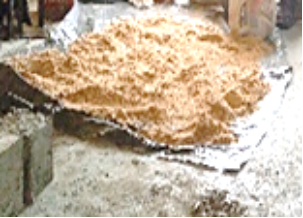
River sand is a fine aggregate that is used in concrete and mortar. It is typically clean, well graded, and is essential for the workability of concrete mixes. They fill the voids between coarse aggregates, enhancing the density of the concrete. River sand used for this study was sourced from the Calabar River in Choba, Port-Harcourt and were mostly 6mm in size. The sand was washed, air-dried, and sieved to remove organic matter, following ASTM C128-22
| [23] | ASTM C128-22 Standard Test Method for Relative Density (Specific Gravity) and Absorption of Fine Aggregate. ASTM International. |
[23]
.
2.1.2. Portland Cement (PC)
The type of cement used was the Portland Cement, conforming to the standards specified in
| [24] | Nigerian Industrial Standard NIS 444-1. Composition, specification and conformity criteria for common cements, 2003. |
[24]
for general construction purposes. It was obtained from a Dangote cement depot at Aluu, Port Harcourt, Rivers State. Its chemical properties are illustrated in
Table 1.
Table 1. Chemical property test of Dangote 3X Brand of Portland Cement.
S/NO. | OXIDES | (%) |
1 | CaO | 60.94 |
2 | SiO2 | 16.61 |
3 | Al2O3 | 3.13 |
4 | Fe2O3 | 1.29 |
5 | MgO | 1.51 |
6 | SO3 | 1.72 |
7 | K2O | 0.40 |
8 | Loss of ignition | 9.60 |
Source:
| [25] | Yola, A. M., Miiraj, A. M., Umar, S., Dickson, P., Tyoden, J. N., Inuwa, I. A., Jibril, S. Investigating the physical, chemical, and mechanical properties of concrete from different cement brands. International Journal of Advances in Engineering and Management, 2021, 3(10), 1369-1381. |
[25]
2.1.3. Palm Kernel Shell (PKS)
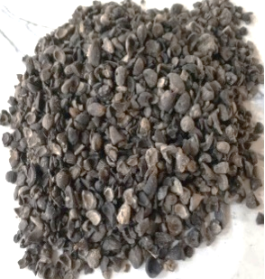
Palm kernel shell (PKS), a by-product of palm oil extraction, was sourced from a local palm oil mill in Delta State, Nigeria. The shells were washed, dried, and sieved to remove debris before use. The average particle size was about 4.75 mm. The material was characterized following the ASTM C127-24
| [26] | ASTM C127- 24 Standard Test Method for Relative Density (Specific Gravity) and Absorption of Coarse Aggregate. ASTM International. |
[26]
for coarse aggregates.
2.1.4. Granite Chippings (GC)
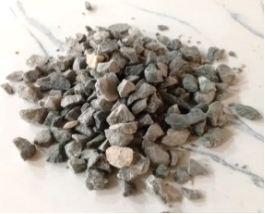
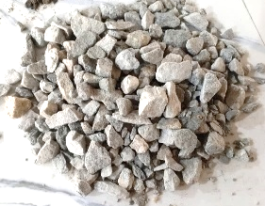
Granite chippings are crushed rocks from granite rock that are commonly used as a coarse aggregate in concrete production. They provide higher strength and durability to concrete structures. The angular shape of granite chippings enhances the interlocking of particles, which contributes to the overall strength of the concrete mix. Two samples of generally available granite chippings (i.e. GC1 and GC2) with varying particle sizes were used for this study. GC1 contained more of flaky aggregates while GC2 had some more content of elongated aggregates. They were sourced within Choba, Port-Harcourt. Testing was carried out in line with ASTM C136-06
| [27] | ASTM C136-06- Standard Test Method for Sieve Analysis of Fine and Coarse Aggregate. ASTM International. |
[27]
for sieve analysis, ASTM C127-24
| [26] | ASTM C127- 24 Standard Test Method for Relative Density (Specific Gravity) and Absorption of Coarse Aggregate. ASTM International. |
[26]
for specific gravity, and ASTM C29
| [28] | ASTM C29. Standard Test Method for Bulk Density (Unit Weight) and Voids in Aggregate. ASTM International. |
[28]
for bulk density. Samples of aggregate materials adopted for the study are presented in
Figure 1,
Figure 2,
Figure 3, and
Figure 4.
2.1.5. Sieve Analysis of Aggregates
Sieve analysis test was conducted according to
| [29] | AASHTO T 27-20 Standard Method of Test for Sieve Analysis of Fine and Coarse Aggregates. |
| [30] | ASTM C33M. Standard Specification for Concrete Aggregates. 2018; ASTM International. |
[29, 30]
requirements to assess the particle size distribution (gradation) of the aggregates. The coefficient of uniformity and curvature were determined from the grain size curve using Equation (
1) and (
2). The coefficient of uniformity (Cu) and coefficient of curvature (Cc) are gradation parameters. Higher Cu values indicate a broader range of particle sizes, improving packing density and reducing voids. Cc values within 1–3 suggest well-graded materials. In mix design, these coefficients help assess suitability of aggregates for achieving dense and workable concrete. These parameters were used to classify the aggregates accordingly.
(1)
(2)
where D
60 is the particle size at 60% of the particles are finer: D
30 is the particle size at 30% of the particles are finer: D
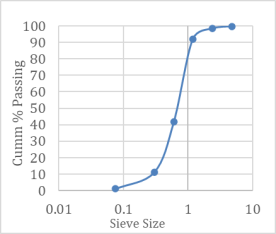
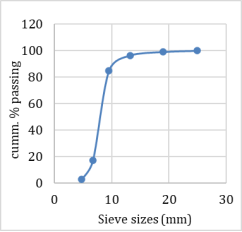
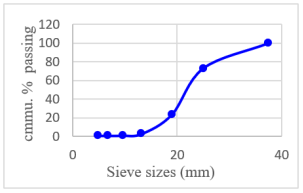
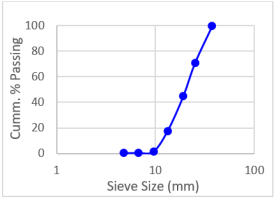
10 is the particle size at 10% of the particles are finer. Results obtained are presented in
Figure 1 to 8.
Figure 5. Particle size distribution of sand.
Figure 6. Particle size distribution of PKS.
Figure 7. Particle size distribution of GC1.
Figure 8. Particle size distribution of GC2.
The particle size distribution results presented in
Figure 10 to 13 indicate that all aggregates are poorly graded, with low coefficients of uniformity (Cu), suggesting limited particle size diversity across fine sand, palm kernel shell, and granite (GC1 and GC2). Specifically, river sand with a Cu of 2.4 fell short of the recommended value (i.e. Cu > 6) for well-graded aggregates, highlighting its limited gradation. Additionally, its coefficient of curvature (Cu) of 3.8 exceeded the preferred range of 1 to 3. This suggests an imbalance near the median size, which may reduce compaction and stability potential
| [31] | Adebayo, O. L., & Adegoke, Y. A. Properties of lightweight concrete using palm kernel shell as coarse aggregate. Journal of Building Materials Research, 2021; 5(3), 45-53. |
[31]
.
Palm kernel shell, with a Cu of 1.42 and Cc of 1.1, showed a balanced distribution near the median size but remains highly uniform in size, potentially limiting its versatility
| [32] | Mindess, S., Young, J. F., and Darwin, D. Concrete. 2nd Ed., Prentice-Hall Inc., Englewood Cliffs, New Jersey. Minnesota Department of Transportation Concrete Engineering Unit. (2003). Concrete manual, properties and mix designations. Minnesota Department of Transportation, Report No. 5-694.200. |
[32]
. Granite (GC1 and GC2) both exhibited a Cc of 1, indicating nearly identical particle sizes and very poor grading. Although their Cu values (1.6 and 1.9 respectively) lie within the acceptable range, suggesting some balance around the median size, the lack of size variety restricts their suitability for applications requiring well-graded materials
| [33] | Shetty, M. S. Properties of Concrete. Multicolour revised edition, S. Chad & Company Ltd, India, 2006. |
[33]
. Overall, the aggregates were poorly graded. This condition can compromise the mechanical properties and durability of concrete, as they fail to provide the packing and stability advantages seen with well-graded aggregates
| [2] | Neville, A. M. Properties of Concrete, 5th ed. Pearson Education Limited, United Kingdom, Uk, 2011. |
[2]
.
2.1.6. Specific Gravity of Aggregates
The specific gravity test was conducted to measure the relative density of the aggregates used with respect to water. This was done using the pycnometer method outlined in
| [34] | Olutoge, F. A., Olaniyan, D. A., & Odetoyinbo, S. O. The use of palm kernel shells as a lightweight aggregate in concrete. Journal of Civil Engineering and Construction Technology, 2010; 1(2), 34-41. |
[34]
for coarse aggregates and
| [35] | Mahuta, A. S., & Aku, P. E. Compressive strength of re-vibrated concrete made from pebbles. International Symposium of Earth, Energy, Environmental Science and Sustainable Development. E3S Web of Conferences 211, 03007, 2020.
https://doi.org/10.1051/e3sconf/202021103007 |
[35]
for fine aggregates. The calculation for determining specific gravity is presented in Equation (
3).
(3)
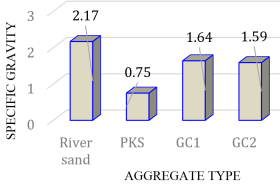
where A is the mass of oven dry aggregate sample (g): B is the mass of saturated surface dry test sample (g): C is the apparent mass of saturated test sample in water (g). Results obtained are illustrated in
Figure 9.
From
Figure 9, the specific gravity values for PKS, GC1, GC2, and sand are 0.75, 1.64. 1.59, and 2.17 accordingly. This means that PKS has a low specific gravity, indicating it is less dense than conventional aggregates, supporting its use in lightweight concrete. Higher specific gravity in granite implies they contribute more to the overall weight of the concrete mix, leading to denser, and stronger concrete. GC1 granite aggregate was observed to be denser than GC2 by 3.05%.
| [33] | Shetty, M. S. Properties of Concrete. Multicolour revised edition, S. Chad & Company Ltd, India, 2006. |
[33]
stated that the specific gravity of PKS is between 0.7 and 0.85 which supports the current study's value of 0.75, confirming PKS as a lightweight aggregate. The specific gravity of river sand obtained from the study (i.e. 2.17), fits into the 2.0 - 2.6 limit given by
| [2] | Neville, A. M. Properties of Concrete, 5th ed. Pearson Education Limited, United Kingdom, Uk, 2011. |
[2]
. While values for GC1 and GC2 were both lower than the 2.5 – 2.7 range prescribed by
| [30] | ASTM C33M. Standard Specification for Concrete Aggregates. 2018; ASTM International. |
[30]
.
Figure 9. Specific gravity results of the various aggregates.
2.1.7. Bulk Density and Porosity of Aggregate
The bulk density is the mass of aggregate per unit volume in either compacted or loosed state. Its purpose is to determine the unit weight, and the voids present in the aggregate. This measurement is essential for converting quantities in mass into volume during concrete mix design and vice versa. While the porosity of the aggregate is a measure of the percentage of empty spaces within the aggregate particles. This was determined using Equation (
4). Bulk density and porosity results for the aggregates are presented in
Table 2.
(4)
From
Table 2, PKS had the lowest bulk density of 742 g/cm³, followed by granite (GC2) with a value of 1537 kg/m³, and GC1 having the highest reading of 1668 kg/m³. These results align with general expectations such as PKS, being lighter and more porous, typically having a lower bulk density compared to denser natural stone aggregates such as granite. The results of the bulk density tests in this study can be compared to findings from similar past research. For example,
| [34] | Olutoge, F. A., Olaniyan, D. A., & Odetoyinbo, S. O. The use of palm kernel shells as a lightweight aggregate in concrete. Journal of Civil Engineering and Construction Technology, 2010; 1(2), 34-41. |
[34]
reported that the bulk density of palm kernel shell (PKS) ranged between 600–800 kg/cm³, which aligns closely with the 742 kg/m³ found in this study. This reinforces the lightweight nature of PKS as a coarse aggregate.
| [35] | Mahuta, A. S., & Aku, P. E. Compressive strength of re-vibrated concrete made from pebbles. International Symposium of Earth, Energy, Environmental Science and Sustainable Development. E3S Web of Conferences 211, 03007, 2020.
https://doi.org/10.1051/e3sconf/202021103007 |
[35]
, stated that the bulk densities of granite were at 1580 kg/m
3 (uncompacted value) and 1692 kg/m³ (for compacted value). These results are very close to those obtained from this investigation. However, slight differences occurred due to factors like aggregate gradation, mineral composition, and quarry source
| [2] | Neville, A. M. Properties of Concrete, 5th ed. Pearson Education Limited, United Kingdom, Uk, 2011. |
[2]
. Variations in test procedures, environmental conditions during testing, and compaction methods could also contribute to the observed differences in bulk densities.
PKS has the lowest porosity at 1.1%, followed by GC1 at 4.9%, and GC2 at 6.3%. The minimum porosity of PKS means it retains less water and air within its structure, which could improve its durability in concrete. In contrast, higher porosity in granite could contribute to reduced strength but may offer better compaction for certain concrete types
| [36] | ASTM F3191-16. Standard Practice for Field Determination of Substrate Water Absorption (porosity) for Substrates to Receive Resilient Flooring. ASTM International. |
[36]
.
Table 2. Bulk density and porosity of aggregates.
Property | Types of Aggregates |
PKS | GC1 | GC2 |
Bulk density (kg/m3) | 742 | 1668 | 1537 |
Porosity (%) | 1.1 | 4.9 | 6.3 |
2.2. Method
2.2.1. Sample Proportioning and Preparation
Concrete specimens were cast into cube molds of dimensions of 150mm×150mm×150mm as specified by
| [37] | ASTM C192. Standard Practice for Making and Curing Concrete Test Specimens in the Laboratory. 2019; ASTM International. |
[37]
. These molds were filled in three layers, each layer compacted using a tamping rod to remove air voids and ensure uniform distribution of the materials. Three different mixes; 1: 2: 3, 1: 1.5: 3, and 1: 2: 4, (Cement: Sand: coarse aggregate) at w/c of 0.45 and 0.50 respectively were investigated. Each concrete batch was mixed manually to ensure uniformity. After casting, the specimens were left to cure for 24 hours at room temperature (approximately 25°C).
Following this initial curing period, the specimens were demolded and submerged in a curing tank, containing potable water, for 28 days to ensure proper hydration of the cement in accordance with
| [37] | ASTM C192. Standard Practice for Making and Curing Concrete Test Specimens in the Laboratory. 2019; ASTM International. |
[37]
. 3 cubes were prepared for each mix ratio using the 3 different aggregates respectively at 0.45 and 0.5 water-cement ratios. This produced a total of 54 samples. The mix proportions of the different concrete types investigated are shown in
Table 3.
Table 3. Mix proportion of concrete by mass for 150mm cube.
Mix ratio | 0.45 w/c | 0.5 w/c | PC (kg) | Sand (kg) | PKS (kg) | Granite (kg) |
1: 1.5: 3 | 1.99 | 2.21 | 4.42 | 6.63 | 6.98 | 13.25 |
1: 2: 3 | 1.82 | 2.03 | 4.05 | 8.1 | 9.62 | 12.15 |
1: 2: 4 | 1.56 | 1.74 | 3.47 | 6.94 | 11 | 13.89 |
2.2.2. Slump Test
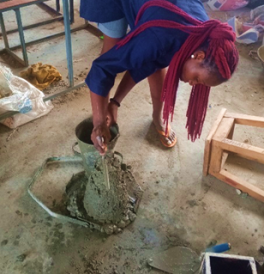
The ease with which one can work with concrete is called workability and this can be measured using a simple test called the slump test. This test was conducted according to
| [38] | ASTM C143/C 143M. Standard Test Method for Slump of Hydraulic-Cement Concrete. 2003; ASTM International. |
[38]
as shown in
Figure 10.
2.2.3. Bulk Density of Concrete
The bulk density of the concrete was determined by diving the mass of the concrete (kg) after demolding by the volume of the mold/concrete specimen.
2.2.4. Compressive Strength Test
According to
| [39] | ASTM C39. Standard Test Method for Compressive Strength of Cylindrical Concrete Specimens. 2021; ASTM International. |
[39]
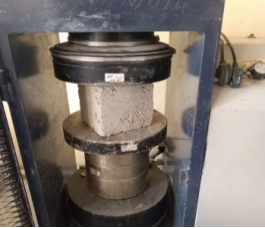
, the compressive strength test was performed using a compressive strength machine. The specimens were placed under a compressive load, and the loads at failure were recorded. The compressive strength (σ) was calculated as illustrated in Equation (
5).
where P is the maximum load applied (N): A is the cross-sectional area of the cylinder (mm²): σ is the 28th day compressive strength (N/mm2).
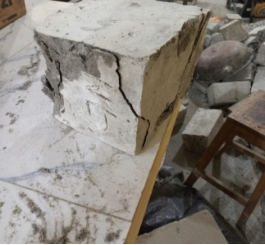
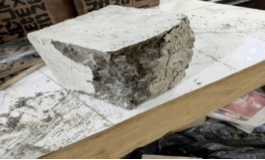
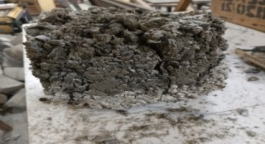
Figure 11 depicts the process of carrying out the compressive strength test on a cube specimen. While some crushed cubes are shown in
Figure 12, 13, and 14.
Figure 11. Compressive strength test.
Figure 12. Crushed GC1 granite concrete.
Figure 13. Crushed GC2 granite concrete.
Figure 14. Crushed PKS concrete.
2.2.5. Determination of Elastic Modulus
According to
| [40] | EN 1992-1-1 (2004): Euro Code 2: Design of concrete structures-Part 1-1: General rules and rules for building. The European Union Per Regulation 305/2011. |
[40]
, the equation for determining the elastic modulus of concrete is given in Equation (
6) as:
where Ec is the elastic modulus of concrete (MPa): Fcu is the characteristic strength of concrete (MPa).
This equation was applied in determining the elastic modulus of the concrete in this study. However, values obtained for the GC1 and GC2 concrete were reduced by 10% as stipulated by the code for limestone aggregates
| [40] | EN 1992-1-1 (2004): Euro Code 2: Design of concrete structures-Part 1-1: General rules and rules for building. The European Union Per Regulation 305/2011. |
[40]
.
2.2.6. Determination of the Sensitivity of Aggregate Type and Mix Ratio on the Elastic Modulus of Concrete Using Analysis of Variance (ANOVA)
The ANOVA statistical test was implemented on the SPSS software. In this method, the effect of the two independent factors (i.e. types of coarse aggregates and different concrete mixes) on the elastic modulus of concrete was assessed to see which of them significantly contributed to this property.
The output provides p-values for both factors, which indicates whether each factor has a significant effect on the elastic modulus of the concrete or not. When P-value < 0.05, that means there is a significant effect or difference among the factors (aggregate type and mix ratio) being compared. This comparison is crucial for understanding how the type of aggregate and the mix ratio influence concrete's mechanical properties.
3. Results and Discussion
3.1. Slump of Concrete
The slump readings for the various concrete specimen experimented in this study are presented in
Table 4.
Table 4. Slump of concrete.
Mix Label | Agg. Type | W/C | Slump value (mm) |
1: 1.5: 3 | 1: 2: 3 | 1: 2: 4 |
M1 | PKS | | 0 | 5 | 7 |
M2 | GC1 | 0.45 | 23 | 25 | 27 |
M3 | GC2 | | 17 | 17 | 18 |
M4 | PKS | | 6 | 7 | 0 |
M5 | GC1 | 0.5 | 27 | 25 | 30 |
M6 | GC2 | | 22 | 22 | 21 |
These values reveal that GC1 concrete generated highest slump with the upmost value occurring at mix 1: 2: 4 at 0.5 w/c. For both w/c considered, PKS concrete consistently produced the lowest slump values that fell within the limits of 0 to 7 mm, indicating a lower workability compared to granite, which showed higher slump values ranging between 17mm and 30mm.
It can be inferred that although the porosity of the PKS was lowest, it produced concrete with the least slump. This is mainly due to the irregularities in the shape of the aggregate, having very rough edges, uneven, and fibrous surface area that cause friction thereby dropping the consistency of the concrete. Also, the oily surface of PKS does not allow sufficient bonding of cement particles making the mixing wet concrete drier
| [41] | Almabrok, M., Mclaughian, R., Vessalas, K. Effect of oil contaminated aggregates on cement hydration. American Journal of Engineering Research, 2019, 8(5), 81-89. |
[41]
. GC1 aggregates produced concrete with better consistency. This can be connected to the fact that the porosity of GC1 was about 28.6% less than that of GC2. Hence the water absorption ability of GC1 concrete was less than that of GC2 concrete.
3.2. Bulk Density of Concrete
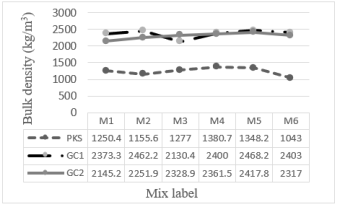
The results of the bulk density of the various concrete are presented in
Figure 15.
Figure 15. Bulk density results of concrete.
Overview, the bulk density of granite concrete produced far better results than those of the PKS concrete. GC1 aggregates (containing more flaky aggregates) generated slightly higher bulk density than the GC2 aggregates (having more elongated aggregates). The granite concrete was observed to be normal weight in nature (ranging from 2130.37kg/m
3 to 2468.15kg/m
3). According to
| [42] | ACI CT-23: ACI Concrete Terminology. American Concrete Institute. |
[42]
, low weight concrete fall within the weight limit of 1120kg/m
3 to 1920kg/m
3. This means that the PKS concrete produced are low weight in nature since they fell within the range 1042.96kg/m
3 to 1380.74kg/m
3.
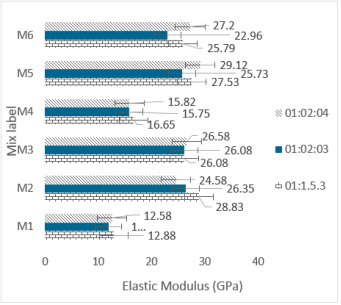
3.3. Compressive Strength/Elastic Modulus of Concrete
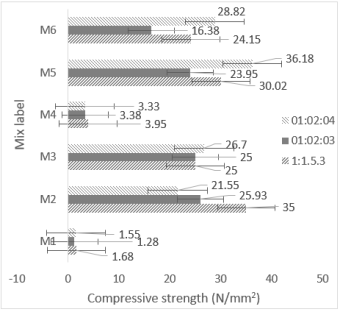
Values of 28th day compressive strength of concrete together with their corresponding elastic modulus obtained from this study are shown in
Figure 16 and 17 respectively.
Figure 16. Relationship between aggregate type vs. compressive strength at 0.45w/c and 0.5 w/c.
Figure 17. Relationship between aggregate type vs. Elastic modulus at 0.45w/c and 0.5 w/c.
From
Figure 16 and 17, it is observed that the granite concrete generated the highest compressive strength value of 36.18N/mm
2 and a corresponding maximum elastic modulus of 29.12GPa. This was obtained at mix label M5 having a proportion of 1: 2: 4 at w/c of 0.5 for GC1. Lowest compressive strength of 1.68N/mm
2 with corresponding elastic modulus of 12.88GPa was obtained for the GC2 aggregate at 0.45 w/c for mix 1: 2: 3. The performance of the two-granite concrete reduced as the w/c ratio increased from 0.45 to 0.5 for mix ratios 1: 1.5: 3, and 1: 2: 3. On the contrary, it improved for mix 1: 2: 4.
The PKS concrete generated compressive strength values that were very low (i.e. between 1.28N/mm
2 to 3.28N/mm
2). This was attributed to the fact that the PKS concrete manufactured were quite unworkable and could not be properly compacted to obtain a strong, and dense mix. Also, there were lots of honeycombs within the matrix as shown in
Figure 9. This occurrence negatively affected the elastic modulus results obtained for the concrete making it very susceptible to deformation under load. Therefore, superplasticizers should be introduced in the concrete mix to improve its performance.
Typical elastic modulus values for concrete made with conventional aggregates, such as gravel and granite, range from 25 N/mm
2 to 30 N/mm
2. Lower values of elastic modulus were observed for PKS (i.e. between 11.87GPa to 16.65GPa). These values are close to the readings (i.e. between 12GPa to 14.5GPa) obtained from the study by
| [43] | Purwantia, H., Artiningsih, T. P. Palm kernel shell as an alternative aggregate on high performance concrete. Journal of Science Innovare, 2018, 1(2), 68-75. |
[43]
due to its lower density and organic nature.
Furthermore, it was observed that the elastic modulus of the PKS concrete were higher at 0.5 w/c than at 0.45 w/c. This happened because concrete produced at 0.5 w/c contained more mixing water than that at 0.45 w/c allowing for a better hydration process. In addition, the concrete experienced an improved consistency (as shown in
Table 4) and could be worked on to produce a firmer and stronger mix. Therefore, the mix design for PKS concrete must be given good priority to achieve reasonable strength and stiffness for the material.
3.4. ANOVA Results
The impact of the aggregate type and mix ratios on the elastic modulus of concrete were studied using the 2-way ANOVA without replication. Summary of the data at w/c of 0.45 and 0.5 are presented in
Tables 6 and 7 respectively. While the results of the ANOVA test are shown in
Table 8 and 9 accordingly. The data in the columns are the aggregate types while data in the row are the mix ratios. Therefore, the inputs used to conduct the ANOVA test are the mix ratios (independent variable), the type of aggregate (independent variable), and the modulus of elasticity (dependent variable).
Table 5. Summary of data obtained at 0.45 w/c.
SUMMARY | Count | Sum | Average | Variance |
PKS | 3 | 37.33 | 12.44333 | 0.269033 |
GC1 | 3 | 79.49 | 26.49667 | 5.123733 |
GC2 | 3 | 78.74 | 26.24667 | 0.083333 |
mix 1 | 3 | 67.79 | 22.59667 | 72.70083 |
mix 2 | 3 | 64.3 | 21.43333 | 68.61123 |
mix 3 | 3 | 63.47 | 21.15667 | 56.45763 |
Table 6. Summary of data obtained at 0.5 w/c.
SUMMARY | Count | Sum | Average | Variance |
PKS | 3 | 48.22 | 16.07333 | 0.250633 |
GC1 | 3 | 82.38 | 27.46 | 2.8767 |
GC2 | 3 | 75.95 | 25.31667 | 4.662433 |
mix 1 | 3 | 69.97 | 23.32333 | 34.15693 |
mix 2 | 3 | 64.44 | 21.48 | 26.5429 |
mix 3 | 3 | 72.14 | 24.04667 | 51.68013 |
Table 7. Results of 2-way ANOVA test without replication at 0.45 w/c.
Source of Variation | SS | df | MS | F | P-value | F crit |
Rows | 388.0907 | 2 | 194.0453 | 104.2034 | 0.000355 | 6.944272 |
Columns | 3.503489 | 2 | 1.751744 | 0.940697 | 0.462551 | 6.944272 |
Error | 7.448711 | 4 | 1.862178 | | | |
Total | 399.0429 | 8 | | | | |
Table 8. Results of 2-way ANOVA test without replication at 0.55 w/c.
Source of Variation | SS | df | MS | F | P-value | F crit |
Rows | 219.6893 | 2 | 109.8446 | 86.65104 | 0.000509 | 6.944272 |
Columns | 10.50887 | 2 | 5.254433 | 4.144965 | 0.105931 | 6.944272 |
Error | 5.070667 | 4 | 1.267667 | | | |
Total | 235.2688 | 8 | | | | |
From
Table 5 to 8, the 2-way anova analysis conducted for concrete w/c of 0.45 and 0.5 demonstrates that the type of coarse aggregate used has a significant effect on elastic modulus of concrete, while variations in mix proportions did not yield significant differences. At 0.45 w/c, the result for aggregate type (rows) yielded a p-value of 0.000355, which is far below the 0.05 threshold, indicating a highly significant effect of aggregate type on the elastic modulus. In contrast, the mix types (columns) gave a p-value of 0.462551, well above 0.05, confirming no statistically significant influence from the mix composition.
This finding is supported by the observed averages and variances: PKS produced the lowest average value of 12.44 and a very small variance of 0.27. Whereas GC1 (flaky granite) and GC2 (elongated granite) had much higher averages of 26.50 and 26.25 respectively, GC2 showed exceptional consistency (variance = 0.08). At 0.5 w/c, similar pattern as in 0.45w/c was observed. Aggregate type significantly affected elastic modulus of the concrete, with a p-value of 0.000509, while the p-value for mix types remains non-significant at 0.105931. PKS improved to an average of 16.07. GC1 and GC2 recorded an average of 27.46 and GC2 25.32 accordingly. They both maintained relatively low variances of 2.88 and 4.66 respectively.
These results show that, across both water-cement ratios, the choice of aggregate played a critical role in determining concrete's elastic modulus, whereas modifying mix compositions alone did not result in statistically meaningful changes. Thus, optimizing aggregate selection is far more impactful than varying the mix design when aiming to improve the elastic modulus of concrete.
4. Conclusions
Based on the result of this study the following conclusions were made:
1) Concrete produced with more flaky shaped granite aggregates generated the highest modulus of elasticity across all mix ratios (1: 1.5: 3, 1: 2: 3, and 1: 2: 4), and w/c ranging from 24.31 to 29.12GPa. This was followed by concrete made with granite having more of elongated shaped component. They had consistent values between 22.96GPa, and 27.20GPa.
2) Palm kernel shell (PKS) concrete yielded the lowest elastic modulus, varying between 11.87GPa, and 16.65GPa.
3) Aggregates with higher bulk densities were observed to produce concrete with higher elastic modulus and consequently leading to higher stiffness.
4) The relatively low bulk density of PKS indicates its lower load-bearing capacity and resultant lower modulus of elasticity.
5) Considering the granite aggregates, mix ratios 1: 1.5: 3, and 1: 2: 3 at w/c of 0.45 produced concrete with better performance than at 0.5 w/c.
6) PKS concrete produced at 0.5 w/c generated improved elastic modulus when compared to those made at 0.45 w/c.
7) Although the porosity of the PKS was lowest at 1.1%, concrete made from it experienced very low slump. This was attributed to the fibrous surface area of the aggregate, its rough edges, and uneven surfaces that caused friction.
8) To obtain a meaningful strong, firm PKS concrete, the mix design must be carefully determined to achieve desired qualities. Air voids within the concrete mix must be limited as much as possible.
9) Since PKS is organic by nature, it can decay over time if exposed to air and moisture. To improve its durability in service, the PKS concrete can be surface treated with lime, or sodium silicate. Also, the process of saponification can be done on the PKS to improve strength.
10) The use of superplasticizers in producing PKS concrete will help to make the concrete more consistent and workable without the addition of excess water thereby improving its strength.
11) Sensitivity test using the 2-way ANOVA revealed that the type of aggregate used in producing concrete contributed immensely to the modulus of elasticity of concrete rather than the mix proportions.
12) The granite samples with more elongated aggregates (GC2) performed well, though not as consistently as the flaky shaped samples (GC1). While PKS, despite being a more sustainable and cost-effective option, showed lower performance.
These findings underline the potential use of granite for more structurally demanding applications and suggest that PKS might be suitable for less critical uses or where sustainability is prioritized.








 Share This Article
 Twitter
 Linked In
 Facebook
 Copy
Copy Download